Table of Contents
In September 1985, finance ministers from five of the world’s largest economies gathered at the Plaza Hotel in New York City. The carpets were expensive. The chandeliers were ridiculous. And the agreement they signed would quietly detonate one of the most spectacular economic bubbles in modern history.
The Plaza Accord was, on paper, a gentlemanly arrangement. The United States dollar was too strong, American exports were suffering, and something had to be done. So the G5 nations agreed to intervene in currency markets and push the dollar down. For Japan, this meant allowing the yen to rise. Dramatically.
What followed was not what anyone in that gilded hotel room had planned. Or maybe it was, depending on how cynical you feel about American trade diplomacy.
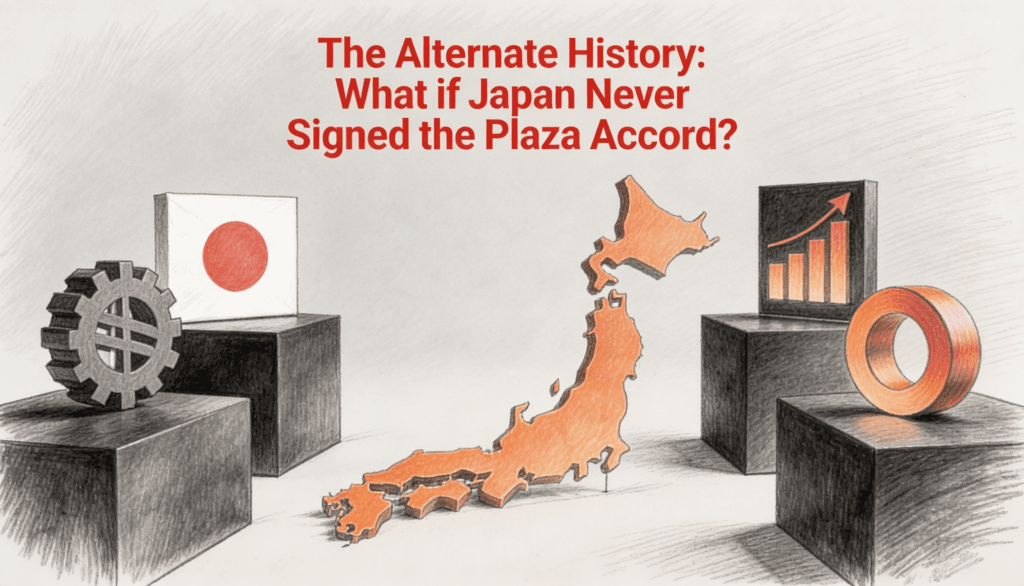
But here is the question worth sitting with: what if Japan had simply said no?
The Setup Nobody Talks About
Before we explore the counterfactual, it helps to understand why Japan said yes in the first place. And the answer is not purely economic. It is deeply political.
By the mid 1980s, Japan was the economic miracle that would not stop. Japanese cars flooded American highways. Japanese electronics sat in every living room. The trade deficit between the two countries had become a political weapon in Washington, and protectionist sentiment was rising fast.
Japan signed the Plaza Accord partly out of genuine economic cooperation, but mostly out of fear. Fear that refusing would invite something worse: tariffs, trade barriers, a full blown economic cold war with its most important ally and security guarantor. Japan was, and still is, dependent on the American security umbrella in the Pacific. That dependence gave Washington leverage that had nothing to do with exchange rates.
So Japan agreed to let the yen strengthen. And strengthen it did. The dollar fell from roughly 240 yen to about 120 yen in less than two years. Japanese exports suddenly cost twice as much for American buyers.
This is where the dominoes start falling.
The Chain Reaction That Built a Bubble
Faced with a surging currency that threatened to crush its export driven economy, the Bank of Japan did what central banks often do when they panic. It cut interest rates. Aggressively.
Cheap money flooded the Japanese economy. But it did not flow into factories or research labs or productive investment, at least not proportionally. Instead, it poured into real estate and stocks. The Nikkei index tripled. Land prices in Tokyo became so absurd that the grounds of the Imperial Palace were famously said to be worth more than all the real estate in California.
This was not rational exuberance. This was a monetary policy response to a currency shock, dressed up as prosperity.
And when the bubble finally burst in 1990, it did not just pop. It collapsed in slow motion over an entire decade. Japan entered what economists politely call “the Lost Decade,” though it was really closer to two lost decades, and some would argue the country has never fully recovered.
The Road Not Taken
So now imagine the counterfactual. Japan refuses the Plaza Accord. The yen stays weak. What happens?
The first and most obvious consequence is that American frustration boils over. Congress was already drafting protectionist legislation in 1985. Without the pressure valve of a coordinated currency agreement, those bills likely pass. Japan faces tariffs on automobiles, electronics, and steel. The trade war that the Plaza Accord was designed to prevent actually happens.
This sounds bad for Japan, and in the short term, it would be. But here is the counterintuitive part: a trade war might have been less destructive than what actually happened.
Tariffs hurt. They reduce export volumes, they invite retaliation, and they make consumers pay more. But they do not fundamentally distort an entire financial system the way cheap money does. A trade war with America in 1986 would have caused a recession in Japan. It would have been painful, visible, and politically costly. But recessions end. Asset bubbles, when they reach the scale Japan experienced, leave structural damage that lasts for generations.
Think of it like the difference between breaking your arm and developing a chronic illness. The broken arm hurts more at first. But you heal. The chronic illness is quieter, subtler, and it never quite goes away.
The Monetary Policy Trap That Never Springs
Without the Plaza Accord, the Bank of Japan has no reason to slash interest rates. The yen is not surging. Exports are under pressure from tariffs, not currency appreciation. The policy response to tariffs looks completely different from the policy response to a strong currency.
In a tariff scenario, Japan likely pursues structural reforms. It diversifies its export markets. It invests in domestic consumption. It does the hard, slow, unglamorous work of rebalancing an economy that had become dangerously dependent on selling things to Americans.
None of this is exciting. None of it produces a stock market that triples in four years. But that is precisely the point. The spectacular rise of Japanese asset prices in the late 1980s was not a sign of economic health. It was a symptom of monetary policy that had lost its connection to reality.
Without the Plaza Accord, Japan probably grows more slowly in the late 1980s. But it also probably avoids the catastrophic crash of the 1990s. The tortoise, in this alternate timeline, never tries to be the hare.
What America Loses in This Scenario
Here is where it gets interesting for the other side of the Pacific.
If Japan refuses the accord and the dollar stays strong, American exporters continue to struggle. The Rust Belt keeps rusting. Political pressure builds on Washington to address the trade deficit through industrial policy rather than currency manipulation.
This might have forced the United States to confront its own structural problems earlier. The decline of American manufacturing was not caused by the strong dollar alone. It was driven by decades of underinvestment, poor labor relations, and a financial sector that was already beginning to prioritize Wall Street over Main Street.
Without the easy fix of a weaker dollar, American policymakers might have had to do something genuinely difficult: invest in their own industrial base. Whether they would have actually done this is another question entirely. Politicians and difficult long term planning have never been close friends.
But the possibility is worth noting. The Plaza Accord gave the United States a currency adjustment that masked deeper problems. It was aspirin for a headache caused by a tumor.
The Global Ripple Effects
One of the less discussed consequences of the Plaza Accord was its influence on how other countries thought about currency policy and sovereign economic autonomy.
China watched what happened to Japan very carefully. When China began its own export driven rise in the 1990s and 2000s, it resisted American pressure to let the yuan appreciate with a stubbornness that bordered on theatrical. Chinese policymakers studied the Plaza Accord the way generals study lost battles. They saw what happened when a rising Asian economy let Washington dictate its currency policy, and they decided they would not repeat the mistake.
If Japan had refused the accord in 1985, China might not have had that cautionary tale. The irony is thick enough to cut: Japan’s compliance may have inadvertently armed China with the strategic insight it needed to resist similar pressure decades later.
This is one of those connections between historical events that rarely gets made but matters enormously. Japan’s sacrifice at the Plaza Hotel did not just reshape its own economy. It reshaped how every emerging economy after it thought about the relationship between currency sovereignty and national power.
The Deeper Lesson About Coordination
There is a fashionable idea in economics that international coordination is always good. Countries should cooperate, align their policies, and work together for mutual benefit. The Plaza Accord is often held up as an example of successful multilateral action.
But successful for whom?
The United States got a weaker dollar and temporary relief for its exporters. Germany managed the adjustment reasonably well. France and Britain muddled through. Japan got a bubble, a crash, and two decades of stagnation.
International economic coordination is not inherently virtuous. It depends entirely on the terms of the deal and who has the leverage. The Plaza Accord was not a meeting of equals making a fair bargain. It was the world’s dominant military and economic power pressuring its most dependent ally into a policy that served American interests first and foremost.
Japan’s mistake was not that it cooperated. It was that it cooperated from a position of weakness and then compounded the error with domestic monetary policy that turned a manageable adjustment into an unmanageable catastrophe.
What This Means for Investors Today
The Plaza Accord story is not just history. It is a template that keeps repeating in different forms.
Whenever a government makes a major policy concession under external pressure, watch what the central bank does next. The currency adjustment itself is rarely the problem. The problem is the second order response. It is the rate cuts, the liquidity injections, the desperate attempts to offset the pain of the original concession. That is where bubbles are born.
Japan in 1985 is not fundamentally different from the pattern we see whenever policymakers try to use monetary tools to solve what are essentially structural or political problems. You cannot print your way out of a bad trade deal. You cannot cut rates enough to make a fundamental economic imbalance disappear. All you can do is delay the reckoning while making it worse.
The investors who understand this are the ones who recognize that the most dangerous moments in markets are not the obvious crises. They are the quiet periods when everything seems to be working, when asset prices are climbing, when everyone agrees that this time the policymakers have it figured out.
The Imperial Palace was never worth more than California. Everyone knew that. But for a few glorious years, the math said otherwise, and the math had the backing of a central bank that had run out of better ideas.
The Verdict
If Japan had refused the Plaza Accord, it would have faced a painful but survivable trade war. Instead, it accepted a currency deal that led to a monetary policy catastrophe. The country traded a visible, manageable crisis for an invisible, unmanageable one.
There is something almost tragic about it. Japan did the cooperative thing. It played the good ally. It signed the agreement in the fancy hotel. And it paid for that cooperation with a generation of economic stagnation.
Sometimes the polite choice is not the wise one. And sometimes the most dangerous room you can walk into is one with very expensive chandeliers.