Table of Contents
There is a version of financial ruin that nobody warns you about. It does not involve bad investments, gambling, or reckless spending on things you do not need. It looks noble. It feels warm. People admire you for it.
It is generosity without boundaries.
We live in a culture that celebrates the giver. The person who picks up every check, who lends money without asking when it will come back, who quietly subsidizes the lifestyles of people around them. We call these people “good.” We call them “generous.” What we rarely call them is “broke,” even when that is exactly where they are heading.
This is not an argument against generosity. Generosity is one of the finest human impulses. But so is eating, and nobody argues that eating without limits is a virtue. The issue is not the act. It is the absence of a stopping point.
The Psychology of the Compulsive Giver
Here is something therapists know but financial advisors rarely mention: compulsive giving is often not about the other person at all. It is about the giver.
People who cannot say no to financial requests are frequently managing something deeper. A need to be needed. A fear that love is transactional and must be purchased. A childhood where affection was inconsistent and money became a proxy for emotional safety. The generosity is real, but the engine driving it is not generosity. It is anxiety.
This is where it gets uncomfortable. Because if you suggest to a compulsive giver that their behavior might be a problem, they will look at you like you just argued against sunlight. “I am helping people,” they will say. And they are. But they are also avoiding something, and that avoidance has a compound interest rate that works against them.
Think about it from the perspective of attachment theory, the framework psychologists use to understand how people bond. People with anxious attachment styles often use resources, including money, as a way to secure relationships. The logic, mostly unconscious, runs something like this: if I give enough, they cannot leave. If I am useful enough, I am safe.
The tragedy is that this strategy usually produces the opposite result. People who give compulsively tend to attract people who take compulsively. And the relationship that gets built on that foundation is not love. It is a supply chain.
The Dinner Table Test
You can learn almost everything you need to know about someone’s relationship with money by watching what happens when a check arrives at a restaurant.
There is the person who grabs it immediately, every single time, with a kind of aggressive cheerfulness that dares anyone to object. There is the person who suddenly needs to visit the restroom. There is the person who suggests splitting it and gets treated like they committed a small crime. And there is the person who takes turns naturally, without performance or guilt.
That last person is the financially healthy one. Everyone else is acting out a script they did not write.
The habitual check grabber is worth examining closely. On the surface, this looks like pure generosity. But watch the pattern over months and years. Notice how it creates a dynamic where others stop even reaching for their wallets. Notice how the generous one starts to feel resentment but cannot articulate why. Notice how the relationship slowly becomes organized around one person’s willingness to pay, which is another way of saying one person’s willingness to sacrifice their own financial future for the temporary comfort of being liked.
This is the paradox. Excessive generosity does not strengthen relationships. It quietly corrodes them. It introduces an imbalance that both parties can feel but neither wants to name. The giver starts keeping a mental ledger they insist does not exist. The receiver starts feeling a guilt they convert into irritation. Eventually, the money becomes the relationship, and nobody is happy about it.
When Generosity Becomes a Financial Strategy (A Bad One)
There is a fascinating concept in game theory called the “sucker’s payoff.” It describes what happens when one player in a repeated game consistently cooperates while the other consistently defects. The cooperator keeps giving, keeps trusting, keeps extending goodwill. The defector keeps taking. The cooperator loses every round and, here is the important part, their continued cooperation actually incentivizes the other player to keep exploiting them.
This is not a metaphor. This is literally what happens in financial relationships where one person gives without limits.
The person who lends money to a sibling for the fifth time, knowing the first four loans were never repaid, is not being generous. They are running a losing strategy and calling it virtue. The person who funds a partner’s lifestyle while their own retirement account sits empty is not being supportive. They are making a bet that love will function as a return on investment. It will not. Love is many things, but it is not a dividend.
And here is the counterintuitive part that most people resist hearing: setting financial boundaries in relationships is actually more generous than having none. A boundary says, “I value this relationship enough to protect it from the thing that destroys relationships, which is resentment.” No boundary says, “I will sacrifice my own wellbeing to avoid a difficult conversation,” which is not generosity. It is cowardice wearing a generous mask.
The Family Trap
There is a specific dynamic that plays out in millions of families. One sibling becomes financially successful. The others do not. Gradually, an unspoken expectation develops. The successful one should help. Should cover expenses. Should be the safety net. And they do, because the alternative, saying no to family, feels like a betrayal of something sacred.
But watch what happens over time. The helping does not create independence. It creates dependence. The siblings who receive do not use the support as a bridge to stability. They use it as a floor. Why solve your own financial problems when someone else will solve them for you? This is not because they are bad people. It is because incentives shape behavior, and unlimited financial support is an incentive to never become financially capable.
The successful sibling, meanwhile, carries a weight that grows heavier each year. They cannot save adequately. They cannot invest properly. They feel guilty about their own purchases. They start to see their success not as something to enjoy but as something that obligates them. Their wealth becomes a trap, and the lock is made of love.
The Hardest Conversation You Will Ever Have
If any of this sounds familiar, you already know what needs to happen. You need to draw a line. And drawing that line will be one of the most painful things you ever do.
It will feel selfish. It is not.
It will feel cruel. It is not.
People will be upset with you. They will use words like “changed” and “cold” and “selfish.” They will remind you of times they helped you. They will imply that your money has made you a worse person. And you will have to sit with all of that discomfort and hold the line anyway.
Here is what nobody tells you about this moment: the people who truly love you will adjust. They might be angry at first. They might need time. But eventually, they will respect the boundary because they respect you. The people who do not adjust, who cannot accept a version of you that does not come with unlimited financial access, were not in a relationship with you. They were in a relationship with your wallet. And that is information you needed, even though it hurts to have.
What Healthy Generosity Actually Looks Like
Healthy generosity is not the absence of giving. It is giving with awareness.
It means knowing what you can afford to give without damaging your own financial future. It means giving without expectation of return but also without enabling patterns that harm the receiver. It means understanding that sometimes the most generous thing you can do is say no and let someone experience the discomfort that leads to growth.
It means understanding that your financial health is not separate from your relationships. It is the foundation of them. A person who bankrupts themselves through generosity does not end up with strong relationships and an empty bank account. They end up with neither.
There is a beautiful simplicity to this idea once you accept it. You can be generous and solvent. You can be loving and financially responsible. You can help people and still help yourself. These are not contradictions. They are the same thing, viewed from different angles.
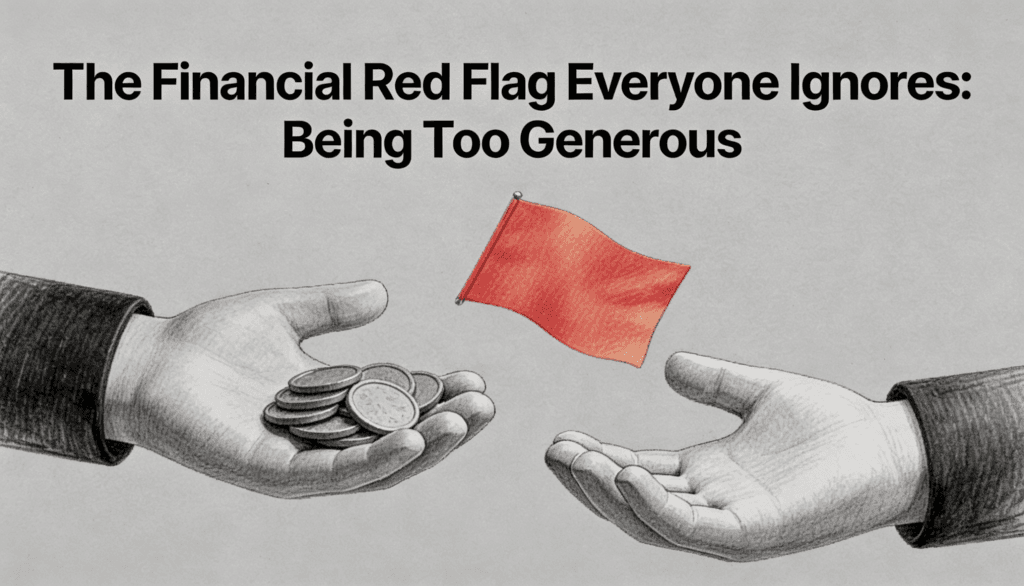
The red flag is not generosity. The red flag is generosity that has no floor, no limit, and no regard for the person doing the giving. That is not a virtue. It is a slow, quiet, socially approved form of self destruction.
And the first step to fixing it is calling it what it is.