Table of Contents
The Moment Isaac Newton Lost a Fortune He Already Knew Was Coming
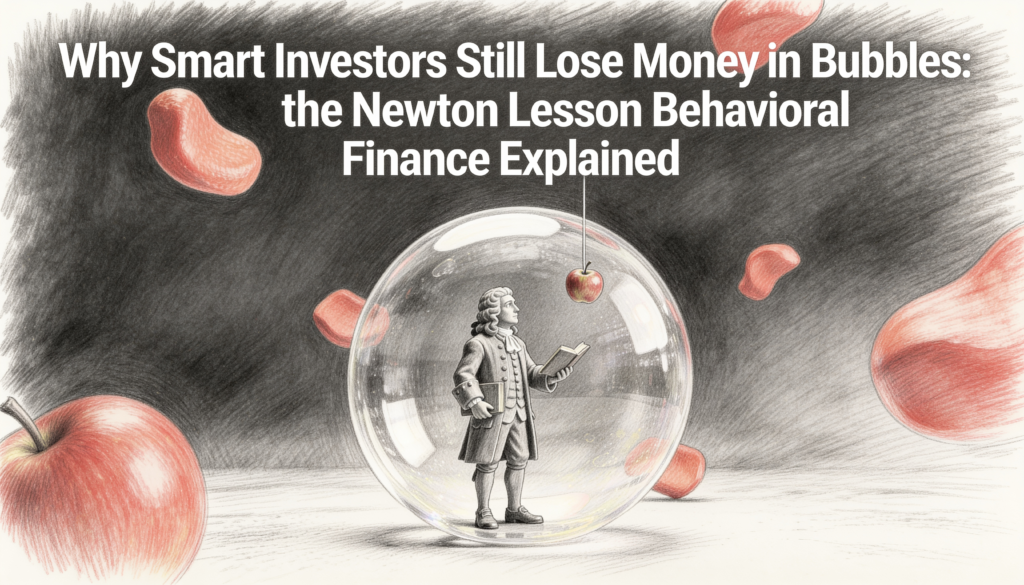
In the summer of 1720, Isaac Newton bought back into a stock he had already sold for a profit, near the very top, and lost the equivalent of roughly three million pounds in today’s money. He was not ignorant. He was not reckless. He was the most powerful analytical mind alive, and he walked straight into a financial trap that he had, weeks earlier, successfully escaped.
This is the question that should keep every serious investor awake: if the man who mapped the laws governing every object in the known universe could not resist a bubble, what exactly is your edge? The answer lies not in finance but in psychology, and understanding why smart investors still lose money in bubbles is the single most valuable lesson behavioral finance has to offer.
Newton’s first trade was excellent. He got in relatively early, rode the wave, and sold his position for a tidy profit of around seven thousand pounds. He understood the mathematics. He probably understood, at some level, that the fundamentals were thin. He walked away with money and dignity intact. A rational exit. A textbook move.
Then he watched.
He watched his friends and colleagues continue to make money after he sold. He watched the price keep climbing. And here is the part that matters most: Newton did not buy back in because he suddenly believed in the company. He bought back in because he could not stand watching other people get rich on something he had already been right about.
Why Intelligence Makes the Bubble Trap Worse, Not Better
We assume that intelligence protects us from financial mistakes. The Newton lesson suggests the opposite. Intelligence does not immunize you against bubbles. In some ways, it actively endangers you.
Smart people are better at constructing reasons for doing what they already want to do. Newton could have built an elaborate justification for re-entering the trade. He had the intellectual firepower to make any decision sound reasonable to himself. That is the curse. The brighter you are, the more convincing the story you can tell yourself about why this time is different, why the price still has room to run, why your re-entry is analysis rather than envy.
There is a concept in psychology called the illusion of explanatory depth. People believe they understand complex systems far better than they actually do. Ask someone to explain how a toilet works in genuine detail and watch their confidence evaporate in real time. Markets operate the same way, except the feedback loop is slower and the stakes are far higher.
The market did not outsmart Newton. Newton outsmarted himself. His second purchase was not a calculation. It was a capitulation to a feeling he could not name, expressed in a language of reason he had mastered but that was never designed for this problem.
You think you understand why the price is moving. You build a story. The story feels solid. Then the price moves against you and you discover your story was only ever a story. Newton fell for exactly this. The man who genuinely understood the deep mechanics of the physical universe assumed that understanding would transfer to markets. It does not. Physics has laws. Markets have participants.
The Difference Between Knowing and Enduring
This is not a failure of knowledge. It is a failure of a very specific kind, and it is one that intelligence can make worse rather than better. Newton knew the math. He had already proven he could act on that knowledge by selling. What broke him was not a gap in understanding. It was the inability to sit with the discomfort of watching an irrational thing continue to work.
The gap between what we can understand and what we can endure is where fortunes go to die. It always has been.
Bubbles Are Not Bugs in the Market, They Are Features
Here is a counterintuitive idea worth taking seriously: bubbles are not market failures. They are market features. They are not glitches in an otherwise rational system. They are the predictable output of human beings interacting at scale.
Every bubble follows roughly the same pattern. A real innovation or opportunity emerges. Early adopters profit. The profits attract attention. The attention attracts money. The money drives prices beyond any rational valuation. Latecomers pile in, driven not by analysis but by the fear of missing what everyone else seems to be getting. Then it collapses.
The South Sea Bubble of Newton’s day. The Railway Mania of the 1840s. The dot-com frenzy. Housing in 2008. Crypto. The template is remarkably stable across centuries, technologies, and cultures. The surface details change. The underlying human mechanics do not.
This is because bubbles are not primarily financial events. They are social events. They run on the same dynamics as fashion trends, political movements, and viral content. They are coordination games where the reward for being early is enormous and the punishment for being late is devastating, and the only way to know which one you are is in hindsight.
The brilliant investor who buys near the start and sells near the peak looks like a genius. The brilliant investor who buys near the top looks like a fool. They may be the same person with the same thesis. Timing was the only difference, and timing in a bubble is not a skill. It is a confession of luck dressed up as strategy.
The Circular Logic That Feels Like Proof
Early investors in a bubble are rarely fools. Many of them understand the asset is overvalued. But they also understand something else: it does not matter yet. If everyone around you is buying, the price goes up. If the price goes up, you were right to buy. The logic is circular, and it works perfectly until it does not.
This is why behavioral finance treats bubbles as recurring rather than exceptional. The same psychology that produced one mania will produce the next. The names of the assets change. The behavior of the humans does not.
The Emotional Ratchet: How Risk Perception Inverts
One of the most underappreciated aspects of any bubble is how the emotional experience of participants changes as it inflates. Early on, buying feels risky. By the peak, not buying feels risky. The entire emotional framework inverts.
This is not a metaphor. This is how human risk perception genuinely works. We do not assess risk in absolute terms. We assess it relative to what everyone around us is doing. If your neighbor, your barber, and your member of Parliament are all in on the same trade, staying out feels like the dangerous position. You are no longer evaluating the investment. You are evaluating your social standing.
Newton experienced exactly this. After selling, he was technically richer but socially poorer. Everyone around him was still riding the wave. The emotional cost of being right and being out felt higher than the financial cost of being wrong and being in. At least, that is how it felt in the moment. Feelings are expensive.
Why Social Proof Overrides Analysis
When the crowd and the analysis disagree, the crowd usually wins, because the crowd is louder, closer, and more emotionally vivid than a spreadsheet. Social proof is one of the oldest survival heuristics we possess. For most of human history, doing what the group did kept you alive. Markets weaponize that instinct against you, turning a survival mechanism into a wealth destruction mechanism.
The terror of being left behind is not a character flaw. It is a deeply wired feature of the human mind. The investor who pretends to be immune to it is the investor most likely to be ambushed by it.
What Newton Could Not Have Known That You Can
It would be unfair to Newton to suggest he should have known better. Behavioral finance did not exist. The psychology of crowds had not been studied. There was no vocabulary for concepts like loss aversion, herding behavior, or the disposition effect. Newton was operating without a map in territory no one had yet charted.
You do not have that excuse.
Three centuries of financial history have given us a detailed catalog of how people lose money in predictable, repeatable ways. We know about confirmation bias. We know about overconfidence. We know about the endowment effect. We know about narrative fallacies. The research is thorough, accessible, and largely ignored.
This is perhaps the most damning part of the entire lesson. Knowing about cognitive biases does not make you immune to them. You can read every paper on herding behavior and still find yourself buying near the top, telling yourself a sophisticated story about why your case is the exception.
If Knowledge Does Not Protect You, What Does?
Mostly structure. Rules you set in advance and follow even when your emotions are screaming at you to break them. The investor who survives bubbles is rarely the smartest one in the room. It is the one who built a system before the emotional storm arrived.
- Automatic contributions that continue regardless of how you feel about the market on any given morning.
- Predetermined exit points decided in calm moments, not in the heat of a rally or a crash.
- Diversification chosen not because it is exciting but because it is boring, and boring is precisely the point.
- Position sizing rules that cap how much damage any single conviction can do.
- A written investment thesis you can read back to yourself to check whether your story has quietly changed.
The best financial decisions tend to feel like nothing is happening, which is exactly why most people cannot stick with them. We are wired to want action. Markets reward patience. The mismatch is permanent, and the only reliable defense is to remove yourself from the decision at the moment you are least equipped to make it.
The Real Lesson Newton Left Behind
Bubbles are usually taught as cautionary tales about greed or reckless speculation. That reading is too simple. Newton was not greedy in any meaningful sense. He was already wealthy. He was not speculating wildly. He had already demonstrated the discipline to sell at a profit.
What got him was something more subtle and far more universal. It was the slow erosion of conviction in the face of social proof. It was the very human need to be part of what is happening, even when what is happening makes no sense.
The enemy is not ignorance. The enemy is the confidence that your intelligence will protect you from the forces that operate beneath intelligence. The forces that run on envy, on social comparison, on the terror of being left behind. These forces do not negotiate with IQ. They never have.
You are not smarter than Newton. Neither am I. Neither is anyone managing your money. The good news is that you do not need to be. You just need to be honest about what you are up against, and humble enough to build systems for the person you actually are rather than the rational actor you imagine yourself to be.
Newton gave us the tools to send rockets to the moon. He could not give himself the tools to sit quietly while other people made money. If the greatest mind in history could not close that gap through brilliance alone, you will not close it either. You can only build around it. That, far more than any formula, is the inheritance he left every investor who came after him.