Table of Contents
The Banker Who Sold a War and Then Broke a Nation
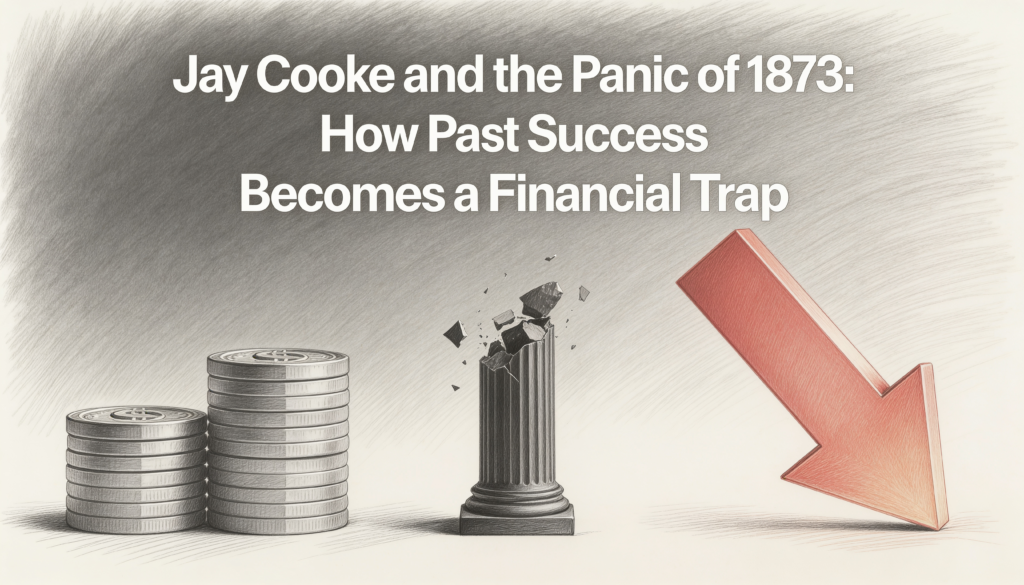
Jay Cooke financed the Union victory in the Civil War, invented retail investing, and turned ordinary citizens into bondholders. Then, in a single September morning, he took down the entire United States economy and dragged it into a depression that lasted six years. His story is the clearest demonstration in American financial history of a single, uncomfortable truth: past success is the most dangerous thing a risk taker can own.
There is a particular kind of disaster that only visits people who believe they are too important to fail. Jay Cooke knew this disaster intimately. He simply did not know it was coming for him. In September 1873, the most powerful private banker in America locked the doors of his firm and sent the financial world into a spiral. The man who had been called the financier of American freedom was broke, and he took a large portion of the country down with him.
The story of Jay Cooke is not really about one man losing his money. It is about what happens when an entire society mistakes one person’s confidence for actual safety. It is about the distance between reputation and reality. And that distance, when it finally closes, collapses with terrifying speed.
Who Was Jay Cooke? The Salesman Who Financed the Civil War
Before Jay Cooke became a cautionary tale, he was something close to a miracle worker. To understand the catastrophe, you first have to understand the genius.
When the Civil War broke out, the Union faced a problem that rarely makes it into the heroic narratives. The government was nearly bankrupt. Fighting a war costs staggering amounts of money, and the Treasury could not raise it fast enough through traditional channels. The wealthy bankers of the Northeast were cautious. They wanted safe returns, not patriotic risk.
Cooke saw an opportunity where everyone else saw a headache. He convinced the Treasury to let him sell government bonds directly to ordinary Americans. At the time, this was a genuinely radical idea. Bonds were instruments for the rich and the institutional. Regular people did not buy them. They did not even understand them.
How Jay Cooke Invented Retail Investing
Cooke changed everything. He hired thousands of agents across the country. He ran newspaper advertisements that wrapped financial products in the American flag. He did not just sell bonds. He sold the idea that buying a bond was an act of loyalty. You were not making an investment. You were saving the Union.
It worked spectacularly. Cooke moved hundreds of millions of dollars in government bonds. He democratized war finance in a way nobody had attempted before. The Union got its funding. Cooke got his commissions. And American citizens got their first taste of participating in large scale financial markets. In the truest sense, Jay Cooke invented retail investing.
This is worth pausing on, because it contains a lesson that repeats across financial history with almost mechanical regularity.
The same innovation that solves a crisis tends to plant the seed for the next one. Cooke taught an entire generation that complex financial instruments were simple, safe, and backed by something trustworthy. That lesson would prove ruinously expensive.
Building the Myth: When a Banker Believes His Own Story
After the war, Cooke was not merely wealthy. He was famous. He was trusted in a way that modern financiers can only dream about. The government had leaned on him, and the public had followed his lead. He had earned a reputation that functioned almost like a second currency.
This is where the story becomes fascinating from a psychological standpoint. Cooke began to believe his own legend. Not in the crude way of someone who becomes arrogant and reckless overnight. It was subtler than that. He had solved an impossible problem during the war. He had moved markets through sheer persuasion. So when he looked at his next venture, the Northern Pacific Railway, he saw another impossible problem that he alone was uniquely qualified to solve.
The Northern Pacific Gamble
The Northern Pacific was supposed to build a transcontinental railroad through some of the most remote territory on the continent. It was wildly ambitious. The land was largely unsettled. Revenue projections were based on populations that did not yet exist. The entire enterprise depended on the belief that if you built the railroad, the people and the commerce would follow.
Cooke poured his firm’s resources into financing the Northern Pacific. He sold its bonds the same way he had sold bonds for the war, with aggressive marketing, appeals to patriotism and progress, and an implicit promise that Jay Cooke’s name on something meant it was safe.
The Halo Effect in Finance
There is a concept in psychology called the halo effect. When we admire someone for one quality, we tend to assume they possess other positive qualities as well. A brilliant surgeon must also be wise. A successful athlete must also be disciplined in every area of life. And a banker who financed a war must surely know which railroad investments are sound.
Cooke was riding his own halo effect. The public trusted him because of the war bonds. He trusted himself for exactly the same reason. But selling government debt during a national emergency and financing speculative railroad construction through empty wilderness are fundamentally different activities. The first had the full backing of the United States government. The second had the backing of optimism.
The Architecture of a Collapse: The Panic of 1873
By the early 1870s, Cooke’s firm was dangerously overextended. The Northern Pacific bonds were not selling as well as expected. The railroad was burning through capital faster than Cooke could raise it. Meanwhile, Cooke was using his firm’s own money to prop up the project, essentially betting the entire operation on a single outcome.
This is a pattern that appears with tiresome frequency in financial history. A successful person takes a concentrated position in something they believe cannot fail. They double down. Then they triple down. Each additional commitment feels rational because admitting the position is wrong would mean admitting that their judgment, their identity, their entire narrative about themselves was wrong.
The money becomes secondary. What is really at stake is the story they tell about who they are. Cooke was not stupid. He was trapped by his own success.
Every past victory whispered that he should hold on, push forward, trust his instincts. The market would come around. The bonds would sell. The railroad would be built. The settlers would arrive. The settlers simply did not arrive fast enough.
On September 18, 1873, Jay Cooke and Company closed its doors. The most trusted name in American finance was insolvent. What followed was not a calm reassessment. It was panic. Pure, irrational, contagious panic. The New York Stock Exchange shut down for ten days. Banks collapsed across the country. Businesses folded. Unemployment surged. The economy entered a depression that would last until 1879.
Why One Firm’s Failure Broke the Entire Economy
Here is the part that should genuinely trouble anyone who thinks about financial systems. Jay Cooke’s firm was one firm. The Northern Pacific was one railroad. How does one bad bet by one banker paralyze an entire economy for half a decade?
The answer lies in something economists would later call systemic risk, though in 1873 nobody had a term for it. Cooke’s firm was not just a participant in the financial system. It was a load bearing wall. Other banks had lent money to Cooke. Other firms had bought his bonds and used them as collateral. Other businesses depended on the credit that flowed through his network.
When Cooke failed, it was not like a single tree falling in a forest. It was like pulling a thread that turned out to be connected to the entire fabric. Each failure triggered another failure. Each bank that could not collect from Cooke found itself unable to pay its own creditors. The crisis cascaded outward in waves.
The Real Damage Was to Trust Itself
There is a deeper issue here, one that goes beyond the mechanics of interconnected balance sheets. Cooke had spent years building a system based on public confidence. He had taught ordinary Americans that the financial system was safe, that bonds were reliable, that the name on the prospectus mattered. When he failed, he did not just lose money. He shattered the very confidence that his system required to function.
This is the paradox at the heart of every confidence based system. A system built on skepticism is resilient because nobody expects much. A system built on faith is fragile because everyone expects everything.
The Uncomfortable Lessons of Jay Cooke
The Panic of 1873 offers lessons that most people would prefer not to learn, because they challenge comfortable assumptions about how finance actually works.
- Reputation is not the same as soundness. Cooke was not a fraud. He genuinely believed in the Northern Pacific and genuinely believed he could make it work. His reputation was earned through real accomplishment. But reputation tells you about the past. It tells you nothing about the current quality of someone’s judgment or the soundness of their present positions.
- Narrative is dangerous. Cooke did not just sell bonds. He sold a story about progress, about destiny, about a nation expanding westward. The story was compelling and even partly true. But a compelling story and a sound investment are different things, and the more compelling the story, the harder it becomes to evaluate the investment on its own merits. When someone is selling you a vision of the future, that is exactly when you should be most skeptical about the spreadsheet.
- Success is the most dangerous thing that can happen to a risk taker. Every success reinforces the belief that your judgment is reliable. Every success makes it harder to recognize when conditions have changed. Every success builds the confidence that eventually becomes overconfidence.
Cooke’s wartime triumph was the direct cause of his peacetime disaster, not because it made him careless, but because it made him certain.
The Aftermath and the Irony
Jay Cooke did not die in poverty. He eventually recovered some of his wealth through a silver mine investment. There is a certain dark humor in that. The man who had built the most sophisticated bond distribution network in American history made his comeback through one of the oldest and most straightforward forms of wealth: pulling metal out of the ground.
The Northern Pacific Railroad was eventually completed, years after Cooke’s failure, by other hands and other money. The settlers did come. The commerce did follow. Cooke was not wrong about the destination. He was wrong about the timing. And in finance, being right about what will happen but wrong about when it will happen is functionally identical to being wrong about everything.
The Panic of 1873 reshaped the American financial landscape in ways that are still felt today. It sparked debates about banking regulation, monetary policy, and the role of government in financial crises. These are debates we are still having, which either means they are genuinely complex questions or that we are not very good at learning from history. Probably both.
As for Cooke himself, he spent his later years in relative quiet. The Napoleon of Finance had met his Waterloo. Unlike the original Napoleon, he did not get a dramatic exile on a windswept island. He got something arguably worse for a man of his ambitions. He got to watch other people finish what he had started, using the methods he had pioneered, building the future he had envisioned. He was right about almost everything except the one thing that mattered most: how much time he had.
In finance, that is usually enough to ruin you.