Table of Contents
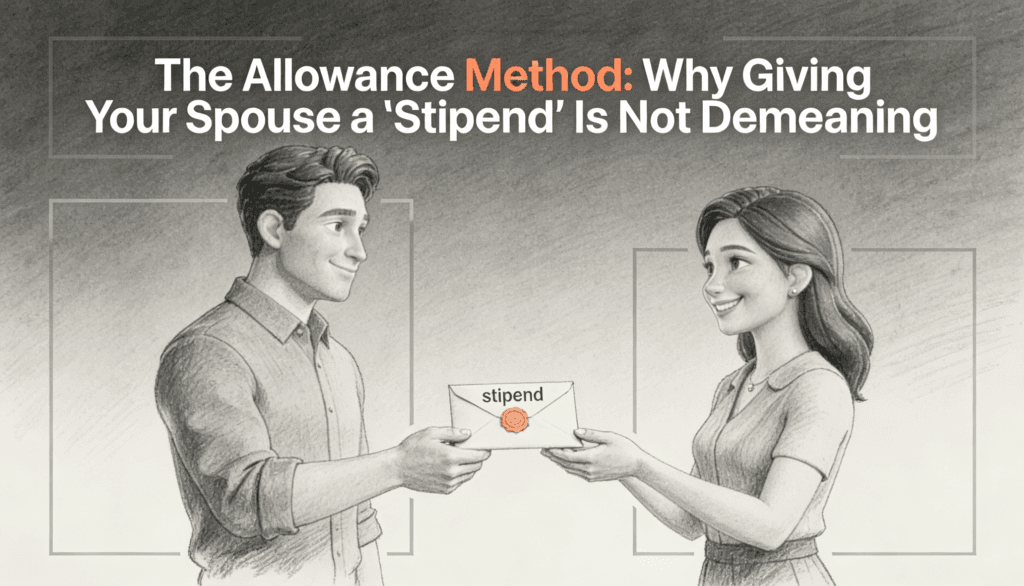
Say the word “allowance” in the context of marriage and watch the room split. Half the people will picture a controlling partner handing out cash like a parent doling out pocket money. The other half will quietly nod, because they have been doing it for years and their marriage is better for it.
The allowance method is one of the most misunderstood concepts in personal finance. Not because it is complicated, but because the language around it triggers something primal. Nobody wants to feel managed. Nobody wants to feel like a child in their own household. And yet, some of the most financially healthy couples on the planet operate with a version of this system.
So what is actually going on here? And why does a concept that sounds so patronizing often produce the opposite effect?
The Word Is the Problem, Not the Practice
Let us start with the obvious. “Allowance” is a terrible word for what this actually is. It carries the weight of childhood, of permission, of hierarchy. When you hear “allowance,” you think of a ten year old earning five dollars for taking out the trash. You do not think of two adults making a rational agreement about discretionary spending.
But strip the word away and look at the mechanics. Two people share a household. They have bills, savings goals, and a finite amount of income. After the fixed obligations are covered, a set amount goes to each person to spend however they want. No questions asked. No justification required.
That is not control. That is architecture.
The irony is that couples who refuse the allowance method on principle often end up in a far more controlling dynamic. Without a system, every purchase becomes a negotiation. Every coffee, every pair of shoes, every impulse buy at the hardware store sits under an invisible microscope. The absence of structure does not create freedom. It creates surveillance.
Why Financial Autonomy Needs a Container
There is a concept in psychology called “the paradox of choice.” When people have unlimited options, they do not feel liberated. They feel paralyzed. The same principle applies to money in relationships.
When everything is shared and nothing is allocated, couples face a constant low grade tension. Should I buy this? Will they think it is too much? Do I need to mention it? This background noise is exhausting, and most people do not even realize it is running until it stops.
The allowance method stops it.
By drawing a clear line between shared money and personal money, you eliminate an entire category of conflict. You are not asking permission. You are spending from a pool that was already designated as yours. The decision was made once, at the system level, rather than being relitigated with every transaction.
Think of it like a budget for a film production. The director does not go to the studio every time they need to buy a prop. The budget was set in advance. Within that budget, the director has creative freedom. Nobody considers this demeaning. They consider it professional.
The Real Power Dynamic Nobody Talks About
Here is where things get interesting. Critics of the allowance method assume it creates a power imbalance. One person controls the money, and the other receives it. But this framing only holds if you ignore how most couples actually manage their finances without a system.
In the majority of households, one partner tends to be the “financial one.” They track the accounts, pay the bills, know the balances. The other partner exists in a fog of approximate awareness. They know things are probably fine, or probably not fine, but the specifics are blurry.
This is the real power imbalance. Not the allowance method. The allowance method actually corrects it.
When both partners receive the same discretionary amount, you have equalized the playing field in a way that informal systems never do. The higher earner does not get to spend more freely simply because they “brought it in.” The partner who manages the household does not have to feel like they are spending someone else’s money. Both people have the same autonomy, backed by the same number.
It is one of those rare cases where imposing structure actually increases equality rather than diminishing it.
What Game Theory Tells Us About Couples and Money
There is a useful parallel here with game theory, specifically the concept of repeated games. In a one time interaction, people tend to act selfishly. But when they know they will interact with the same person again and again, cooperation becomes the dominant strategy.
Marriage is the ultimate repeated game. You are going to have the money conversation thousands of times over decades. The question is whether each of those conversations starts from scratch or whether you have a system that handles the routine decisions automatically.
The allowance method is essentially a cooperative agreement that reduces the number of negotiations required. It is like a treaty. You hash out the terms once, revisit them periodically, and in between, both parties operate with autonomy and trust.
Couples who resist any system tend to treat every financial decision as a new game. And in game theory, that is the setup most likely to produce conflict, resentment, and defection.
The Dignity Objection
Let us take the strongest version of the counterargument seriously. Some people feel that any system where money is “given” to them by a partner is inherently undignified. This is worth engaging with honestly.
The feeling is real. But the logic behind it does not hold up under scrutiny.
If both partners agree to the system, it is not one person giving money to the other. It is both people allocating shared resources according to an agreed framework. The fact that one person might physically move the money into separate accounts is a logistical detail, not a statement about who owns what.
Consider this analogy. When a company distributes bonuses, nobody says the CEO is “giving an allowance” to the employees. The money belongs to the organization. It is being allocated according to a system. The mechanism of distribution does not determine who deserves what.
The same is true in a marriage. If you have genuinely internalized the idea that marital income is shared, then the allowance is not a gift from one person to another. It is a distribution from the whole to its parts.
The only scenario where this feels demeaning is when one partner does not actually believe the money is shared. And that is a relationship problem, not a budgeting problem.
The Hidden Benefit: It Makes Generosity Visible
Here is something nobody expects. The allowance method often makes couples more generous with each other, not less.
When you have your own discretionary fund, buying a gift for your partner means something different. You are spending your money, your allocated freedom, on them. It is a choice, not an obligation funded by a joint account.
There is a meaningful difference between buying flowers with shared money and buying flowers with money you could have spent on yourself. The first is a transaction. The second is a sacrifice, even a small one. And small sacrifices are the currency of long term relationships.
This is counterintuitive. You would think that separating money would make people more individualistic. But it actually creates a clearer channel for intentional generosity. The gift becomes legible because the cost is personal.
How to Do It Without Making It Weird
The execution matters as much as the concept. Here is where most couples go wrong.
First, the amount has to be equal. Not proportional to income. Equal. The moment you tie the allowance to earnings, you have reintroduced the hierarchy you were trying to eliminate. Marriage is a partnership, not a commission structure.
Second, no auditing. The entire point is autonomy. If one partner spends their entire allowance on vintage comic books and the other saves every cent, that is fine. The system works precisely because it does not require approval.
Third, revisit the number regularly. Life changes. Incomes shift. A number that felt generous two years ago might feel tight today. The allowance is not a set it and forget it mechanism. It is a living agreement that should be part of your regular financial check ins.
Fourth, frame it correctly from the start. Do not call it an allowance if that word makes either of you uncomfortable. Call it personal spending money. Call it discretionary funds. Call it whatever you want. The label is cosmetic. The structure is what matters.
The Bigger Picture: Systems Over Willpower
The allowance method works for the same reason that automatic savings contributions work, that meal prepping works, that any good system works. It removes the need for constant decision making and replaces it with a framework that runs quietly in the background.
Willpower is a limited resource. Every decision you make about money, especially money that intersects with your most important relationship, costs something. The allowance method reduces the number of decisions you have to make together, which frees up emotional bandwidth for the things that actually matter.
This is not about being rigid. It is about being intentional. The couples who fight least about money are not the ones who earn the most. They are the ones who have agreed on a system and stuck with it.
The Uncomfortable Truth
Most resistance to the allowance method is not really about money. It is about identity. People do not want to feel like the kind of person who needs a system to manage their spending. They want to believe they are above it. That their relationship is too evolved, too trusting, too mature for something so mechanical.
But trust is not the absence of systems. Trust is the willingness to build systems together. A couple that sits down, agrees on a number, and commits to respecting each other’s autonomy within that number is demonstrating more trust than a couple that just wings it and hopes for the best.
The allowance method is not a sign of a weak marriage. It is a sign of a marriage that has stopped romanticizing money and started treating it like what it is: a tool that works best when you have a plan for using it.
And if calling it a “stipend” still makes you cringe, go ahead and call it something else. Just do not let a word stand between you and a system that might save you a thousand arguments over the next thirty years.