Table of Contents
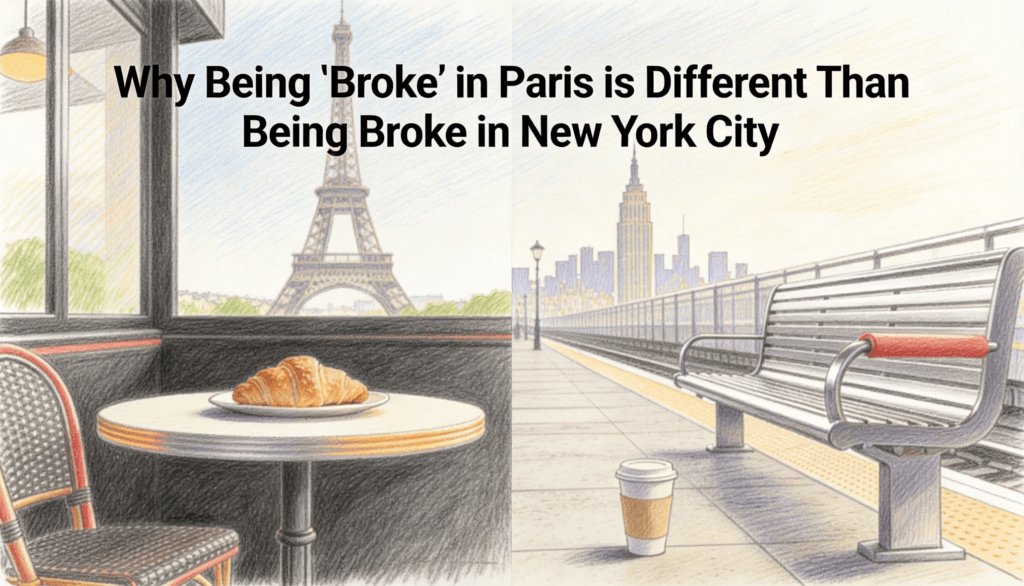
There is a word that means completely different things depending on which side of the Atlantic you are standing on. That word is “broke.”
In New York, being broke is a temporary emergency. It is a problem to solve, a fire to put out, a condition that demands immediate action. You are broke, so you hustle. You pick up a side gig. You optimize. You grind until the numbers change.
In Paris, being broke is more like the weather. It is something you live with, complain about at dinner, and then order another glass of wine anyway.
This is not a story about who is right. It is a story about how two cities reveal two completely different philosophies about money, and how those philosophies shape everything from what you eat to how you think about your future.
The Emergency vs. The Condition
When a New Yorker says “I am broke,” what they usually mean is: I am between money. The phrase carries urgency. It implies motion. Something went wrong, and something must be done about it. Being broke in New York feels like a personal failure because the entire city is built on the assumption that upward mobility is not just possible but expected. If you are not moving up, you must be doing something wrong.
The city itself reinforces this. New York sorts people with brutal efficiency. Your neighborhood tells people your tax bracket. Your gym membership signals your ambitions. Even your coffee order is a class marker. When you are broke in this environment, the city does not let you forget it. Every block reminds you of the version of yourself you have not become yet.
Paris operates on different software entirely. When a Parisian says “I have no money,” there is often a strange calm behind it. Not because they do not care, but because the culture does not treat financial struggle as a character flaw. France has a deep and complicated relationship with money that Americans often misread as laziness. It is not laziness. It is a fundamentally different value system that places art, leisure, and social connection on equal footing with economic productivity.
A broke New Yorker skips lunch to save twelve dollars. A broke Parisian still takes a two hour lunch because skipping it would mean losing something more valuable than twelve dollars.
What the Grocery Store Tells You About a Culture
You can learn almost everything you need to know about a society by watching how people shop for food when they do not have much money.
In New York, budget eating is an exercise in volume and efficiency. You buy in bulk. You clip coupons. You eat things that are engineered to be cheap and filling. The goal is caloric survival at minimum cost. There is an entire economy built around helping Americans eat as much as possible for as little as possible, and the health consequences of that economy are well documented.
In Paris, a person with very little money will still buy a fresh baguette every day. They will choose a small piece of good cheese over a large block of mediocre cheese. They will spend twenty minutes selecting fruit at the market. This is not irrational behavior. This is a culture that defines quality of life differently than quantity of life.
The French food budget, even a tight one, reflects something that economists rarely talk about: the idea that how you consume matters as much as what you consume. A meal eaten slowly with attention is worth more than a meal inhaled at your desk. This is not a financial insight. It is a philosophical one. But it has enormous financial implications, because it means the French relationship with spending is rooted in experience rather than accumulation.
Americans tend to save money so they can eventually spend it on something big. The French tend to spend small amounts on things that make daily life feel less like survival.
The Rent Question
Now, both cities will destroy you on rent. Let us not pretend otherwise. Paris and New York share the dubious honor of making housing unaffordable for most of the people who actually make the cities worth living in. But the cultural response to this shared problem could not be more different.
In New York, the answer to expensive rent is to make more money. Work harder. Get promoted. Find a side hustle. The entire self improvement industry is essentially a response to Manhattan real estate prices dressed up as personal development.
In Paris, the answer to expensive rent is often to simply have less space and not feel particularly bad about it. A Parisian apartment that would make a New Yorker claustrophobic is, to its occupant, perfectly civilized. The city itself is the living room. The café is the office. The park is the backyard. The French have quietly solved the housing crisis not by making apartments bigger but by making the public sphere so pleasant that you do not mind going home to a small space.
This is actually a brilliant financial strategy that nobody frames as a financial strategy. When your city provides beauty, leisure, and social infrastructure for free or nearly free, your personal expenses drop. The brokest Parisian still has access to world class architecture, public gardens, and a café culture that lets you sit for three hours on the cost of a single espresso. Try sitting in a New York coffee shop for three hours and see how long before someone passive aggressively wipes the table next to you.
The Shame Gap
Here is where it gets interesting from a psychological standpoint.
In America, financial shame is one of the most powerful motivators in the entire economy. People go into debt to avoid looking broke. They lease cars they cannot afford. They buy clothes that signal a status they have not achieved. The fear of appearing poor drives consumption more than actual desire does. Sociologist Thorstein Veblen identified this over a century ago, and if anything, social media has made it exponentially worse.
France has financial shame too, but it operates in reverse. In many French social circles, talking about how much money you make is considered vulgar. Displaying wealth too obviously is not admired but suspected. The French word for a flashy display of money is “bling bling,” and they did not mean it as a compliment when they started using it to describe Nicolas Sarkozy.
This creates an almost paradoxical dynamic. In New York, people spend money they do not have to look rich. In Paris, people who have money sometimes go out of their way to not look like it. The result is that being broke in Paris carries less social penalty because the culture is not constantly reminding you that your worth is measured in your wallet.
There is a freedom in that. A strange, counterintuitive freedom that makes being broke in Paris feel less like failure and more like a lifestyle that half the city is also living.
The Safety Net Changes Everything
We cannot have this conversation honestly without talking about structure.
France has universal healthcare. It has subsidized education. It has a welfare system that, while imperfect and often criticized, provides a floor beneath which citizens generally do not fall. Being broke in France rarely means being one medical emergency away from financial ruin. Being broke in America very often means exactly that.
This changes the psychology of money in ways that are hard to overstate. When the worst case scenario is not catastrophic, people relate to money differently. They take more creative risks. They change careers more freely. They do not cling to jobs they hate with the same desperation, because losing a job does not mean losing access to a doctor.
The American system, by contrast, ties so many essential services to employment and income that being broke becomes genuinely dangerous. This is not a political argument. It is an observation about incentive structures. When being broke is dangerous, people make fear based financial decisions. They stay in bad jobs. They avoid risks. They prioritize income over fulfillment not because they are shallow but because the system has made income a matter of survival.
What Each City Gets Wrong
Paris is not a financial paradise. The flip side of a culture that is comfortable with having less money is a culture that can sometimes be complacent about economic mobility. France has real problems with youth unemployment, rigid labor markets, and a tax system that can feel punitive toward ambition. The same cultural attitude that makes being broke feel dignified can also make getting un broke feel unnecessarily difficult.
And the French relationship with money is not purely noble. It can veer into a kind of intellectual snobbery where caring about money is treated as beneath serious people, which is easy to maintain when your parents own an apartment in the 6th arrondissement. Romanticizing poverty is a luxury usually afforded to those who have a safety net made of inherited real estate.
New York, for all its brutality, does something that Paris often does not. It takes ambition seriously. It does not make you feel guilty for wanting more. It provides a density of opportunity that is genuinely unmatched, and for people who arrive with nothing, it offers a path, however steep, that is at least visible. The meritocratic promise of New York is exaggerated but not entirely fictional, and that matters.
The Real Lesson
The most useful takeaway from comparing these two versions of being broke is not that one city is better than the other. It is that your relationship with money is not as personal as you think it is.
You did not develop your spending habits in a vacuum. You developed them inside a culture that trained you to think about money in a very specific way. Americans are trained to treat money as a score. The French are trained to treat it as a tool. Neither approach is complete on its own.
The New Yorker who learns from Paris might stop equating net worth with self worth. They might spend a little more on a good meal and a little less on a subscription they never use. They might realize that sitting in a park for an hour is not wasted time but actually the whole point.
The Parisian who learns from New York might develop a healthier relationship with ambition. They might stop treating financial goals as something embarrassing and start treating them as a form of creative expression. They might realize that building wealth and enjoying life are not mutually exclusive activities.
Being broke is never fun in either city. But the texture of that experience, the way it feels, the stories you tell yourself about it, the choices it leads you to make, those are all shaped by the invisible architecture of culture. And the first step to building a smarter relationship with money is recognizing that the blueprint you have been following was handed to you before you were old enough to question it.
Maybe the best financial advice is not about interest rates or index funds at all. Maybe it is simply this: before you decide how to spend your money, figure out which city is living inside your head.