Table of Contents
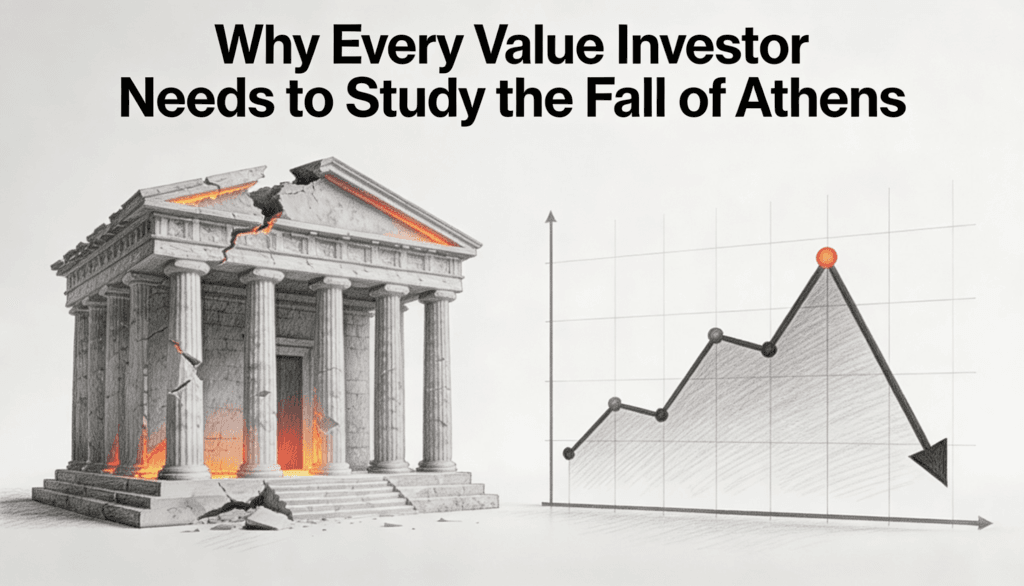
The ancient Athenians had a word for it. They called it hubris. The dangerous belief that success was permanent, that the rules applied to everyone else, and that borrowed time was the same thing as earned time.
Twenty five centuries later, in the spring of 2010, the modern Greeks discovered that the word still carried weight. So did every investor holding European sovereign debt.
The European debt crisis did not arrive like a earthquake. It arrived like a slow leak in a basement pipe. By the time anyone bothered to look, the foundation was already wet. And yet the parallels between what happened in ancient Athens and what unfolded across the eurozone tell us something far more useful than any balance sheet ever could. They tell us how to think about value when everyone around you has stopped thinking at all.
The Empire That Ran on Credit
Athens in the fifth century BC was the Silicon Valley of the ancient world. It had the culture, the military edge, the network effects. After leading the Greek alliance against Persia, Athens did what any self respecting hegemon would do. It turned a defensive coalition into a revenue machine. The Delian League, originally a mutual protection pact, became a tribute system. Member states paid Athens for security whether they wanted to or not.
For a while, this worked beautifully. Athens built the Parthenon. It funded theater, philosophy, and a navy that ruled the Aegean. The money flowed in, and the Athenians convinced themselves it would never stop.
Greece in 2001 joined the eurozone with a similar confidence. Membership in the euro was not just an economic arrangement. It was a signal. It told the world that Greece was stable, creditworthy, and fundamentally European in the northern sense of the word. Bond yields dropped. Borrowing became cheap. And Athens, the modern one this time, started spending like the ancient one.
The value investor looks at this and sees the first lesson. When the cost of borrowing drops not because of improved fundamentals but because of a borrowed label, the margin of safety is an illusion. Greece did not become Germany by adopting the euro. It became a country that could borrow at German rates without a German economy to back it up.
What the Balance Sheet Did Not Show
Here is where things get interesting for anyone who cares about intrinsic value.
Ancient Athens kept two sets of books, in a manner of speaking. There was the visible wealth, the temples and ships and public works. Then there was the invisible liability, the resentment building among its subject allies. Sparta did not defeat Athens through superior strategy alone. It won because half of Athens’ empire was waiting for an excuse to defect. The balance sheet looked strong. The franchise was rotting.
Greece in 2009 revealed something remarkably similar. Goldman Sachs had helped the Greek government use complex currency swaps to hide the true size of its debt. The official numbers said the deficit was around 3.7 percent of GDP. The real number was closer to 15 percent. The books were not just cooked. They were caramelized.
For value investors, this is not just a cautionary tale about fraud. It is a reminder that reported numbers are a story someone is telling you. The question is never just what the numbers say. It is who prepared them, what incentives they had, and what would happen if the narrative changed. Warren Buffett has said that you only find out who is swimming naked when the tide goes out. Greece was not just naked. It was pretending to be fully dressed and charging admission.
The Contagion No One Priced In
One of the most useful concepts in value investing is the idea of a moat. A durable competitive advantage that protects a business from competition. Countries have moats too. Strong institutions, independent central banks, diversified economies, the rule of law. These are the things that let a nation absorb shocks without cracking.
The eurozone in 2010 discovered that its moat had a drawback. It was shared. When Greece started sinking, the water rose for everyone.
This is the part that still surprises people. Spain was not Greece. Italy was definitely not Greece, at least not in the way that mattered. But the bond markets did not care about distinctions. They cared about exposure, about interconnection, about the terrifying question: if one country in a monetary union can lie about its books and nearly default, who else might be lying?
Portugal, Italy, Greece, and Spain. The acronym was not subtle. The markets called them the PIGS.
The ancient parallel here is striking. When Athens fell, the entire Greek world fractured. City states that had nothing to do with Athenian excess still suffered because the system they depended on lost its credibility. The Delian League did not just collapse in Athens. It collapsed everywhere, because the trust that held it together was indivisible.
For the value investor, this is the lesson about correlation in crisis. In normal times, assets behave independently. In a panic, everything correlates toward one. Your diversification works perfectly right up until the moment you need it most. This is not a reason to abandon diversification. It is a reason to understand that diversification is a strategy for normal weather, not for hurricanes.
The Psychology of the Crowd
There is a moment in every crisis where rational analysis leaves the room and pure emotion takes over. The Greeks, both ancient and modern, understood crowds better than most. Thucydides wrote about the plague in Athens, how fear dissolved social bonds and made people act in ways they never would have imagined. Twenty four centuries later, the bond markets did exactly the same thing.
In late 2009, when the Greek deficit revision hit the news, there was a brief window where the crisis could have been contained. A coordinated European response, quick and decisive, might have calmed the markets. Instead, what followed was months of dithering, finger pointing, and moralizing from northern Europe about southern recklessness. Angela Merkel wanted Greece to suffer a little before being rescued. The markets interpreted this not as tough love but as a signal that the eurozone might actually let a member state fail.
Yields on Greek bonds went vertical. The spread between Greek and German government bonds, which had been nearly zero at the start of the euro, blew out to levels that priced in actual default. And here is the cruel irony. The delay in responding made the eventual bailout far more expensive than an early intervention would have been. The desire to punish Greece for its sins ended up punishing European taxpayers even more.
Benjamin Graham wrote that the market is a voting machine in the short run and a weighing machine in the long run. During the European debt crisis, the voting machine went haywire. Assets that had real value were sold at prices that reflected pure panic, not fundamentals. Greek government bonds trading at 20-30 cents on the euro were, for someone with the stomach and the timeline, a spectacular value opportunity. But you had to be willing to hold something that the entire world was running from.
This is the psychological moat that separates good value investors from everyone else. It is not intelligence. It is temperament. The ability to buy what others are selling in a state of terror requires a kind of emotional detachment that most people simply do not have. And that is precisely why it works.
The Austerity Trap and the Paradox of Thrift
Here is where the story takes a turn that should make every investor uncomfortable.
The bailout came with conditions. Greece had to cut spending, raise taxes, and reform its economy. The troika, the European Commission, the European Central Bank, and the International Monetary Fund, imposed austerity measures that were designed to restore fiscal discipline. On paper, this made perfect sense. You cannot spend your way out of a debt crisis.
Except sometimes you can. Or at least, you cannot cut your way out of one either.
The austerity measures crushed Greek GDP. The economy shrank by more than 25 percent over the following years. Unemployment reached 27 percent. The debt to GDP ratio, the very metric the austerity was supposed to improve, actually got worse because the denominator was shrinking faster than the numerator.
This is the paradox of thrift applied at a national scale. When everyone saves at the same time, nobody earns. When a government cuts spending during a recession, it removes demand from an economy that is already starving. The patient was sick, and the doctors prescribed a diet.
What Athens Teaches About Margin of Safety
The most important concept in value investing is the margin of safety. Buy at a price low enough that even if your analysis is wrong, you are unlikely to lose much. Graham invented the idea. Buffett built an empire on it. And the European debt crisis is one of the best real world demonstrations of why it matters.
The investors who got destroyed in the crisis were the ones who had bought European sovereign debt at tight spreads, assuming that the euro made default impossible. Their margin of safety was zero. They were relying on a single assumption, that the political will to hold the eurozone together was absolute, and when that assumption wobbled, they had nothing to fall back on.
The investors who profited were the ones who waited. They let the panic run its course. They watched yields climb to levels that priced in outcomes far worse than what was likely. And then they bought. Not because they were certain Greece would survive, but because the price had fallen so far that even a mediocre outcome would produce a strong return.
Ancient Athens teaches the same lesson from the other side. The city states that survived the fall of Athens were the ones that had maintained their own defenses, their own economies, their own alliances. They had not outsourced their security to a single power. They had kept a margin of safety in their geopolitical portfolio.
The Ending That Is Not Really an Ending
Greece did not collapse. It came close, multiple times, but it did not leave the euro. The bailouts, three of them eventually, kept the country inside the monetary union at enormous social cost. By 2018, Greece exited its final bailout program. The crisis was declared over.
But declaring a crisis over is not the same as fixing what caused it. The structural problems that made Greece vulnerable, weak tax collection, an oversized public sector, a political culture resistant to reform, these did not vanish because a program ended. They improved at the margins. Whether they improved enough is a question that history has not finished answering.
Athens, the ancient one, never recovered its empire. It remained a cultural center for centuries, but the political and military dominance was gone for good. Some falls are recoverable. Some are not. The skill is in knowing which is which before the market figures it out.
For the value investor, the European debt crisis is not ancient history. It is a manual. It teaches that value is not a number on a spreadsheet. It is a judgment about durability, about what an asset can withstand when the story around it changes. It teaches that the best opportunities appear when fear is highest and thinking is lowest. It teaches that borrowed credibility is the most dangerous form of leverage.
And it teaches, perhaps most importantly, that the distance between Athens in 404 BC and Athens in 2010 AD is shorter than anyone would like to admit.
The fundamentals change. The human behavior does not.