Table of Contents
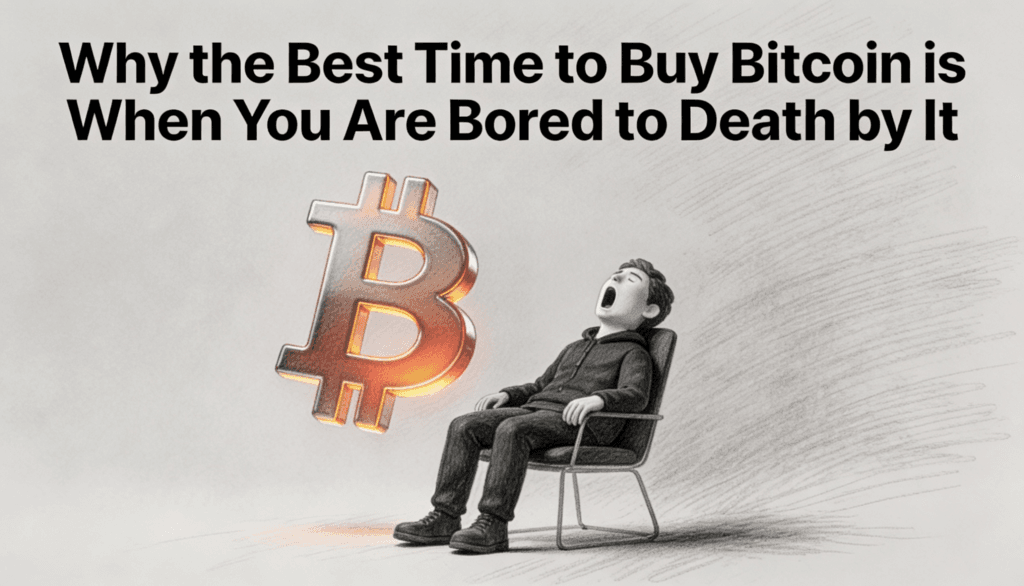
There is a strange paradox at the heart of investing that nobody talks about at dinner parties. The best opportunities tend to show up dressed in the most boring outfits imaginable. They do not arrive with fireworks. They do not trend on social media. They sit quietly in the corner while everyone else is dancing with whatever shiny thing captured attention that week.
Bitcoin is perhaps the purest expression of this paradox. And understanding why could change the way you think about money, timing, and the bizarre psychology that governs both.
The Excitement Tax
When Bitcoin is exciting, you are paying a premium for that excitement. Think of it as an emotional markup. The price is not just reflecting the technology or the network or the math. It is reflecting the collective enthusiasm of millions of people who just discovered it exists, or who just watched it double in three months, or who just heard their cousin made a fortune.
This is not unique to Bitcoin. It is a pattern that runs through every market in history. Tulips, railroads, dot com stocks, real estate in 2006. The story is always the same. When something becomes thrilling, the thrill itself gets priced in. You are no longer buying the asset. You are buying the excitement surrounding it.
The problem is that excitement is perishable. It has a shelf life shorter than most people expect. And when it expires, the price adjusts.
So when Bitcoin is boring, when nobody at work is mentioning it, when the news cycle has moved on to the next crisis or spectacle, that emotional markup evaporates. What remains is closer to something resembling actual value. Whatever that means for a digital asset, and that debate is its own rabbit hole, the point stands. Boredom strips away the froth.
Why Your Brain Hates This Idea
Here is where it gets interesting. Knowing this intellectually and acting on it are two completely different things. Your brain is not wired to buy things that bore you. Evolution spent millions of years training you to pay attention to what is exciting, novel, and socially validated. That saber toothed tiger is exciting. That new berry everyone is eating is socially validated. Your nervous system does not have a module for “this is tedious, therefore it is a good opportunity.”
Daniel Kahneman, the psychologist who won a Nobel Prize in economics (which tells you something about how irrational economics actually is), spent decades documenting how humans make consistently terrible decisions under uncertainty. One of his key findings was that we overweight vivid, emotionally charged information and underweight boring, statistical information.
Bitcoin during a bull run is vivid. It is emotionally charged. Every signal your brain processes says “act now.” Bitcoin during a flat, quiet stretch where the price has done nothing for eight months is statistically more interesting but emotionally dead. Your brain files it under “irrelevant” and moves on to doom scrolling.
This is not a character flaw. It is architecture. But architecture can be worked around once you see the blueprints.
The Cocktail Party Indicator
There is an informal metric that has been floating around investment circles for decades. Some version of it gets attributed to different people, but the idea is consistent. When the topic comes up at cocktail parties, you are late. When taxi drivers are giving you tips, you are very late. When your in laws are explaining the technology to you at Thanksgiving, the top is probably already in.
The inverse is equally useful but rarely discussed. When you mention Bitcoin at a gathering and people change the subject, or worse, when they give you a slightly pitying look like you just brought up your fantasy football team, that is information. That social disinterest is a signal. Not a guarantee, never a guarantee, but a signal that the emotional premium has deflated.
Markets are ultimately voting machines in the short term and weighing machines in the long term. Benjamin Graham said that, and it remains one of the most useful mental models in finance. When everyone is voting for Bitcoin with their enthusiasm, the votes are expensive. When nobody is voting because they are bored, the price of a vote drops.
The Discomfort Premium
Here is something that sounds almost philosophical but has very practical implications. In markets, comfort and returns tend to move in opposite directions. The most comfortable time to buy is usually the worst time to buy. The most uncomfortable time to buy is usually closer to the best time.
Boredom is a form of discomfort. Not the acute kind. Not the panic of a crash where buying feels like catching a falling knife. Boredom is a subtler discomfort. It is the feeling that nothing is happening, that your money could be doing something more productive elsewhere, that maybe you were wrong about this whole thing.
That low grade psychological friction is actually useful because it keeps the crowd away. And the crowd, bless them, tends to show up at exactly the wrong moment with remarkable consistency.
This does not mean every boring period is a buying opportunity. Context matters. Fundamentals matter, to the extent that Bitcoin has fundamentals you can evaluate. But the emotional state of boredom as a starting filter is more valuable than most people realize. It is a crude but effective way to avoid the excitement tax.
What Poker Teaches Us About Bitcoin Timing
There is a useful parallel in poker that illuminates this dynamic. Professional poker players understand that the most profitable moments are not the dramatic all in hands that make it onto television. The most profitable moments are the grinding, boring hands where discipline and position matter more than cards.
Amateurs get bored by these hands. They play too many of them, looking for action. Professionals sit patiently through the tedium because they understand that profitability and entertainment are not the same thing. In fact, they are often inversely correlated.
Bitcoin investing works on a similar principle. The entertaining periods, the moonshots, the crashes, the celebrity endorsements, those are the hands where amateurs pile in looking for action. The boring periods are where disciplined positioning happens. Not because boredom guarantees profit, but because it filters out the emotional noise that leads to poor decisions.
The Difficulty of Doing Nothing Interesting
One of the most underappreciated skills in investing is the ability to do something boring on purpose. This sounds trivial. It is not. We live in an economy that is engineered from the ground up to capture attention. Every app, every notification, every news alert is competing for your engagement. Boredom has become almost countercultural.
Choosing to pay attention to an asset precisely when it is boring requires a kind of contrarian discipline that goes against the grain of modern life. You have to actively resist the pull of whatever is currently exciting and instead focus on what is currently ignored. This is psychologically expensive. It costs mental energy that most people would rather spend elsewhere.
But that cost is also what makes it potentially rewarding. If it were easy or natural to buy boring things, everyone would do it, and the advantage would disappear. The difficulty is the moat.
A Note of Honesty
None of this should be mistaken for a prediction or financial advice. Bitcoin could go to zero. It could go to a million. The future is genuinely uncertain, and anyone who tells you otherwise is selling something or deluded, possibly both.
What this article is arguing is narrower and more defensible. It is arguing that if you have already decided Bitcoin has a place in your portfolio, the emotional state of boredom around the asset is a better entry signal than the emotional state of excitement. That is a claim about psychology and market dynamics, not about the fundamental value of any particular asset.
The boredom signal does not tell you what to buy. It helps you think about when. And “when” is the question that costs most investors the most money, because they consistently answer it with their emotions instead of their observations.
The Uncomfortable Bottom Line
The next time Bitcoin is everywhere, when it is on magazine covers and your group chat will not stop talking about it, notice how easy it feels to want in. That ease is a cost you will pay later.
And the next time Bitcoin is nowhere, when searching for news about it returns nothing interesting and even crypto Twitter seems half asleep, notice how hard it feels to care. That difficulty is where the opportunity tends to live.
Boredom is not the enemy of good investing. It is something closer to a compass.
The crowd has shovels. You have patience. In the long run, patience tends to be the better tool.