Table of Contents
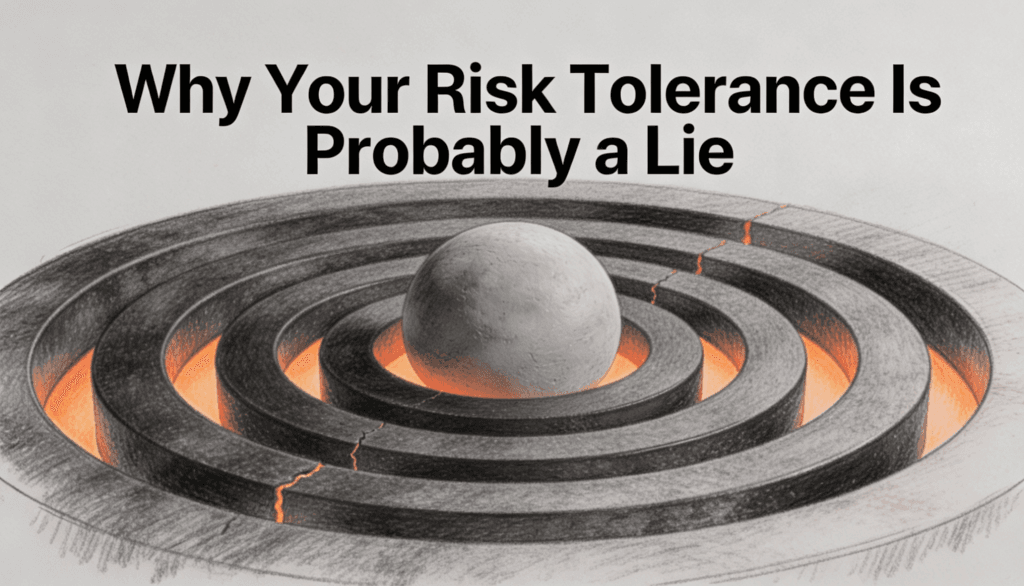
You filled out a questionnaire. You clicked through five, maybe ten questions about how you would feel if your portfolio dropped 20%. You selected something like “I would stay the course and wait for recovery.” The algorithm gave you a score. You were declared a “moderate aggressive” investor. Congratulations. You now have a label that will quietly mislead you for years.
Here is the problem with risk tolerance questionnaires: they measure what you believe about yourself in a calm room, on a calm day, with no money on the line. They capture your self-image as an investor. They do not capture you as an investor. And those are two very different people.
The Person You Think You Are
There is a concept in psychology called the “hot cold empathy gap,” coined by George Loewenstein. It describes a simple but devastating truth: when you are in a calm emotional state, you are structurally incapable of predicting how you will behave in an emotionally charged one. You are not bad at it. You are incapable of it. Your brain literally cannot simulate the version of you that exists during panic.
So when a questionnaire asks, “How would you react to a 30% decline in your portfolio,” you answer from the cold state. You picture yourself as composed, rational, long term. You think you would hold. You might even think you would buy more. That answer is not a prediction. It is a fantasy.
This is not a moral failing. It is architecture. The brain regions responsible for rational planning and the ones responsible for emotional reaction do not collaborate the way we assume they do. When fear shows up, it does not politely consult your prefrontal cortex. It takes the wheel.
The result: millions of investors walk around with a risk profile that describes a person who does not exist under pressure.
The Questionnaire Industrial Complex
Why do these questionnaires persist if they are this flawed? Because they serve a purpose. Just not the purpose you think.
Risk tolerance questionnaires exist primarily as a compliance tool. They give financial advisors and robo platforms legal cover. If the market crashes and you lose money, they can point to the form you filled out and say, “You told us you were comfortable with this level of risk.” It is a liability shield dressed up as financial planning.
This does not mean every advisor using them is cynical. Many genuinely believe the tools work. But the incentive structure is worth noticing. The questionnaire protects the institution first and serves the client second. The order matters.
And the design of the questions themselves is often laughable. Multiple choice answers about hypothetical scenarios. No time pressure. No real stakes. It is like testing someone’s ability to fight by asking them to fill out a survey about fighting. The format cannot capture what it claims to measure.
Risk Tolerance vs. Risk Capacity vs. Risk Composure
Part of the confusion is that we use “risk tolerance” as a catch all term when there are actually three different things at play.
Risk tolerance is your emotional willingness to accept uncertainty. It is psychological.
Risk capacity is your financial ability to absorb losses without it derailing your life. It is structural. A 25 year old with no debt and a stable income has enormous risk capacity regardless of how anxious they feel about markets.
Risk composure is the one nobody measures. It is your ability to stick with your plan when things get ugly. It is behavioral. And it is the only one that actually determines your investment outcomes.
You can have high tolerance, high capacity, and zero composure. That investor says all the right things, has the financial runway to take risk, and then panic sells the moment CNN starts using the word “crash.” The questionnaire captured two out of three. The missing third is the one that mattered.
The Autobiography Problem
Here is another layer. When you answer a risk questionnaire, you are not just predicting future behavior. You are telling a story about who you are. Humans are deeply attached to their self narratives, and “I am a disciplined, long term investor” is a very attractive identity.
The novelist Joan Didion wrote that we tell ourselves stories in order to live. She was talking about something darker and more fundamental than investing, but the mechanism applies. We construct identities that give us coherence and comfort. The risk questionnaire invites you to perform a version of yourself. And most people perform the version they admire, not the version that shows up at 2 AM checking futures on a phone.
This is why experienced advisors who actually know their clients often develop a more accurate picture of risk tolerance through conversation and observation than any form can provide. They watch what clients do during downturns. They notice who calls in a panic. They learn to read the distance between what a client says and what a client does. That gap is the real risk profile.
When the Market Tests Your Identity
March 2020 was a masterclass in revealed preferences. The fastest 30% decline in market history. A global pandemic with no clear timeline. Genuine uncertainty about whether the economy would function at all.
Risk questionnaires had been telling people for years what kind of investors they were. March 2020 told them the truth.
Many “aggressive” investors discovered they were actually moderate at best. Many “moderate” investors discovered they were conservative. The labels dissolved the moment the abstraction became real. It was not that people were dishonest on their questionnaires. They simply did not know themselves as well as they thought.
And here is the counterintuitive part: some of the people who handled it best were not the ones with the highest stated risk tolerance. They were the ones who had structured their finances so that a market crash did not threaten their immediate life. They had cash reserves. They had low fixed expenses. They had, in other words, high risk capacity. Their composure was partly a product of their financial structure, not their psychological makeup.
This suggests something the industry does not love to hear: the best risk management might not be about profiling your personality. It might be about designing your financial life so that you do not need to be brave.
A Better Approach (Or at Least a Less Dishonest One)
So what would an honest risk assessment look like?
First, it would separate the three dimensions clearly. Tolerance, capacity, and composure would each be measured independently. Your emotional comfort with risk is useful information, but it is not the whole picture. Your financial structure matters more than your feelings, and your behavioral track record matters most of all.
Second, it would incorporate real data. What did you actually do in past downturns? If you have investment history, that history is more revealing than any questionnaire. If you do not have history, the assessment should be more conservative by default, because untested risk tolerance is not risk tolerance. It is optimism.
Third, it would be dynamic. Your risk profile is not a fixed trait like your blood type. It changes with age, wealth, life circumstances, market conditions, and even the news cycle. A one time questionnaire treats risk tolerance as a permanent characteristic. It is not. It is a moving target that should be revisited regularly.
Fourth, and most importantly, it would be honest about what it cannot do. No tool can fully predict how you will behave under stress. The best an assessment can do is create a reasonable starting point and then build in safeguards for the inevitable moment when you act against your own stated plan.
The Useful Lie
I should be fair here. Risk questionnaires are not entirely useless. They do serve as a starting point for conversation. They force people to think, even superficially, about their relationship with uncertainty. For someone who has never considered their risk profile at all, a basic questionnaire is better than nothing.
But “better than nothing” is a low bar. And the danger is that people treat the result as a definitive answer rather than a rough sketch. The label “moderate aggressive” feels precise. It feels scientific. It feels like you have been measured. That false precision is the real risk.
The most honest thing a risk questionnaire could do is end with a disclaimer: “This assessment reflects how you think you would behave. How you actually behave may be very different. Plan accordingly.”
No one would add that line, of course. It would undermine the product. But it would be true.
The Bottom Line
Your risk tolerance is not a number. It is not a category. It is not something a ten question form can capture. It is the messy, shifting, context dependent relationship between your money, your emotions, your life circumstances, and the thousand small decisions you make when no one is watching.
The industry needs the fiction of measurable risk tolerance because it makes the business of managing money scalable. Personalized, nuanced, ongoing assessment does not fit into a software platform. A five point scale does.
So when someone tells you your risk tolerance is “moderate aggressive” or “7 out of 10,” smile politely. Then do the harder work of actually understanding how you behave when things go wrong. That version of you is the one your portfolio has to survive.