Table of Contents
Most origin stories about wealth start with gold. A king finds a glittering rock, hoards it, builds a palace. Simple enough. But the real story of how money and trade actually worked before the industrial age is stranger, messier, and far more interesting than that. It starts with a snail.
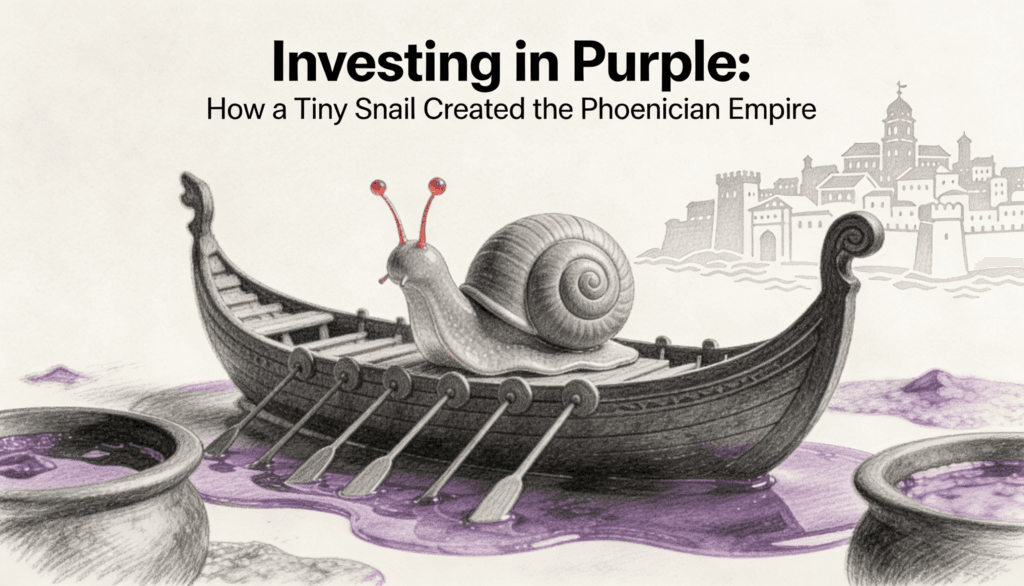
Specifically, the Murex sea snail. A creature so unremarkable to look at that you would step on one at the beach without a second thought. And yet this ugly little mollusk, found along the eastern Mediterranean coast, produced a secretion that would become the most valuable substance in the ancient world by weight. More valuable than gold. More valuable than silver. The Phoenicians figured out how to extract it, process it, and turn it into a dye so vivid and so permanent that it became the color of gods, emperors, and anyone else who wanted the world to know they had arrived.
That color was Tyrian purple.
And the civilization that built itself around this discovery did not conquer territory, raise massive armies, or construct monuments to intimidate their neighbors. They did something far more durable. They created a trade network. The Phoenicians essentially invented the idea of building an empire out of commerce rather than conquest. Which, if you think about it, makes them the earliest proof of a concept that modern investors still struggle to accept: the best monopolies are not built on force. They are built on knowing something nobody else knows how to do.
The economics of rarity
Here is what made Tyrian purple so absurdly expensive. To produce a single gram of dye, you needed roughly ten thousand snails. Each one had to be individually cracked open so that a tiny gland behind the head could be removed. The glands were then left to decompose in stone vats under the sun for days, producing a smell so horrific that ancient writers described the stench of Phoenician dye works as one of the worst sensory experiences available in the known world. The Roman author Pliny called it offensive and that the resulting liquid had a frightening dark color like clotted blood.
None of this sounds like a luxury product. And that is exactly the point.
The lesson here is one that modern brand theory has spent decades trying to articulate: the value of a luxury good has almost nothing to do with the pleasantness of its production and almost everything to do with the exclusivity of its result. The smell was terrible. The process was disgusting. The labor was enormous. But the cloth that emerged on the other side was unlike anything else in existence. It did not fade. It did not wash out. In fact, sunlight and washing made the color deeper and richer over time. In a world where most dyed fabrics turned muddy and dull within weeks, this was practically magic.
The Phoenicians understood something that would not be formally described for another two thousand years. They understood the relationship between scarcity, difficulty of production, and perceived value. They were not just selling a color. They were selling the visible proof that you could afford something most people could not.
Trade as empire
The conventional image of an ancient empire involves armies, fortifications, and a ruler sitting on a throne issuing decrees. The Phoenicians did not really do any of that. What they did instead was establish trading posts across the entire Mediterranean. Tyre, Sidon, Byblos. Then further out: Carthage, Cadiz, ports along North Africa and southern Europe. They were not interested in governing these places. They were interested in being the only people who could reliably move goods between them.
This is a business model, not a political model. And it is one that looks remarkably familiar. The Phoenicians were essentially operating a logistics network. They were the middlemen of the ancient world, connecting Egyptian grain with Greek olive oil, Cypriot copper with Mesopotamian textiles. And at the center of all of it, anchoring the entire system, was the purple dye. It was their signature product, their brand, and their competitive moat all wrapped into one.
The concept of a “moat” in investing, popularized by Warren Buffett, refers to a structural advantage that protects a business from competition. The Phoenicians had one of the strongest moats in economic history. The Murex snails were concentrated along their coastline. The extraction process required specialized knowledge passed down through generations. And the sheer unpleasantness of the work meant that most potential competitors simply did not want to bother.
This is worth pausing on. One of the greatest trade empires in human history was protected not by walls or weapons but by the fact that the work was too disgusting for anyone else to copy.
What counted as money
This brings us to a broader question that most people never think to ask. Before coins existed, before paper currency, before any of the financial infrastructure we take for granted, how did people actually transact?
The answer is that almost anything could function as money, provided it met a few basic criteria. It needed to be portable, durable, divisible to some degree, and widely recognized as valuable. Different societies landed on different solutions. Cowrie shells in parts of Africa and Asia. Cacao beans among the Maya. Ownership was simply agreed upon collectively. You owned the stone everyone said you owned, even if it was sitting in someone else is yard. Or at the bottom of the ocean.
What all of these systems shared was a reliance on social consensus. Money, in every era and in every form, is ultimately a story that a group of people agrees to believe. Gold is not inherently more useful than iron. In many practical senses, it is less useful. You cannot make tools out of it. You cannot build with it. But enough people across enough cultures decided that gold was valuable, and so it was. The same logic applied to purple dyed cloth, to cowrie shells, to everything else that ever served as a medium of exchange.
This is the part that tends to make economists uncomfortable, because it means that the foundation of every monetary system ever devised is, at bottom, a collective fiction. A useful fiction. An extraordinarily powerful fiction. But a fiction nonetheless.
The Phoenician playbook
What the Phoenicians did better than almost anyone before or after them was recognize that controlling the story was just as important as controlling the product. They did not simply harvest snails and sell dye. They cultivated an entire mythology around the color purple. They connected it to royalty, to the divine, to power itself. By the time the Roman Republic adopted purple as the color of the senatorial class, the association was so deeply embedded in Mediterranean culture that it felt natural. Inevitable, even. As if purple had always meant power.
It had not, of course. The Phoenicians made it mean that. Through repetition, through exclusivity, through centuries of careful brand management conducted long before anyone had a word for it.
There is a parallel here to how modern luxury brands operate. Hermes does not sell handbags. It sells the idea that you are the kind of person who carries a Hermes bag. The product is secondary to the narrative. The Phoenicians figured this out roughly three thousand years before the first Birkin bag hit the market.
When the snails ran out
Every monopoly eventually faces a challenge. For the Phoenicians, it came from multiple directions at once. Alexander the Great conquered Tyre in 332 BCE after a brutal seven month siege that effectively ended the city is independence. The Romans later absorbed what remained of Phoenician territory. But even before the military defeats, the underlying resource was becoming scarcer. Centuries of intensive harvesting had depleted the Murex populations along the Levantine coast.
This is the part of the story that carries the sharpest lesson for modern investors. A business built on a finite natural resource, no matter how strong its moat, is always on a timer. The Phoenicians milked their advantage for centuries, which is more than most companies manage. But they never solved the fundamental problem of sustainability. They extracted. They did not replenish. And eventually, the math caught up.
After the fall of Tyre, the production of Tyrian purple continued in diminished form under Greek and then Roman control. But it was never the same. The expertise had been dispersed. The supply chains were disrupted. The snails were fewer. By the time the Byzantine emperors were hoarding the last reserves of true Tyrian purple, restricting its use to the imperial court alone, the product had become more of a historical relic than a commercial force.
The Byzantines literally made it illegal for anyone outside the royal family to wear purple. Which tells you something about what happens when a luxury good becomes too scarce even for the rich. The market does not find a substitute. The government steps in and makes scarcity itself into law.
What the snail teaches us
The story of Tyrian purple is, on its surface, a story about a dye. But underneath it is a story about how value gets created, maintained, and eventually destroyed. The Phoenicians did not stumble into wealth. They identified a unique resource, developed proprietary knowledge around it, built distribution networks that spanned continents, and wrapped the entire operation in a narrative so compelling that it shaped how civilizations thought about power for millennia.
They also made every classic mistake. They over harvested. They failed to diversify. They assumed that because demand was strong today, the supply would hold tomorrow. They built the ancient equivalent of a high margin, single product company with no plan for what happens when the product runs out.
If you wanted to be uncharitable, you could say the Phoenicians were the world is first pump and dump operation, though one that lasted a thousand years, which is a pretty good run by any standard.
But perhaps the most interesting takeaway is the simplest one. Before there were stock markets, before there were banks, before there were even coins, the basic dynamics of investing were already fully operational. Scarcity drives value. Narrative shapes demand. Monopolies work until they do not. And sometimes the ugliest, most unpleasant process imaginable produces the most beautiful result.
All because of a snail that nobody would look at twice.