Table of Contents
The Same Instinct, Two Different Vehicles
Here is something that will bother you once you see it.
A software engineer in Stockholm and a software engineer in Austin both do the exact same thing with their money. They take a portion of their income and place it into a system they believe will return more value than they put in. They trust the process. They rarely question the underlying mechanics. And they sleep well at night.
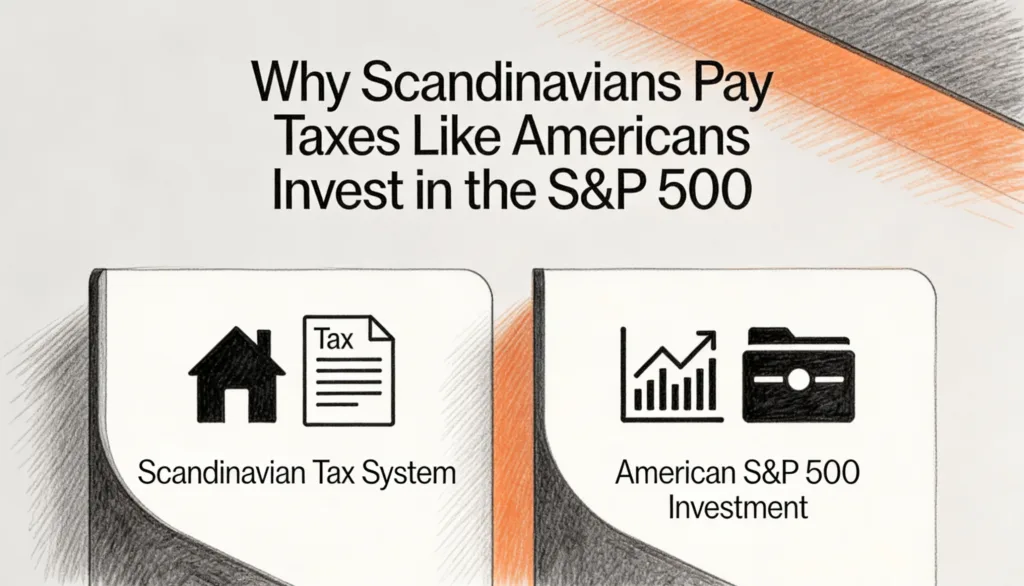
The Swede pays 55% in taxes. The Texan puts 15% into index funds. Both believe they are making the smartest financial decision available to them. And both are right, within their own operating system.
This is not an article about whether taxes are good or bad. It is about something more interesting. It is about how culture quietly programs what we consider an “investment” in the first place.
The Operating System You Did Not Choose
Every country runs on a financial operating system, and nobody remembers installing it.
In the United States, the core code goes something like this: you are an individual. The market is the mechanism. If you are disciplined and patient, compound interest will take care of you. The S&P 500 is not just an index. It is a belief system dressed in a ticker symbol. It says that American enterprise, left alone, trends upward over time. Buy it. Hold it. Trust the process.
In Scandinavia, the core code is different. You are part of a collective. The state is the mechanism. If everyone contributes, the system will take care of all of you. Taxes are not a cost. They are a deposit into a social infrastructure that compounds in ways that do not show up on a brokerage statement.
Neither group thinks of themselves as making a cultural choice. They think they are just being rational.
This is the most important part. Both groups genuinely believe their approach is the obvious one.
What Are You Actually Buying?
Let us do something uncomfortable and treat taxes like a financial product. If a fund manager walked up to a Dane and said, “Give me half your income and I will provide you with free healthcare, free education through a master’s degree, 52 weeks of paid parental leave, subsidized childcare, a pension, and unemployment insurance that does not make you feel like a failure,” that Dane would look at the fee structure and think it was a reasonable deal.
Now imagine pitching the S&P 500 to a Swede. “Give me 15% of your income. Over the next 30 years you might average 10% annual returns, but you will need to use those gains to pay for your own health insurance, your children’s college, your retirement, and hope nothing catastrophic happens in between.” The Swede would look at the risk profile and wonder why anyone would voluntarily build their own safety net from scratch when a collective one already exists.
The products are different. The consumer behavior is identical. Both groups are buying future security with present income.
The Grocery Store Theory of National Finance
There is a useful way to think about this that has nothing to do with economics.
Americans shop at Costco. They buy in bulk. They do the labor themselves. They load the car, drive it home, and store it in their garage. The per unit cost is lower, but the total investment of time, effort, and space is significant. If they are disciplined, they save money. If they are not, food rots in the back of a second refrigerator they bought specifically for overflow.
Scandinavians shop at a place where everything costs more per item but the store does everything for you. It is curated. It is smaller. You walk home with exactly what you need. You do not need a garage. You do not need a second refrigerator. You do not need to be disciplined because the system has removed the need for discipline.
The Costco model rewards optimization. The Scandinavian model rewards participation.
Neither is irrational. But they produce very different relationships with money, risk, and what it means to be “good with finances.”
The Hidden Return on Taxes Nobody Talks About
Here is where it gets genuinely counterintuitive.
Scandinavians are not just paying for services. They are purchasing the absence of financial anxiety. And that absence turns out to be wildly productive.
When you do not worry about a medical bill bankrupting you, you take more entrepreneurial risks. When your education is free, you do not start your career with debt shaping every decision. When parental leave is a given, having children does not become a financial equation you solve with a spreadsheet.
Denmark, Sweden, and Norway consistently rank high on entrepreneurship. This surprises people who assume that high taxes kill ambition.
The S&P 500 investor takes on more personal financial risk but less systemic risk. The Scandinavian taxpayer takes on less personal financial risk but more systemic risk. The Scandinavian is betting that the government will remain competent. The American is betting that the market will remain functional.
Why Americans Cannot Just “Do What Scandinavia Does” and Vice Versa
This is where most articles on this topic become useless. They either say “America should copy Scandinavia” or “Scandinavia is a socialist fantasy.” Both takes miss the point entirely.
You cannot transplant a financial operating system any more than you can transplant a language. The Scandinavian model works because of specific cultural preconditions that took centuries to develop. Small, ethnically homogeneous populations with high institutional trust and a deep Lutheran work ethic that somehow survived secularization. The tax system does not create the trust. The trust creates the tax system.
America’s investment culture works because of a different set of preconditions. A massive, diverse population with extraordinarily high trust in markets and individual agency. The S&P 500 does not create the individualism. The individualism creates the demand for the S&P 500.
Telling an American to trust the government with 55% of their income is like telling a cat to enjoy swimming. The instinct runs too deep. Telling a Scandinavian to build a personal investment portfolio to cover their own healthcare is like telling a fish to appreciate the desert. The entire environment would need to change first.
What This Means for Your Money
Forget which system is better. That is a debate for politicians and people who enjoy being angry online.
The useful takeaway is this: your financial instincts are not as rational as you think they are. They are cultural software running on biological hardware. The amount of your income you are willing to hand to the government, the amount you funnel into a brokerage account, the amount you keep in cash “just in case” – these numbers feel like choices. They are mostly reflexes.
The American who maxes out a 401(k) and the Swede who cheerfully pays marginal tax rates that would make a Texan weep are both doing the same thing. They are converting present income into future security through the mechanism their culture taught them to trust.
The only real financial mistake is not understanding which game you are playing. The American who neither invests nor benefits from a social safety net is falling through both systems. The Scandinavian who pays high taxes but also hoards cash under a mattress out of private anxiety is paying twice for the same product.
Know your operating system. Use it well. And maybe, just maybe, steal one or two features from the other one.
The Part Nobody Wants to Hear
Both systems require something their participants hate to acknowledge: faith.
The S&P 500 investor has faith that American capitalism will continue to generate returns over the long term. This faith has been rewarded historically. It is not guaranteed to be rewarded forever. Past performance, as every prospectus dutifully notes, does not guarantee future results. Nobody reads that line. Everyone should.
The Scandinavian taxpayer has faith that their government will remain competent, uncorrupted, and demographically stable enough to sustain the model. This faith has also been rewarded historically. It is also not guaranteed. Immigration, aging populations, and political polarization are stress tests that have not fully played out yet.
Faith in markets. Faith in institutions. Pick your religion.
The honest truth is that both systems work until they do not. The S&P 500 looked foolish in 2008. Scandinavian models looked fragile during the 2015 migration crisis. Both recovered. Both will face future crises that make recovery less certain.
The difference is not which system is more resilient. It is which system you are culturally equipped to repair when it breaks. Americans are good at market recoveries because they believe in markets. Scandinavians are good at institutional reform because they believe in institutions.
Your savings strategy is not just a financial plan. It is a mirror. It reflects what your culture taught you to trust, what it taught you to fear, and what it never taught you to question.
The most valuable thing you can do with that insight is not change your portfolio. It is notice, for the first time, that you are running software you did not write.