Table of Contents
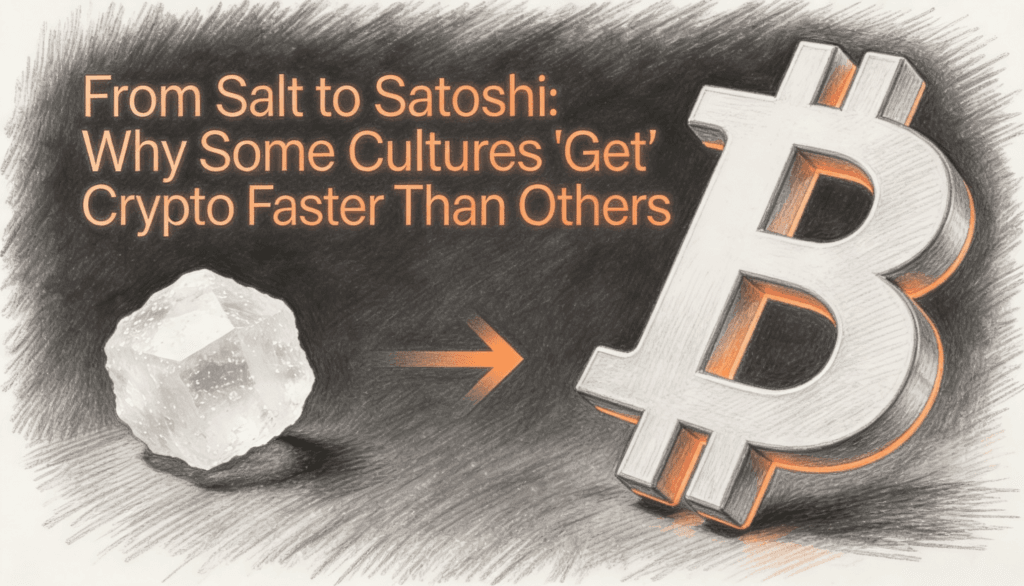
There was a time when Roman soldiers were paid in salt. Not because salt was delicious on eggs, but because it was scarce, portable, and universally accepted. Sound familiar? Swap the salt crystals for cryptographic tokens and you have more or less the same pitch Bitcoin makes today.
The funny thing is, not every culture heard that pitch and reacted the same way. Some countries went all in on crypto like it was a second religion. Others shrugged and went back to their savings accounts. The difference has almost nothing to do with technology and almost everything to do with how a culture thinks about money in the first place.
Trust Is the Real Currency
Here is something that does not get talked about enough. Every financial system is, at its core, a trust exercise. You hand someone a piece of paper with a number on it, and both of you agree to pretend it has value. That is the entire game. The dollar, the euro, the yen. None of them are backed by anything physical anymore. They are backed by collective belief.
Now, if you grew up in a country where that belief held steady for generations, crypto looks like a strange solution to a problem you do not have. Why would a German pensioner care about decentralized finance when the Bundesbank has been boringly reliable for decades? The euro shows up. Inflation stays manageable. The system works.
But if you grew up in Argentina, where the peso has collapsed so many times that your grandparents have a favorite inflation story, the pitch lands differently. You do not need anyone to explain why a currency outside government control might be appealing. You already understand the problem in your bones.
This is the first cultural divide. It is not about tech literacy or internet access. It is about institutional trust. Countries with histories of currency devaluation, bank seizures, or capital controls tend to adopt crypto faster because the population has already been trained to look for alternatives. Nigeria, Turkey, Vietnam, Argentina, Lebanon. These are not random dots on the adoption map. They are countries where the official financial system has, at some point, looked its citizens in the eye and let them down.
The Mattress Index
Every culture has its version of money under the mattress. In India, it is gold jewelry. In China, it is real estate. These are not irrational behaviors. They are perfectly logical responses to local conditions.
What these habits reveal is something economists love to overlook. People do not save according to textbook models. They save according to trauma.
A Vietnamese family that remembers the currency reform of 1985, when the government essentially erased wealth overnight, does not need a TED talk on the merits of hard money. They already operate with a mental model that says the state might take it all tomorrow. When Bitcoin comes along and promises that no government can inflate it away or freeze it, that family hears something deeply familiar. Not a new idea. An old need finally being met.
Contrast this with Scandinavia, where financial systems are transparent, regulated, and trustworthy to the point of being dull. Savings accounts work. Pensions arrive on time. The social safety net is thick. In that context, crypto is not a lifeline. It is a curiosity at best, a speculative toy at worst.
The pattern is uncomfortable but consistent. The more a population has been burned by its own institutions, the faster it runs toward alternatives. Crypto adoption is, in many cases, a trauma response dressed up as innovation.
Collectivism, Individualism, and the Wallet
Culture shapes not just whether people save, but how they think about ownership itself.
In highly individualistic societies like the United States or Australia, personal wealth is personal. Your money is your business. Financial independence is a virtue. This creates fertile ground for crypto in one sense because the idea of self custody, of being your own bank, aligns perfectly with the cultural narrative of self reliance.
But here is the twist. Individualistic cultures also tend to have stronger consumer spending habits. The American dream is not about hoarding wealth. It is about displaying it. Bigger house, newer car, better vacation. This spending orientation can actually slow crypto adoption because holding an asset that you cannot easily flash around does not satisfy the same psychological itch.
Now look at collectivist cultures in East and Southeast Asia. Saving is not just a personal strategy. It is a family obligation. In many Chinese households, saving rates of 40 percent of income are normal because money is not just yours. It belongs to the family unit. It is future security for parents, children, and extended relatives.
This collective saving instinct creates an interesting dynamic with crypto. On one hand, the high saving rate means there is capital available to allocate. On the other hand, the conservative family oriented approach means the capital tends to flow toward perceived safety. Which is why, in practice, many Asian investors gravitate toward stablecoins or established tokens rather than the wilder end of the crypto spectrum.
The culture does not just determine if people invest. It determines what kind of investor they become.
The Remittance Highway
If you want to understand crypto adoption in the Philippines, do not start with blockchain whitepapers. Start with the fact that roughly 10 percent of the country’s GDP comes from overseas workers sending money home.
Traditional remittance channels are slow and expensive. Western Union and similar services take a noticeable cut. When you are a domestic worker in Dubai sending your earnings back to your family in Manila, every percentage point matters. Crypto offered a workaround. Not a perfect one, but a faster and cheaper one.
This is not a technology story. It is a migration story. Countries with large diaspora populations and high remittance flows were practically designed to adopt crypto. The Philippines, Mexico, India, Nigeria. The common thread is not Silicon Valley enthusiasm. It is millions of people trying to move small amounts of money across borders without losing a chunk of it to intermediaries.
The irony is thick here. Crypto was originally sold as a revolutionary break from traditional finance. But in the remittance corridor, it succeeded not by being revolutionary. It succeeded by being slightly less annoying than the existing options.
Religion, Morality, and Money You Cannot Touch
Here is a connection most crypto analysts miss entirely. Religious and moral frameworks around money play a much bigger role in adoption than anyone wants to admit.
Islamic finance prohibits interest. This is not a minor footnote. It is a fundamental structural principle that shapes how hundreds of millions of people interact with money. Traditional banking products often do not comply with Sharia law, which creates a gap. Some Muslim majority countries have explored crypto precisely because certain tokens, particularly those tied to real assets or utility, can be structured in ways that align with Islamic financial principles.
Meanwhile, in parts of Protestant Northern Europe and North America, there is a deep cultural association between money and moral discipline. Thrift is a virtue. Speculation is suspect. Crypto, with its wild price swings and association with overnight fortunes, runs directly against the grain of cultures that believe wealth should be earned slowly and steadily through hard work.
This is not about which framework is right. It is about recognizing that money is never just money. It carries moral weight. And that moral weight varies enormously depending on where you stand on the map.
The Paradox of Financial Inclusion
Development economists love to talk about the unbanked. The roughly 1.3 billion adults worldwide who do not have a bank account. Crypto was supposed to be their on ramp to the global financial system.
The reality turned out to be more complicated. In Sub Saharan Africa, mobile money platforms like M-Pesa had already solved many of the problems crypto claimed to address. Kenyans were sending money via text message years before Bitcoin existed. The infrastructure was simple, accessible, and did not require understanding private keys or seed phrases.
So crypto did not always leap into an empty space. Sometimes it arrived and found the space already occupied by simpler solutions. The cultures that adopted crypto fastest were not necessarily the most underserved. They were the ones where existing solutions were just bad enough to create demand, but not so absent that people lacked the digital infrastructure to try something new.
This is the paradox. Crypto needs a certain level of existing connectivity to thrive, but it also needs existing systems to be sufficiently broken to create motivation. Too functional and nobody cares. Too broken and nobody can access the alternative. The sweet spot of crypto adoption sits in a narrow band of institutional dysfunction paired with just enough digital access.
What the West Misunderstands
There is a persistent narrative in Western media that frames crypto adoption in developing countries as naive or risky. The assumption is that these populations are being taken advantage of, that they do not understand the volatility, that they are gambling with money they cannot afford to lose.
This narrative is, to put it politely, missing the point.
A Nigerian trader who converts naira to USDT is not speculating. He is hedging. A Lebanese professional who moves savings into Bitcoin after watching banks freeze withdrawals in 2019 is not being reckless. He is being rational. These are not people who failed to read the risk disclaimer. These are people who read it, understood it, and decided the risk of staying in the traditional system was worse.
The Western lens tends to evaluate crypto adoption through the framework of someone who already has a functioning financial system. From that position, crypto looks like an unnecessary gamble. From the position of someone whose currency lost 80 percent of its value in three years, it looks like common sense.
The Cultural Clock
Adoption is not a straight line. It moves in cultural time, not technological time.
Japan, one of the most technologically advanced nations on earth, has been cautious and regulatory about crypto despite being the birthplace of the Satoshi Nakamoto pseudonym. Technology was never the barrier. The culture of institutional trust and regulatory compliance created a different relationship with decentralized systems.
Meanwhile, El Salvador made Bitcoin legal tender in 2021, not because it was more technologically sophisticated than Japan, but because its cultural and economic conditions made the leap feel less like a leap and more like a logical next step.
The lesson is simple but easy to forget. Technology does not drive adoption. Culture does. Technology just provides the vehicle. Culture decides whether anyone wants to get in.
Full Circle
The Roman soldiers who accepted salt as payment did not do so because salt was inherently valuable. They did it because the system they operated in made salt the most reliable store of value available to them.
Two thousand years later, the question has not changed. It has just been translated into new languages and new ledgers. Every culture is still asking the same thing it has always asked. What can I trust to hold value until I need it?
The answer depends on where you are standing. And that, more than any whitepaper or protocol upgrade, is what determines whether a culture “gets” crypto or not. The technology is universal. The need it fills is not.