Table of Contents
There is a drug dealer in your pocket. It does not wear a trench coat or lurk in alleyways. It wears the logo of your favourite brokerage app, and it has studied your brain more carefully than you ever will.
Welcome to neuro-harvesting, the quiet art of turning your emotional impulses into somebody else’s profit. Not through fraud. Not through deception, exactly. But through a deep, almost surgical understanding of what makes you click, swipe, and buy at precisely the wrong moment.
The Chemistry You Did Not Sign Up For
Every time you check your portfolio and see green, your brain releases dopamine. You already knew that. What you probably did not know is that dopamine is not actually a reward chemical. It is a prediction chemical. It fires hardest not when you get what you want, but when you think you might be about to get what you want.
This distinction matters enormously.
A slot machine does not hook people because they win. It hooks them because the near miss, the almost win, generates a bigger dopamine spike than the payout itself. Your investing app works on the same principle. The push notification, the price alert, the sudden spike on a chart you were not even watching. These are not features. They are triggers. And they are engineered with the same behavioural science that keeps people feeding coins into machines at 3am in Las Vegas.
The financial industry figured out something that casinos knew decades ago: you do not need to give people what they want. You just need to keep them in a state of anticipation.
FOMO is Not a Feeling. It is a Product.
Fear of missing out is treated like a personal weakness. Something you should overcome with discipline and a balanced portfolio. But this framing is convenient for the people who profit from it, because it places the burden entirely on you.
FOMO is not a bug in your psychology. It is the main feature of a system designed to extract value from your attention.
Think about what happens during a market rally. Social media fills with screenshots of gains. Financial news runs breathless coverage of whatever is surging. Your brokerage app sends you notifications about trending stocks. Every signal in your environment is telling you the same thing: everyone else is getting rich and you are sitting here doing nothing.
That feeling, that urgent, almost physical need to act, is not irrational in the way people think. Your brain is doing exactly what evolution designed it to do. For hundreds of thousands of years, if everyone in your tribe was running toward something, the ones who hesitated were the ones who did not eat. Social proof was a survival mechanism.
The problem is that financial markets are not the savannah. When everyone is running in the same direction in markets, it usually means the opportunity is already gone. Your ancient wiring is being used against you, and the people on the other side of your trade know it.
The Attention Economy Meets the Capital Economy
Here is where it gets interesting. The business model of social media is capturing attention and selling it. The business model of modern retail finance is capturing impulse and monetizing it. These two industries have merged, and the result is something that neither regulators nor investors fully understand yet.
When a stock trends on social media, it is not organic discovery. It is a feedback loop. Attention creates volume. Volume creates price movement. Price movement creates more attention. Each cycle pulls in another layer of participants who are responding not to fundamentals but to the dopamine hit of watching a number go up.
The sophisticated players in this game are not the ones posting rocket emojis. They are the ones who understand that the cycle has a half-life, that attention fades, that the crowd always arrives late and leaves later. They are selling into the enthusiasm that your brain is telling you to buy into.
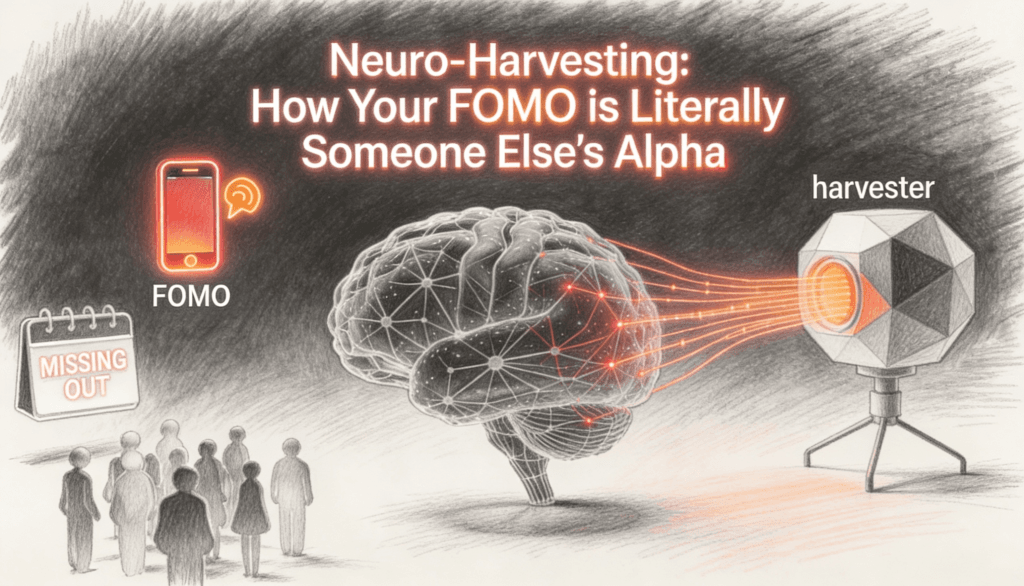
Your FOMO is, quite literally, their alpha.
Alpha, in finance, means excess returns above what the market gives you for free. And one of the most reliable sources of alpha in modern markets is being on the other side of emotionally driven trades. Not because emotional traders are stupid. Because they are human, and humans are running software that was last updated about 200,000 years ago.
The Confetti Problem
In 2021, a major brokerage app literally showered users with digital confetti when they made their first trade. Think about that for a moment. A financial transaction, one that could lose you real money, was being celebrated like a birthday party.
This was not an accident or a quirky design choice. It was applied neuroscience. The confetti triggers a small dopamine release that associates trading with reward. The next trade becomes easier. And the one after that. Each transaction generates revenue for the platform through payment for order flow, which means every time you trade, someone is paying for the privilege of seeing your order before the market does.
The confetti was removed after public backlash, but the underlying architecture remains. The smooth interface, the one-tap trading, the push notifications, the social features that let you see what others are buying. All of it is designed to reduce the friction between impulse and action.
In every other context, we recognize this pattern. When a game is designed to maximize in-app purchases through psychological triggers, we call it predatory. When a food company engineers products to override satiety signals, we call it manipulative. But when a financial platform engineers its interface to maximize trading frequency, we call it innovation.
Your Brain on a Dip
There is a counter-intuitive wrinkle here. The same dopamine system that drives FOMO also drives panic selling, but through a different pathway.
When your portfolio drops sharply, your brain shifts from the dopamine-seeking mode to a threat-response mode governed by cortisol and the amygdala. This is the fight or flight system, and in markets, flight means selling. The drop feels like a physical threat because, neurologically, it is processed as one. Financial loss activates the same brain regions as physical pain. This is not a metaphor. Brain imaging studies have shown this consistently.
So the same person who bought in a frenzy of FOMO at the top will sell in a frenzy of fear at the bottom. Buy high, sell low. The oldest joke in investing, and it is hardwired into your nervous system.
The professionals know this too. The smart money does not just harvest your enthusiasm on the way up. It harvests your panic on the way down. Your fear is also someone else’s alpha.
The Paradox of Information
Here is something that should bother you more than it probably does. We have more access to financial information than at any point in human history. Real-time data, analyst reports, earnings transcripts, satellite imagery of parking lots. And yet retail investors, on average, perform worse than they did when information was scarce.
More information has not made us better investors. It has made us more reactive investors. Every data point is a potential trigger. Every notification is an invitation to act. And action, in investing, is usually the enemy.
There is a famous study, often misattributed but directionally accurate, suggesting that the best-performing retail accounts at one major brokerage belonged to people who had forgotten they had accounts. The second-best performers were dead.
The joke writes itself, but the implication is serious. The human brain, left to its own devices and bombarded with information, will consistently find reasons to do something. And doing something in markets carries costs, both in transaction fees and in the spread between what you wanted to pay and what you actually paid.
Doing nothing is the most profitable strategy that almost nobody can psychologically tolerate.
What the Brain Cannot Do For You
Your dopamine system is an extraordinary piece of evolutionary engineering. It kept your ancestors alive, motivated them to explore, to take risks, to seek out new resources. It is the reason humans crossed oceans and built cities.
But it did not evolve for an environment where you can buy fractional shares of a cryptocurrency named after a dog at 2am from your bed. The mismatch between the brain you have and the environment you are operating in is the core problem. And no amount of financial literacy education can fully bridge that gap, because the issue is not knowledge. It is neurochemistry.
The people who do well in markets over long periods tend to share one trait that has nothing to do with intelligence or information. They have somehow learned, or been forced, to tolerate boredom. They can sit with a portfolio and do nothing while the world screams at them to act. This is not discipline in the way self-help books describe it. It is more like a trained override of a biological system that is constantly whispering: do something. Move. React.
The Real Edge
If there is a practical takeaway from all of this, it is not about deleting your brokerage app or going off the grid. It is simpler and harder than that.
The real edge in modern markets is understanding that you are the product and the participant at the same time. Every platform you use to invest is also studying how you invest, and feeding that information into systems designed to keep you engaged, active, and trading.
Recognizing the feeling of FOMO for what it actually is, a dopamine-driven prediction error, not a signal that you should act, is the closest thing to a free lunch in investing. Not because it makes you smarter. Because it makes you slower. And in a game where most losses come from speed, from the frantic need to do something right now, being slow is a genuine competitive advantage.
The irony of neuro-harvesting is that the only real defence is the one thing your brain hates most.
Stillness.