Table of Contents
The Asset You Cannot Sell
There is a strange irony at the center of modern wealth. The most valuable asset most people will ever own is one they cannot trade, cannot liquidate, and cannot pass on to their children. It does not appear on any balance sheet. No bank will hold it in custody. And yet, for the vast majority of working age adults, it dwarfs everything else they possess.
That asset is human capital.
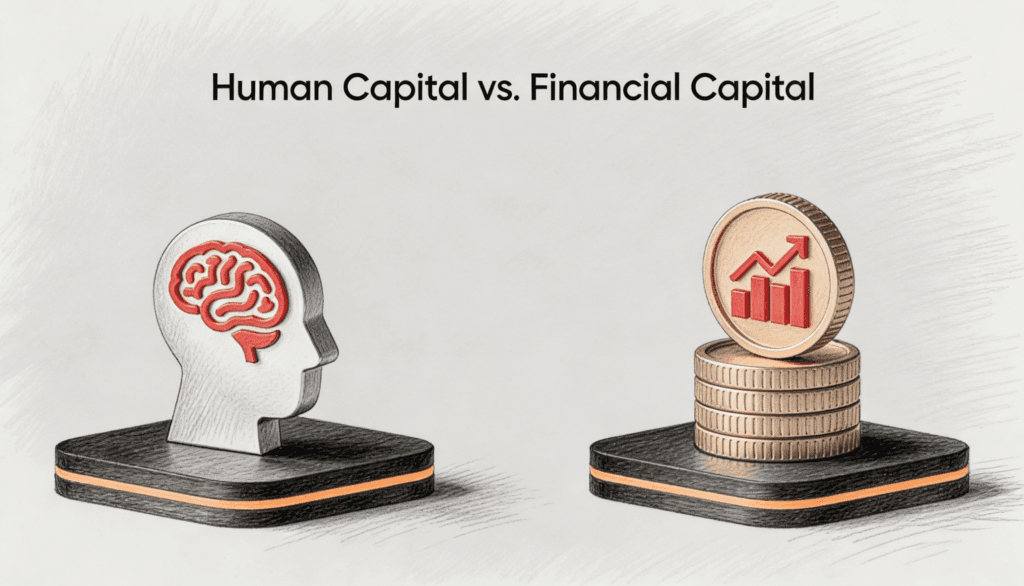
Human capital is, in simple terms, the economic value of everything you are capable of earning over your lifetime. It includes your skills, your knowledge, your health, your professional network, and that harder to define quality some people call hustle or drive or simply showing up when it counts. If you are 25 and reasonably competent in a professional field, your human capital might be worth well over a million dollars. Maybe several million. Meanwhile, your financial capital, the money you actually have in the bank or invested, might be close to zero.
This creates a fascinating inversion. The youngest workers in the economy are, in one sense, the richest. They just cannot access the wealth yet. It is locked inside a future that has not happened.
Financial capital, on the other hand, is what most people think of when they hear the word “capital.” It is money. Stocks, bonds, real estate, savings accounts. It is tangible, transferable, and deeply measurable. You can count it. You can compare it. You can lose it all on a Tuesday afternoon if you are not careful.
The relationship between these two forms of capital is not just a topic for financial planners. It is, at its core, a philosophical question about what value really means and where it actually lives.
The Conversion Problem
Life, financially speaking, is a long conversion process. You start with almost all human capital and almost no financial capital. The goal, if we are being honest about it, is to slowly trade one for the other. You exchange hours, effort, creativity, and years of your life for money. Then, if things go well, the money starts working so you do not have to.
But here is where it gets interesting. This conversion is wildly inefficient.
Most people leak enormous amounts of human capital into things that produce no financial return at all. That is not necessarily a tragedy. Raising children, volunteering, pursuing art for the joy of it, these are real and meaningful uses of human capital. But they complicate the clean narrative that says your skills and time will naturally become wealth.
The conversion also runs in one direction only. You can always turn human capital into financial capital through work. But you cannot reliably turn financial capital back into human capital. You can pay for education, sure. You can buy better health care. But you cannot purchase talent, and you certainly cannot buy back time. A 60 year old retiree with five million dollars cannot transform that money back into the energy and cognitive sharpness of a 30 year old. The trade is final.
This one directional flow gives human capital a quality that financial capital lacks. It is perishable. Every year that passes, a portion of it expires whether you use it or not. Financial capital, properly invested, compounds. Human capital, left idle, decays.
What Finance Gets Wrong
Traditional finance tends to treat human capital as an input and financial capital as the output. The implicit assumption is that financial capital is the real destination and human capital is merely the vehicle. This framing has shaped how entire generations think about careers, savings, and success.
But this hierarchy is not as obvious as it seems.
Consider a surgeon who earns five hundred thousand dollars a year. In pure financial terms, his human capital is enormous. But he cannot diversify it. He cannot hedge it. If his hands are injured, if his specialty becomes obsolete, if a health crisis removes him from practice, the value collapses overnight. His human capital is concentrated in a single sector, a single skill set, a single body. No financial advisor would recommend a portfolio that concentrated.
Now consider someone with modest earnings but extreme adaptability. A person who can learn new skills quickly, shift industries without panic, and stay productive across a wide range of conditions. On paper, their human capital might look smaller. But it is far more resilient. It is, to borrow a concept from investing, well diversified.
This reveals something that career advice rarely acknowledges. The total size of your human capital matters less than its structure. A million dollars of fragile earning power is worth less than eight hundred thousand dollars of durable earning power. Fragility is a hidden cost, and most people never price it in.
The Portfolio You Already Own
Here is a thought experiment that changes how you look at your own finances.
At any given moment, your total wealth is the combination of your human capital and your financial capital. Young professionals are like a portfolio that is 95 percent in a single illiquid asset, their future earnings, and 5 percent in cash. As they age and save, the portfolio gradually shifts. By retirement, the split reverses. Financial capital dominates, and human capital has been almost entirely spent.
This framing has a practical consequence that most people overlook.
If your human capital resembles a stable job with predictable income, something like a bond, then your financial portfolio should probably take more risk. You already have the safe asset. You do not need your investments to also be conservative. The steady paycheck is doing that work.
But if your human capital is volatile, if you are a freelancer, an entrepreneur, or anyone whose income swings dramatically, then your financial portfolio should lean toward safety. You already have enough risk. Adding more through aggressive investments is doubling down in the wrong direction.
Almost nobody thinks about it this way. Most people set their investment risk tolerance based on how they feel about losing money, not based on the structural characteristics of their earning power. That is like choosing your car insurance based on your favorite color.
The Philosophy Beneath the Numbers
Strip away the financial planning angle and something deeper emerges.
Human capital is fundamentally about potential. It is the capacity to create, to solve, to contribute. It exists in the future tense. Financial capital is fundamentally about storage. It is value that has already been created, captured, and preserved. It exists in the past tense.
This distinction mirrors an old tension in philosophy between becoming and being. Human capital is dynamic. It changes with every book you read, every skill you acquire, every failure you survive. Financial capital is static in character. It sits there. It can grow through compounding, but it does not learn anything. Money does not get better at being money.
There is something almost existential about the trade between the two. Every hour you spend earning money is an hour of human capital you will never get back. The money persists. The hour does not. You are, in a very literal sense, converting a piece of your life into a number on a screen.
This is not meant to sound dramatic. It is simply the mechanical reality. And once you see it clearly, it changes the calculation. Not the math, but the meaning.
What Death Teaches Us About Capital
There is a morbid but useful lens here, and it comes from estate planning.
When someone dies, only their financial capital survives them. Their human capital vanishes completely. The skills, the relationships, the expertise, the potential, all of it disappears. What remains is money, property, and whatever digital footprint they left behind.
This means that financial capital is the only form of wealth that can be inherited. And this single fact has shaped civilizations. Dynastic wealth, class structures, generational inequality, all of these emerge from the simple reality that money outlives people but talent does not.
It also explains something about why society tends to overvalue financial capital relative to human capital. We can see it, measure it, and pass it on. It feels permanent. Human capital, no matter how extraordinary, is mortal.
But here is the counter argument. The most transformative contributions to human progress, scientific breakthroughs, artistic movements, philosophical shifts, came from human capital that produced far more value than its owners ever captured financially. Einstein did not die rich. Neither did many of the people whose ideas now underpin trillion dollar industries.
The market is reasonably good at pricing financial capital. It is terrible at pricing human capital. And the gap between the two is where some of the most interesting economic stories live.
The Overlooked Connection to Identity
There is a psychological dimension to this that deserves attention because it affects real decisions.
People often confuse their human capital with their identity. What you do for a living becomes who you are. This fusion is so common that the first question most adults ask a stranger is some version of “what do you do?” We are not asking about hobbies. We are asking about economic function.
This merger creates a problem. When human capital declines, through job loss, illness, aging, or obsolescence, it can feel like the self is declining too. Retirement, which should be a transition from human capital to financial capital, often triggers an identity crisis because the person has been drawing meaning from the asset they just depleted.
Financial capital does not carry this burden. Nobody has an existential crisis because their index fund went up 8 percent. Money is psychologically neutral in a way that skills and work are not.
Understanding this distinction is not just philosophical navel gazing. It has practical implications. People who tie their identity too tightly to their human capital tend to make poor financial decisions. They over invest in their careers at the expense of diversification. They resist career changes even when the economics clearly favor a shift. They treat threats to their professional status as threats to their survival, which leads to defensiveness rather than adaptation.
The most financially resilient people tend to be those who can separate what they do from who they are. They treat their human capital as a tool, not a soul.
The Quiet Endgame
If life is the slow conversion of human capital into financial capital, then the endgame is a strange kind of silence. You stop producing. The income stream dries up. What remains is whatever you managed to store along the way.
This is the moment that reveals whether the conversion was successful. Not in dollar terms, but in structural terms. Did you build financial capital that can sustain you without the engine of human capital running? Did you diversify the right things at the right time? Did you recognize that the asset you started with was always going to expire?
Most financial advice focuses on optimizing the output, the savings rate, the investment returns, the withdrawal strategy. That is fine as far as it goes. But the deeper insight is about the input. The quality, the structure, the resilience, and the inevitable decline of the human capital that funds everything.
Money is a store of value. But value originates in people. In their effort, their ingenuity, their willingness to trade a piece of their finite lives for something that lasts longer than they do.
That is the real exchange rate. And no market in the world quotes it accurately.