Table of Contents
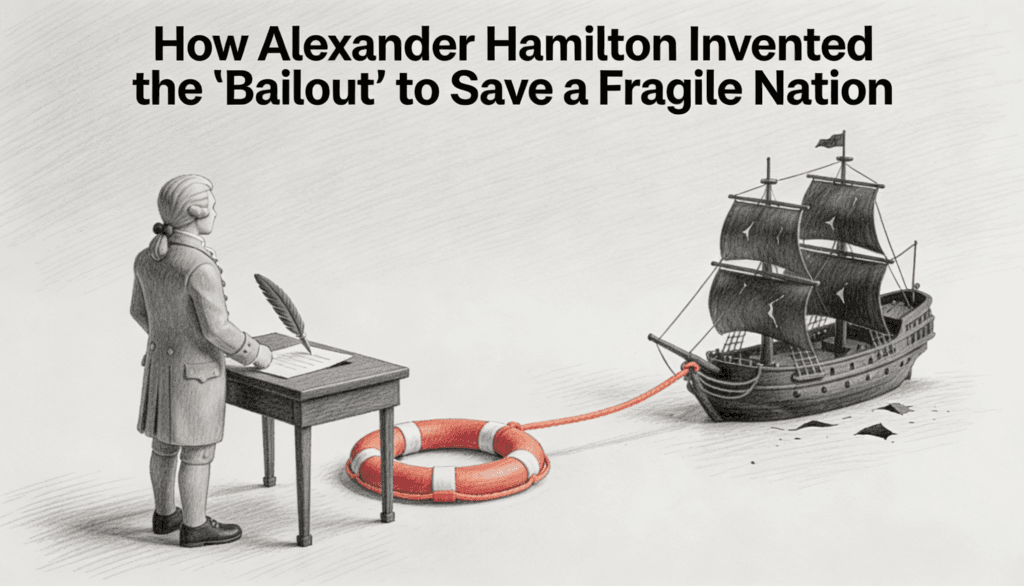
Most people meet Alexander Hamilton through a Broadway musical or through the face on a ten dollar bill. Few realize he essentially invented the modern concept of a government stepping in to rescue a collapsing financial system. And he did it before the United States had a functioning economy, a credible currency, or any real reason for the rest of the world to take it seriously.
The year was 1790. The Revolutionary War was over, but the country it produced was broke. Not metaphorically broke. Actually broke. The states owed money they could not repay. The federal government owed money it could not repay. Soldiers who had fought for independence were holding IOUs from a government that had no tax revenue, no central bank, and no plan. The grand experiment in democracy was, from a financial standpoint, a startup burning through goodwill with no path to profitability.
Hamilton looked at this disaster and saw something no one else saw: an opportunity.
The Debt Nobody Wanted
Here is the part that sounds insane to modern ears. After the war, federal and state debts were trading at steep discounts. Investors and ordinary citizens who held government bonds had largely given up on ever being repaid in full. Many soldiers sold their IOUs to speculators for pennies on the dollar because a fraction of something felt better than all of nothing.
The conventional wisdom was simple. The country owed too much. It should negotiate down its debts, pay what it could, and move on. This was not a radical position. It was the obvious one. Most of the Founding Fathers agreed. Thomas Jefferson certainly did. James Madison had reservations about the whole mess. The debts were a burden, and burdens should be lightened.
Hamilton disagreed. He wanted the federal government to assume all the state debts and pay every single creditor back at full face value. Every dollar. Every IOU. Everything.
His colleagues thought he had lost his mind.
The Logic Behind the Madness
Hamilton was not being generous. He was being strategic in a way that still echoes through modern finance. His reasoning was beautifully counterintuitive: the debt was not the problem. The debt was the solution.
Think about it from the perspective of someone lending money. If a borrower defaults, you learn one thing about that borrower. They do not pay. If a borrower honors debts they arguably did not need to honor, you learn something far more valuable. They will pay no matter what. The first scenario makes you cautious. The second makes you eager to lend again, and at better rates.
Hamilton understood something that would not become formal economic theory for another two centuries. Creditworthiness is not about how much you owe. It is about how seriously you take what you owe. A country drowning in debt but fanatical about repayment is a better bet than a country with modest debt and a casual attitude toward its obligations.
This is the same logic that underpins modern credit scores. A person who has borrowed extensively and always repaid is a more attractive borrower than someone with no credit history at all. Hamilton grasped this intuitively, decades before anyone had the vocabulary to describe it.
The Political Price
Of course, assuming all state debts was politically radioactive. Virginia and other southern states had already paid down much of what they owed. Why should they subsidize Massachusetts and South Carolina, who had not? It was the 18th century version of bailing out your irresponsible neighbor and then splitting the mortgage.
This is where Hamilton revealed another skill that modern policymakers would recognize instantly. He made a deal. The famous Dinner Table Bargain of 1790, brokered over a meal with Jefferson and Madison, traded federal assumption of state debts for moving the nation’s capital to a swampy stretch of land along the Potomac River. Virginia got inclusion into the capital. Hamilton got his financial system.
The whole arrangement had the elegant absurdity of a transaction you might see in a schoolyard. I will take your problems if you let me pick where we build the clubhouse. But it worked. And the clubhouse became Washington, D.C.
Building Something from Nothing
With debt assumption secured, Hamilton moved to the second phase of his plan. He did not just want to pay off the debts. He wanted to restructure them into something productive. He proposed new federal bonds, backed by reliable tax revenue from tariffs and excise taxes. Creditors could exchange their old, dubious IOUs for new, trustworthy securities.
This was not a bailout in the way we usually think of one. Hamilton was not writing checks to make problems disappear. He was converting chaos into order. He took a mess of overlapping, contradictory obligations and replaced them with a single, standardized system of federal credit. He was, in essence, creating a product that did not previously exist: the full faith and credit of the United States.
And here is where it gets genuinely interesting. Those new bonds became a form of money. Merchants used them as collateral. Banks held them as reserves. They circulated through the economy like a quiet engine, lubricating transactions that would not have been possible otherwise. Hamilton had turned debt into infrastructure.
There is something almost alchemical about this. Most people think of debt as a weight. Hamilton treated it as building material. The country owed a fortune it could not pay, so he standardized the fortune, guaranteed it, and watched it become the foundation of a financial system. It is like taking the water that is flooding your basement and using it to power a mill.
The First Central Bank
Hamilton was not finished. He pushed for the creation of the Bank of the United States, a quasi public institution that would manage the government’s finances, issue currency, and provide stability to an economy that had none. Jefferson opposed it. He argued it was unconstitutional, that the Constitution said nothing about creating a national bank.
Hamilton responded with one of the most consequential legal arguments in American history. He articulated the doctrine of implied powers: the idea that the Constitution grants the government not just the powers explicitly listed but also the powers reasonably necessary to carry out those listed powers. If Congress can collect taxes and regulate commerce, it can create a bank to facilitate those functions.
This argument did more than justify a bank. It established a framework for interpreting the Constitution that persists to this day. Every time the federal government does something that is not explicitly mentioned in the founding document, it is walking a path Hamilton cleared. The Federal Reserve, the SEC, Medicare, interstate highways. None of these are in the Constitution. All of them exist because Hamilton won an argument about a bank in 1791.
The Panic and the Precedent
The real test came in 1792, when the young nation experienced its first financial panic. Speculation in bank stocks and government securities had created a bubble. When it burst, prices collapsed, credit froze, and the economy seized up. Sound familiar? It should. The pattern has repeated itself with almost comic regularity ever since.
Hamilton responded by directing the Treasury to buy government securities on the open market, injecting liquidity into the system and stabilizing prices. He coordinated with banks to extend credit rather than call in loans. He acted as a one man Federal Reserve more than a century before the Federal Reserve existed.
This was the first bailout in American history. Not a bailout of a specific company or a specific group of investors, but a bailout of the system itself. Hamilton was not trying to save the speculators who had driven prices up. He was trying to prevent a collapse that would have destroyed confidence in the new financial architecture he had spent years constructing.
The panic subsided. The markets stabilized. And a precedent was set that would echo through every financial crisis to come: when the system is at risk, the government steps in. Whether you call it a bailout, quantitative easing, emergency lending, or simply doing what needs to be done, the playbook Hamilton wrote in 1792 is still the one central bankers reach for when things fall apart.
The Irony of the Legacy
There is a deep irony in Hamilton’s story. He built a financial system designed to create stability, predictability, and trust. And that system, over the following two centuries, enabled the very speculation, leverage, and risk taking that produces the crises he designed it to prevent. He invented the cure and, in doing so, made the disease more likely.
This is not a criticism. It is a description of how complex systems work. Every safety net encourages someone to jump a little higher. Every insurance policy makes someone a little less careful. Economists call this moral hazard. Hamilton probably would have recognized it immediately, though he might not have been too bothered by it. He was a pragmatist. Systems that work imperfectly are still better than no systems at all.
It is worth noting that Hamilton himself never got rich from any of this. He died in 1804, killed in a duel by Aaron Burr, with a modest estate and significant debts of his own. The architect of American capitalism did not personally benefit from the edifice he constructed. He was, if you want to be sentimental about it, a man who built a house he never got to live in.
What It Means Now
Every modern bailout is a descendant of Hamilton’s original intervention. When the Federal Reserve rescued the banking system in 2008, it was running an updated version of Hamilton’s 1792 playbook. When governments around the world injected liquidity during the pandemic, they were doing what Hamilton did first: prioritizing systemic stability over moral arguments about who deserves to be saved.
The debates have not changed much either. In 1790, critics accused Hamilton of rewarding speculators at the expense of ordinary citizens. In 2008, critics accused the government of exactly the same thing. The tension between saving the system and the perceived unfairness of how systems get saved is baked into the DNA of modern finance. Hamilton put it there.
What Hamilton understood, and what every Treasury Secretary and central banker since has had to grapple with, is that financial systems are not natural phenomena. They are constructed. They require maintenance. And occasionally, they require someone to step in and do something that looks irrational or unfair in the short term to preserve something essential in the long term.
He did not call it a bailout. He did not have a word for it. But he invented the concept, proved it worked, and left behind a template that the world still follows. Not bad for a guy who started out as an orphan from the Caribbean with no money, no connections, and no particular reason to believe anyone would listen to a word he said.