Table of Contents
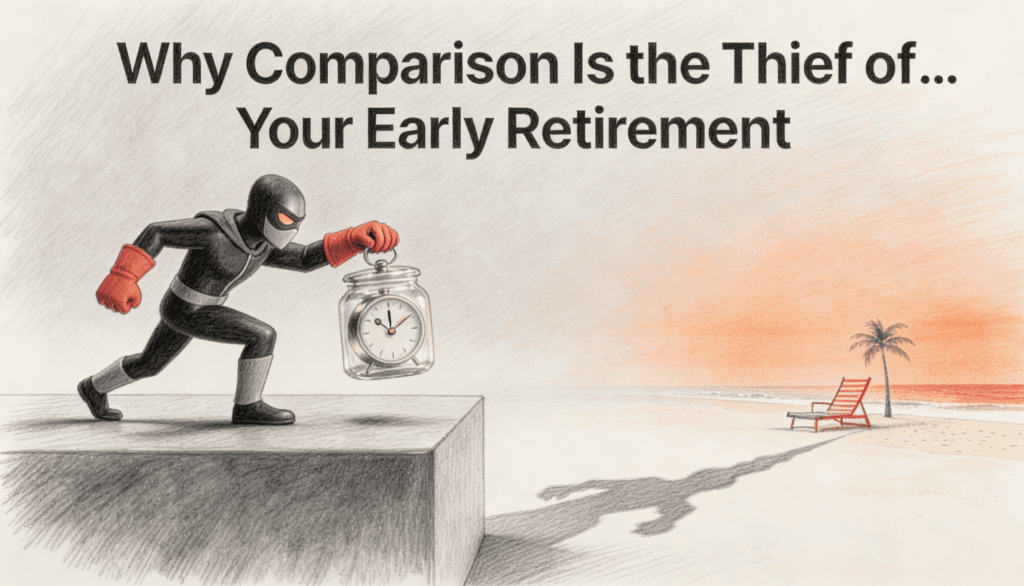
There is a famous quote attributed to Theodore Roosevelt: “Comparison is the thief of joy.” It is a fine quote. Inspirational posters love it. But Roosevelt was being generous. Comparison does not just steal your joy. It steals your money, your time, your freedom, and quite possibly the decade of your life between 55 and 65 that you could have spent doing literally anything other than working.
Let us talk about that.
The Joneses Do Not Exist
Here is the first thing worth understanding. The Joneses, those mythical neighbors you are supposed to keep up with, are themselves trying to keep up with someone else. They are looking at the family across the street the same way you are looking at them. It is an infinite chain of people performing wealth for an audience that is not actually watching. Everyone is on stage. Nobody is in the seats.
This is what the French theorist René Girard called mimetic desire. We do not want things because we independently decided we want them. We want things because other people want them. Desire is not born inside us. It is borrowed. You did not wake up one morning and decide you needed a kitchen renovation. You saw someone else’s kitchen renovation. Then you needed one.
Girard was writing about literature and theology, not personal finance. But his idea might be the single most useful concept for anyone trying to build wealth. Because once you see mimetic desire for what it is, you start to notice it everywhere. The car you drive. The school your kids attend. The vacation you post about. These are not neutral choices. They are moves in a game you did not consciously agree to play.
And games have costs.
The Arithmetic Nobody Wants to Do
Financial writers love to show you compound interest charts. They will demonstrate how skipping your morning coffee saves you $1.2 million by age 60, which is technically true and practically useless because nobody’s retirement was ever saved or ruined by a latte.
But comparison spending is different. Comparison spending does not operate at the latte level. It operates at the life architecture level. It is the difference between a $280,000 house and a $450,000 house. It is the difference between a three year old Honda and a new BMW lease. It is the difference between a state university and a private college that your kid chose because their friend is going there.
These are not small numbers. And unlike the latte, they repeat. The bigger house has bigger taxes, bigger maintenance, bigger insurance, bigger everything for every year you own it. The leased car resets every three years with a fresh payment. The private college tuition runs for four years and sometimes five, because apparently some degrees now take a victory lap.
When people model early retirement, and by early I mean anything before the traditional age, the math is stunningly sensitive to spending. A household that spends $60,000 a year needs roughly $1.5 million to retire safely. A household that spends $100,000 a year needs roughly $2.5 million. That extra million dollars represents years of working life. Not months. Years.
And what accounts for the difference between the $60,000 household and the $100,000 household? Rarely is it fundamentally different needs. It is almost always a different reference group. Different neighbors. Different coworkers. A different set of Joneses.
The Hedonic Treadmill Has a Subscription Fee
Psychologists have a concept called hedonic adaptation. It means that humans adjust to new circumstances with remarkable speed. You get the bigger house and within six months it is just your house. The thrill is gone. The mortgage is not.
This is well documented and widely discussed. What is less discussed is that hedonic adaptation creates a kind of subscription model for unhappiness. You upgrade your lifestyle, adapt to it, feel neutral again, and now need another upgrade to feel the same temporary spike of satisfaction. It is essentially a dopamine toll road where every exit leads to a more expensive entrance ramp.
The connection to comparison is direct. You adapt to your own possessions almost immediately. But you do not adapt to the gap between your possessions and someone else’s. That gap refreshes itself constantly because other people keep buying things too. Social media has turned this into an Olympic sport. You are no longer comparing yourself to your physical neighbors. You are comparing yourself to curated highlight reels from people in different tax brackets, different cities, and sometimes different continents.
Your grandparents compared themselves to maybe twenty families in their immediate community. You compare yourself to thousands of people every week without even trying. The Joneses used to live next door. Now they live in your phone.
Status Is a Positional Good (and That Changes Everything)
Economists have a useful distinction between two types of goods. Regular goods are things that improve your life in absolute terms. Clean water. A warm coat. A reliable car. You benefit from having them regardless of what anyone else has.
Positional goods are different. Positional goods only matter relative to what other people have. A designer handbag is a positional good. A country club membership is a positional good. A prestigious zip code is a positional good. Their value comes not from what they do but from what they signal.
Here is where it gets interesting. Spending on regular goods tends to flatten out naturally. Once you have a safe, comfortable home, there is a limit to how much more comfort money can buy. But spending on positional goods has no natural ceiling. There is always a more exclusive neighborhood, a more impressive car, a more selective school. Positional goods are a ladder with no top rung.
And here is the truly painful part. Positional goods are zero sum. If everyone upgrades, nobody gains status. The whole group just spent more money to end up in the same relative position. It is an arms race where everyone loses purchasing power and nobody gains ground.
This is perhaps the most counter intuitive thing about comparison spending. It does not even accomplish the thing it is trying to accomplish. You cannot win a status race because the finish line moves every time someone else spends more. The only winning move, and I realize this sounds like a line from a 1983 movie about nuclear war, is not to play.
The Hidden Opportunity Cost
When people talk about the cost of keeping up with the Joneses, they usually talk about the money you spend. But there is another cost that is arguably larger and almost never mentioned: the money you do not invest.
Every dollar spent on a positional good is a dollar that does not compound. And compounding is the one genuinely magical force in personal finance. It is the reason that money invested in your thirties is worth dramatically more than money invested in your fifties. Time is the active ingredient, and comparison spending burns time.
Think about it in terms of what economists call opportunity cost. That $15,000 difference between the car you need and the car you bought to impress people at stoplights is not just $15,000. It is $15,000 plus thirty years of growth. At a historically average return, that is roughly $75,000 in future money. And that is just the car. Run the same math on the house, the vacations, the private school, the furniture, the clothes, and the dinners, and you are looking at numbers that could comfortably fund years of financial freedom.
You are not spending money. You are spending future time. And you are spending it to impress people who are too busy worrying about their own spending to notice yours.
The Stoics Were Onto Something
There is a reason that Stoic philosophy has experienced a resurgence in recent years, particularly among people interested in financial independence. The Stoics were essentially running an ancient beta test for the same insight.
Epictetus, who was born a slave and became one of the most influential philosophers in Western history, drew a hard line between things within our control and things outside it. Other people’s opinions? Outside your control. Social status? Outside your control. The size of your neighbor’s house? Aggressively outside your control.
What is within your control is your own response. Your own values. Your own definition of enough.
This is not feel good philosophy. It is strategic. People who define “enough” internally rather than externally have a structural advantage in building wealth. They are playing a different game with different rules, and their game is actually winnable.
So What Do You Actually Do?
Awareness is useful but it is not a plan. Here are a few things that genuinely help.
First, audit your reference group. The people you spend time with and the content you consume will shape your spending more than any budget spreadsheet. This is not about ditching your friends. It is about being honest with yourself about which of your desires are actually yours and which ones you caught from your environment like a financial cold.
Second, practice delayed decision making on big purchases. Comparison driven spending thrives on urgency. It creates a feeling that you need to act now, upgrade now, buy now. Give yourself a mandatory waiting period. Thirty days is a good starting point. Mimetic desire often has a surprisingly short half life. The thing you desperately wanted on Tuesday feels irrelevant by Thursday.
Third, measure your wealth in time rather than dollars. Instead of asking “can I afford this,” ask “how many months of freedom does this cost me?” That reframe changes the emotional math completely. A $40,000 kitchen renovation looks very different when you see it as a year of your life.
Fourth, find your actual Joneses. By which I mean, find the people whose lives you genuinely admire and look closely at what they actually value. You will notice something interesting. The people who seem most free, most content, most in control of their time are rarely the ones with the most visible wealth. They are often the ones who opted out of the comparison game early and redirected that energy toward things that do not depreciate.
The Real Luxury
There is a final irony worth sitting with. The ultimate status symbol, the thing that virtually everyone envies when they see it, is not a car or a house or a watch. It is freedom. The ability to wake up on a Monday and do whatever you want. The ability to say no. The ability to walk away from work not because you have to, but because you can.
That freedom is available much earlier than most people think. But it requires spending less than you earn by a meaningful margin, for a sustained period of time. And the single biggest obstacle to that is not income. It is not investment returns. It is not inflation or taxes or any of the things financial news likes to worry about.
It is the need to look like you are doing as well as the people around you.
Comparison is the thief of joy, yes. But more importantly, it is the thief of your time. And time, unlike money, does not compound. You cannot get it back. You cannot earn more of it. You can only choose how much of it you are willing to trade for the approval of people who are not paying attention.
The Joneses, if they are smart, are trying to keep up with you. And you are trying to keep up with them. And somewhere in that beautiful, expensive, entirely pointless loop, a decade of freedom quietly disappears.
Maybe stop first. See who follows.