Table of Contents
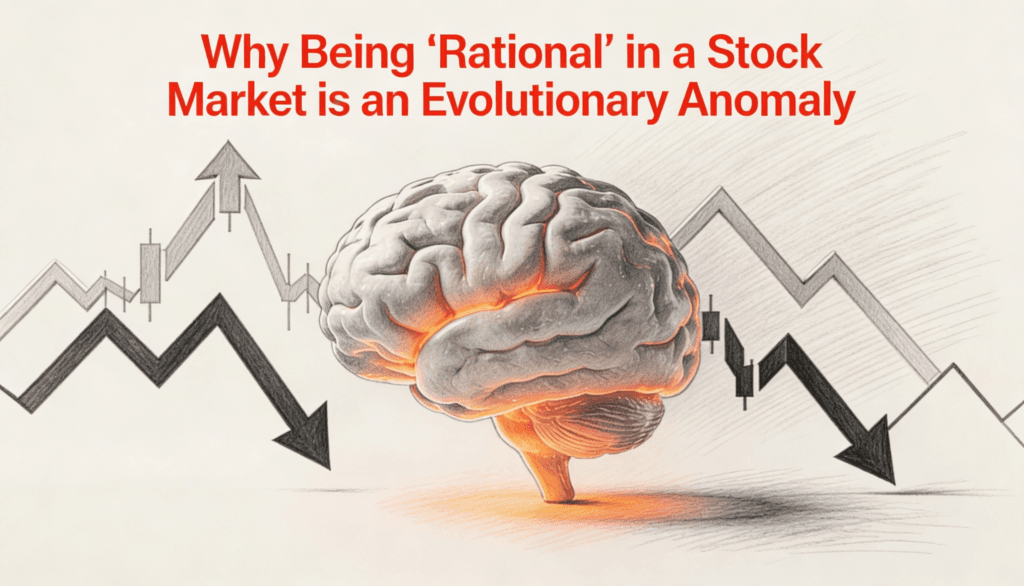
Modern finance asks you to do something your brain was never designed to do. It asks you to sit still while your money drops 30% and call it “staying the course.” It asks you to buy more of something that just lost value. It asks you to ignore your gut, override your instincts, and trust a spreadsheet over a feeling.
This is not normal behavior. Not for a human being, anyway.
For roughly 300,000 years, your ancestors survived by doing the exact opposite of what a good investor is supposed to do. They ran from danger. They followed the crowd. They grabbed what they could now because tomorrow was not guaranteed. And they were right to do all of it. The ones who did not do those things are not your ancestors. They are fossils.
So when someone tells you that panic selling is “irrational,” what they really mean is that you are responding correctly to the wrong environment. Your software is fine. It is just running on hardware that was built for a completely different world.
The Savanna Did Not Have a 60/40 Portfolio
The ancestral environment, the world in which human psychology was forged, had a few key features. Resources were scarce and physical. Threats were immediate and visible. Time horizons were short because life was short. And information was local, meaning what you saw and heard was basically all there was.
In that world, loss aversion made perfect sense. Losing your food supply was not a temporary drawdown. It was a death sentence. The asymmetry was real. Gaining an extra deer was nice. Losing your only deer meant your children starved. The brain learned to weigh losses roughly twice as heavily as equivalent gains, and that math was correct for the world it was designed for.
Now transplant that same brain into a brokerage account interface.
A 15% portfolio loss triggers the same neurological alarm system that once fired when a predator appeared at the edge of camp. Your palms sweat. Your focus narrows. Every instinct screams: get out, protect what you have, move to safety. The amygdala does not know the difference between a bear in the woods and a bear market on screen. It just knows something valuable is disappearing and you need to act.
The problem is that acting is exactly the wrong move. In markets, the danger is not the loss. The danger is the reaction to the loss.
Herding Made You Alive. Now It Makes You Poor in Stock Market.
Following the crowd is one of the most powerful survival strategies in nature. Fish school. Birds flock. Early humans who wandered off alone generally became something else’s lunch. Social conformity was not a weakness. It was a prerequisite for existence.
Financial markets exploit this wiring with remarkable efficiency.
When everyone around you is buying, you feel the pull to buy. When everyone is selling, the urge to sell becomes almost physical. This is not because you have analyzed the fundamentals and arrived at a conclusion. It is because a very old part of your brain is telling you that the group knows something you do not, and separating from the group is how you die.
Bubbles and crashes are not anomalies in this framework. They are the predictable output of savanna brains operating in a marketplace. The dot com bubble was not a failure of analysis. It was a successful execution of herd behavior in an environment where herd behavior happens to be destructive. Everyone was running in the same direction, which is exactly what you are supposed to do when the group starts running. The fact that they were running toward a cliff is a detail the software does not check for.
Your Brain Thinks in Meat, Not Compounding
Compound interest is often called the eighth wonder of the world, and there is a reason it needs that kind of marketing. The human brain does not intuitively understand exponential growth. It was never required to.
In the ancestral environment, most growth was linear. You planted seeds, you got crops. You walked for a day, you covered a certain distance. One plus one equaled roughly two, and that was good enough for survival.
Compounding is a different animal entirely. It asks you to believe that small, boring, repeated actions will eventually produce extraordinary results, but only if you do not touch anything for decades. This is a concept so alien to ancestral logic that it might as well be magic.
This is why people chronically underestimate long term investment returns and chronically overestimate their ability to improve results through active intervention. The urge to “do something” is not laziness in reverse. It is an adaptation. In the wild, passivity killed you. The humans who sat around waiting for good things to happen did not pass on many genes. The ones who acted, moved, and intervened were the ones who survived.
So when your financial advisor tells you the best strategy is to do literally nothing for 30 years, your brain processes this as a threat. Inaction feels reckless. It feels irresponsible. It feels like lying on the savanna while the weather changes and hoping for the best.
And in the original environment, it would have been.
Present Bias Is Not a Bug
Behavioral economists talk about “present bias” as if it is a cognitive flaw. The tendency to prefer a smaller reward now over a larger reward later. In laboratory settings, this looks irrational. In evolutionary settings, it looks like the only sane choice.
If you are living in a world where you might not survive the winter, taking the guaranteed meal today over the promise of two meals next month is not a bias. It is arithmetic. Future rewards had to be discounted heavily because the future itself was heavily discounted. You might not be there to collect.
Now consider what retirement investing demands. It asks a 25 year old to sacrifice consumption today for a payoff 40 years from now. Forty years. For most of human history, the average person did not live that long. The brain literally does not have a filing system for that kind of time horizon.
This creates a bizarre situation where the “rational” financial behavior, maxing out your 401k in your twenties, is actually the most evolutionarily unnatural thing you could do. You are asking a machine that was calibrated for immediate survival to play a game measured in decades. And then you are surprised when people do not do it.
The Social Status Problem
Here is a connection that does not get discussed enough. In ancestral environments, status was not just a nice thing to have. It was directly linked to survival and reproduction. Higher status meant better access to food, mates, and protection. Status was, in a very real sense, a life or death resource.
Money has become the primary status signal in modern societies. Which means your brain treats portfolio performance not as an abstract number but as a proxy for social standing, which it further treats as a proxy for survival probability.
This is why losing money feels like more than losing money. It feels like losing standing. Losing safety. Losing the thing that keeps you and your family viable. A bad quarter is not just a financial event. It is a status event. And status threats activate some of the deepest and most aggressive neural circuitry we have.
This also explains why people take outsized risks when they are behind. The investor who has underperformed their peers is not just trying to catch up financially. They are trying to reclaim status. And status competition in the ancestral environment rewarded bold, aggressive action. Going all in on a speculative bet feels reckless to a financial advisor. To the ancestral brain, it feels like the only logical response when you are falling behind the group.
So What Do You Actually Do With This Information
Understanding that your brain is working against you in financial markets is useful, but only if it changes behavior. And changing behavior is, predictably, the hardest part. You cannot uninstall 300,000 years of evolutionary software.
But you can build systems that account for it.
Automatic contributions work not because they are financially optimal, though they often are, but because they remove the decision point where your ancestral brain would otherwise intervene. You never see the money, so you never have to fight the urge to spend it now.
Diversification works not because any individual investor calculates optimal asset correlations, but because it is the financial equivalent of not putting all your food in one place, which is actually an ancestral strategy your brain does understand.
Long term investing works, but only if you can create enough friction between your impulses and your brokerage account to let time do its job. The investors who perform best are, famously, either dead or have forgotten they have accounts. This is not a joke. It is an empirical finding that perfectly illustrates the problem. The best financial strategy requires you to behave as if you do not exist.
The Real Anomaly
The stock market is roughly 400 years old if you count the Dutch East India Company. Human psychology is roughly 300,000 years old. We are asking an ancient machine to operate in a modern environment, and then we write academic papers about why it does not work properly.
The rational investor that modern finance assumes, the calm, calculating, probability weighting optimizer, is not a description of a human being. It is a description of something that has never existed. Every real investor is a survival machine from the Pleistocene trying to navigate an abstraction invented in the 17th century.
The wonder is not that people behave irrationally in markets. The wonder is that anyone manages to behave rationally at all.