Table of Contents
Two Manias, Three Centuries Apart, One Identical Mistake
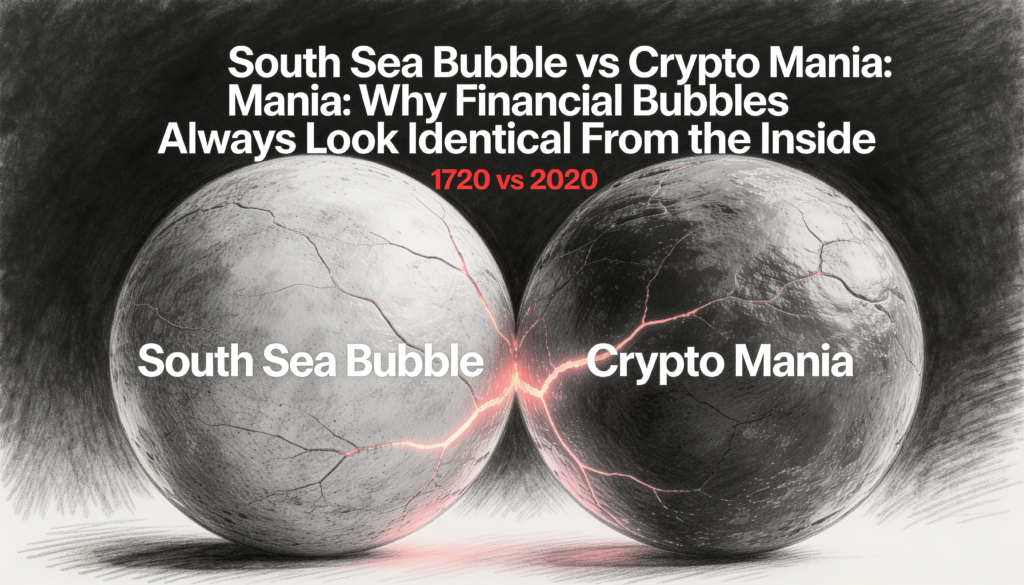
In 2021, a Reddit user could move millions of dollars with a single screenshot of his brokerage gains. In 1720, a London speculator needed only a whispered rumor in a coffeehouse. The technology changed beyond recognition. The behavior did not change at all. This is the uncomfortable truth that comparing crypto mania to the South Sea Bubble reveals: financial bubbles are not failures of information. They are features of human psychology that no amount of innovation will patch.
The South Sea Bubble of 1720 is usually filed away as a quaint cautionary tale from a powdered wig era. But strip away the costumes and the centuries, and you are not looking at a history lesson. You are looking at a mirror. The mechanics of that ancient mania map so precisely onto the crypto boom of 2020 and 2021, and onto the meme stock frenzy of GameStop and AMC, that the resemblance stops being interesting and starts being disturbing.
If you want to understand why your crypto portfolio behaved the way it did, why a token named after a dog reached a multi billion dollar valuation, or why intelligent friends poured savings into projects with no product, the answer was written down three hundred years ago. Here is what the South Sea Bubble teaches us about crypto, meme stocks, and the unchanging operating system of the human mind.
A Company That Sold Nothing, A Token That Did the Same
The South Sea Company was founded in 1711 with an impressive sounding purpose. It held a monopoly on British trade with South America. There was just one small problem. Spain controlled South America and had no intention of letting British merchants set up shop. The actual trading rights amounted to one ship per year and the right to sell enslaved people to Spanish colonies. It was, by any honest measure, a mediocre business.
But mediocre businesses do not create bubbles. Stories do. The directors understood something that token founders would rediscover three hundred years later. If you cannot sell a product, sell a narrative. The South Sea Company repositioned itself not as a trading operation but as a financial instrument, offering to absorb the British national debt in exchange for stock privileges. The details were deliberately complex.
Complexity is not a bug in financial schemes. It is the feature that keeps people from asking too many questions.
This should sound painfully familiar to anyone who lived through the crypto cycle. The entire boom ran on the same engine. Projects with no revenue, no working product, and sometimes no identifiable team raised billions on the strength of a whitepaper and a Discord server. The less people understood about the actual mechanics, the more confident they became. Confusion was not an obstacle to investment. It was the investment thesis.
The meme stock surge worked on a parallel logic. GameStop was a declining mall retailer in a world that had moved to digital downloads. Its fundamentals were not the point. The story was the point: a war between retail traders and short selling hedge funds, a David versus Goliath narrative that had nothing to do with how many video games the company actually sold. The company sold almost nothing of interest to the people buying it. They were not buying the company. They were buying the story about the company.
Newton Could Not Resist It Either
Here is a single fact that should humble every investor who believes intelligence is protection. Isaac Newton, the man who described the laws of gravity itself, bought South Sea stock. He bought in early, made a tidy profit, and sold like a rational man he was. Then he watched his friends keep getting rich, so he bought back in near the top and lost what would be roughly twenty million dollars today. He reportedly said he could calculate the motions of heavenly bodies but not the madness of people. Newton was not stupid. He was human. And being human, it turns out, is the entire problem.
The Gravity of Social Proof in the Age of Screenshots
The most dangerous substance in finance is not greed. It is the sight of other people making money. This is the part that most commentary about crypto mania and meme stocks gets wrong. Bubbles are not populated by idiots. They are populated by intelligent people who are slowly poisoned by watching their peers grow wealthy.
On Reddit in 2021, the dynamic was identical to a 1720 coffeehouse but immeasurably faster. WallStreetBets users did not start buying GameStop because they had completed deep fundamental analysis. They bought because other people were buying, and those people were posting screenshots of enormous gains. Each screenshot functioned exactly like a rumor passed between London merchants. It was social proof rendered in numbers, and it was irresistible.
Crypto Twitter operated on the same fuel. A founder posting a chart that pointed only upward, an influencer flaunting a new sports car bought with token gains, a friend casually mentioning a ten times return. None of this was analysis. All of it was social pressure dressed up as opportunity. The fear of missing out is not a modern invention created by mobile apps. It is an ancient human reflex that mobile apps simply weaponized.
The Tribal Language of a Bubble
There is a pattern in the vocabulary that recurs across centuries. In every bubble, the crowd develops a shared language that functions as tribal identity. In 1720, people spoke of subscriptions, projecting, and the funds. In 2021, the words were diamond hands, HODL, and to the moon. The jargon does two things at once. It creates a sense of belonging, and it discourages critical thinking. If you question the thesis, you are not merely wrong. You are outside the group. You do not understand.
This is not finance. This is anthropology, and the costume changes while the ritual stays the same.
The Feedback Loop With No Brakes
Here is where 1720, crypto, and meme stocks become eerie in their similarity. The South Sea directors did something clever and deeply cynical. They lent money to people so those people could buy South Sea stock. The purchases drove the price up. The rising price made the stock look like good collateral, so more money was lent, more stock was bought, and the price rose further. Everyone smiled and pretended this was sustainable.
The modern mechanism looked different on the surface but was structurally identical. Brokerages made buying stocks frictionless. Options trading, which multiplies both gains and losses, was gamified with confetti animations. Stimulus checks arrived in bank accounts. Crypto exchanges offered enormous leverage. Money flowed in, prices rose, and rising prices attracted more money. The confetti kept falling.
Both systems were feedback loops with no natural brake, and both had participants who genuinely believed they had discovered a new paradigm. In 1720, the new paradigm was that joint stock companies would generate unlimited wealth. In 2021, it was that decentralized finance would replace the entire banking system. The conviction was not faked. That is precisely what made it so dangerous.
The Copycat Bubble Within the Bubble
One of the strangest chapters of 1720 was the eruption of imitators. Once people saw how easily the South Sea Company raised money, dozens of new ventures launched to cash in. These were called bubble companies, and their plans ranged from optimistic to clinically insane. One proposed to drain the Red Sea to recover gold supposedly lost when the Egyptian army drowned. Another famously listed its purpose as an undertaking of great advantage, but nobody to know what it is. It reportedly raised money before its founder vanished.
Now consider the wave of meme coins that followed the original crypto surge. Tokens named after dogs, tokens named after other tokens, tokens named after tweets. Projects whose entire value proposition was that they existed and had an active community chat. The pattern is not merely similar. It is the same pattern wearing different clothes.
To participants inside a bubble, the copycats do not signal danger. They look like confirmation. The proliferation of nonsense feels like proof of legitimacy.
If everyone is launching projects, the reasoning goes, then the space must be real. It is only afterward, standing in the wreckage, that people recognize the absurdity. At the time, it just feels like the early days of something historic.
The Crash Follows the Same Script Every Time
The South Sea Bubble collapsed in stages through the autumn of 1720. The stock price fell from roughly one thousand pounds to under two hundred. Fortunes disappeared overnight. The directors were arrested. Parliament launched an investigation. The public screamed for accountability.
The crypto crash of 2022 followed the same script almost beat for beat. Prices fell, then fell further. Projects that had been worth billions evaporated. Celsius, FTX, and Terra Luna entered the obituary column. The names were new, but the trajectory was ancient. Founders were investigated, arrested, or simply disappeared. Governments began talking about regulation only after the damage was done.
But here is the part nobody wants to hear. After the South Sea Bubble, the British financial system did not die. It adapted. Some of the regulatory frameworks that emerged from the disaster helped lay groundwork for what eventually grew into the modern London capital markets. The mania attracted capital and attention to financial infrastructure that, once the garbage was cleared away, proved genuinely useful.
Crypto appears to be following this same arc. The speculation was real and the losses were real, yet some of the underlying technology may prove valuable once it is separated from the circus that surrounded it. Bubbles destroy wealth, and they also, paradoxically, fund innovation by throwing absurd amounts of money at a space until something useful survives. It is an extraordinarily expensive way to make progress, but it keeps happening because humans keep being human.
What Never Changes About Financial Bubbles
The real lesson of comparing 1720 to the crypto and meme stock era is not that people are greedy. Greed is too simple an explanation. People are social. They take cues from one another. They construct narratives that justify what they already want to do. They mistake complexity for sophistication. They confuse price movement with value creation. And they are spectacularly poor at recognizing these tendencies in themselves, even while easily spotting them in others.
Technology changes the speed and scale of bubbles, but it does not touch their structure. A coffeehouse rumor in 1720 might take days to cross London. A Reddit post in 2021 could move millions of dollars in minutes. But the underlying software, the human operating system of imitation and social proof and story building, has not received an update in three hundred years.
There is something almost comforting in this. Not because losing money is pleasant, but because it suggests that financial manias are not random. They are predictable in their shape, if not in their timing. They follow rules, and those rules are not written in economics textbooks. They are written in the psychology of groups, in the sociology of status, and in the deep human need to not miss out on what everyone else seems to have.
The South Sea Bubble was not an aberration. It was a template. And every generation discovers this the same way: by living through it, losing money, and then explaining to the next generation why this time is completely different. It never is.