Table of Contents
There is a particular kind of confidence that comes from having a good reason for everything. It feels sturdy. It feels earned. You did the research, ran the numbers, built the thesis. And then the market did something that made your airtight reasoning look like a paper umbrella in a hurricane.
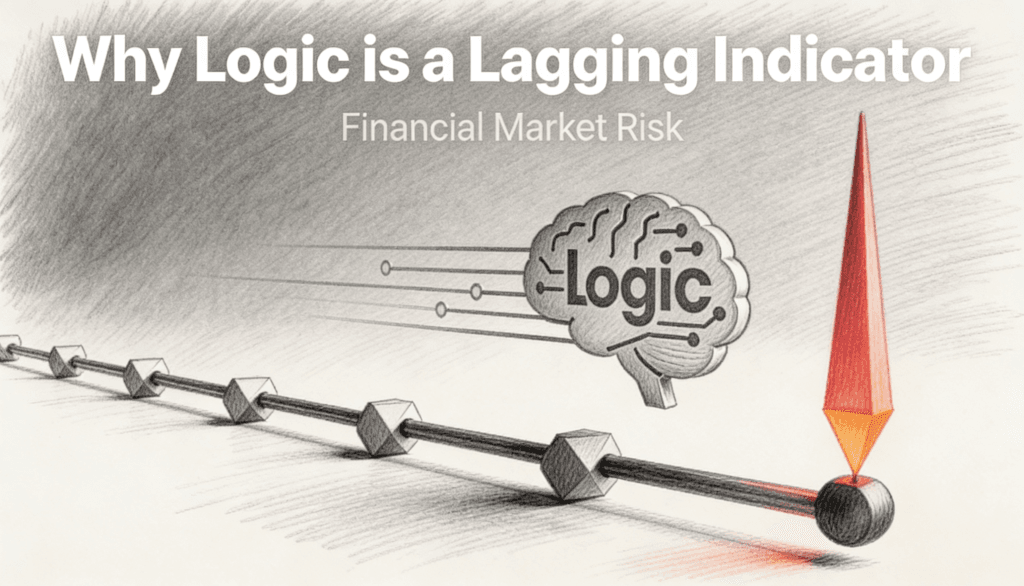
This is not a failure of intelligence. It is a feature of how logic actually operates in environments shaped by uncertainty. Logic is a lagging indicator. It arrives after the pattern has already formed, dressed in a suit, carrying a clipboard, ready to explain what just happened as if it knew all along.
Understanding this does not mean abandoning reason. It means understanding where reason sits in the timeline of events and why that position matters more than most investors ever consider.
The Rearview Mirror Problem
Logic depends on information. Information depends on events. Events depend on countless variables that no model fully captures. By the time you have enough data to construct a rational case for something, the thing has usually already started moving.
Think about how narratives form around stocks, sectors, or entire economies. A company reports three strong quarters in a row. Analysts upgrade. The financial press writes glowing profiles. A logical case emerges. But the move began long before the case was built. The early movers were not operating on logic. They were operating on pattern recognition, intuition, positioning, or sometimes just luck that later got dressed up as foresight.
The logical investor shows up to the party when the music is loudest, convinced they arrived early because the invitation looked fresh.
This is not cynicism. It is observation. And it reveals something important about the relationship between reason and timing. Logic is a tool for justification far more often than it is a tool for anticipation. It excels at making sense of the past and struggles with the future, because the future does not owe your spreadsheet anything.
Why We Worship Reason Anyway
There is a deep human need to feel that decisions are grounded in something solid. Randomness is terrifying. The idea that outcomes might be largely independent of the quality of your reasoning is almost unbearable for anyone who has spent years sharpening their analytical skills.
So we build frameworks. We backtest. We create mental models that give us the feeling of control in systems that are fundamentally resistant to control. And here is the uncomfortable part: the frameworks often work just well enough to keep us believing in them. A strategy that succeeds 55% of the time feels like genius if you do not track the 45% too closely.
Daniel Kahneman spent decades showing that human beings are spectacularly bad at distinguishing between a good process and a lucky outcome. We reverse engineer logic from results. The trade worked, so the thesis must have been sound. The trade failed, so something external interfered with what should have happened.
This is not investing. This is mythology with a Bloomberg terminal.
The Surgeon and the Investor
Consider a surgeon. She operates in a domain where logic is a leading indicator. If she cuts precisely, avoids the artery, follows the procedure, the patient lives. Cause and effect are tightly coupled. Skill and outcome are closely linked. More logic, more preparation, better results.
Now consider an investor making a bet on emerging market debt. He has read every report. He understands the fiscal dynamics, the political risks, the currency exposure. His logic is impeccable. Then a central banker in a country he was not even watching makes a surprise announcement, triggering a contagion effect that wipes out his position in forty eight hours.
The surgeon operates in a complicated system. The investor operates in a complex one. This distinction, borrowed from systems theory, matters enormously. In complicated systems, more analysis yields better outcomes. In complex systems, more analysis yields more confidence, which is not the same thing. And the gap between confidence and accuracy is where fortunes go to die.
The Paradox of Due Diligence
Nobody would argue against doing your homework. Research matters. Understanding what you own matters. But there is a shadow side to thoroughness that rarely gets discussed.
The more work you put into a thesis, the harder it becomes to abandon it. This is the sunk cost fallacy wearing a lab coat. You have invested not just money but identity into the position. Your logic becomes a prison because leaving it means admitting that all that careful reasoning was, at best, incomplete. At worst, irrelevant.
Some of the most spectacular blowups in financial history came from people who were too smart and too thorough for their own good. Long Term Capital Management was not staffed by amateurs. It was staffed by Nobel laureates. Their models were elegant. Their logic was airtight. And the market did not care, because markets are not debates. You do not win by having the better argument. You win by being positioned for what actually happens.
There is a strange irony here. The person who does less research but sizes their position conservatively and maintains the flexibility to be wrong often outperforms the person who does exhaustive research and then bets heavily because they are so certain. Conviction is just risk you are confident about.
What Actually Leads
If logic lags, what leads? This is where things get uncomfortable for the analytically minded, because the honest answer is: nothing leads reliably.
But some things lead more often than others. Sentiment leads. Liquidity leads. Positioning leads. The flow of money often moves before the reasons for that flow become apparent. By the time you can articulate why capital is moving in a particular direction, the move is often mature.
This is why some of the most successful investors describe their process in ways that sound almost unscientific. George Soros famously talked about feeling physical discomfort when his portfolio was wrong. That is not a rigorous methodology. But it points to something real: the body and the subconscious often process information faster than the conscious, logical mind. Pattern recognition happens below the surface. The narrative comes later.
This does not mean you should trade on backaches. But it does mean that the hierarchy most people assume, where logic sits at the top and everything else is noise, is probably inverted. Logic is the narrator, not the protagonist. It explains the story. It does not write it.
Living With the Lag
So what do you do with this understanding? You do not throw away your models. You do not stop reading annual reports. You do not start making decisions by coin flip.
You do something harder. You hold your conclusions loosely. You build systems that do not require you to be right about the future. You size your bets in a way that acknowledges you are probably wrong about something important, even if you cannot identify what that something is.
You treat logic as one input among many rather than the final word. You pay attention to what is happening before you can explain why it is happening. You develop comfort with the phrase “I do not know,” which is possibly the most valuable sentence in investing and almost certainly the least spoken.
Most importantly, you stop confusing the map with the territory. Your model of reality is not reality. It is a simplification that helps you navigate, and simplifications break precisely when navigation matters most.
The Punchline
Logic is beautiful. It is clarifying. It is essential for post-mortem analysis and process improvement. But it is not prophetic, and treating it as prophecy is the quiet error behind countless confident, well-reasoned, catastrophically wrong decisions.
The best relationship with logic is a humble one. Use it. Respect it. But do not mistake it for a crystal ball just because it happens to be very good at explaining yesterday.
Markets do not reward the best thinkers. They reward the best adapters. And adapting requires something logic alone cannot provide: the willingness to update faster than your ego would prefer.
That is not a comfortable truth. But comfort and truth have never been especially close friends.