Table of Contents
There is a certain dark comedy in the phrase “pump and dump.” It sounds like something you would do with a flat tire or a bad relationship. Instead, it describes one of the oldest and most reliable methods for separating people from their money. Not your money, of course. You are too smart for that. Everyone is, right up until they are not.
Let us walk through the mechanics of how these schemes work, why they keep working, and what they reveal about the strange relationship between human psychology and money.
The Basic Recipe
A pump and dump scheme operates on a principle so simple it is almost insulting. Someone buys a large amount of a cheap, obscure asset. They then create excitement around that asset through promotion, hype, misleading claims, or outright lies. As new buyers rush in, the price rises. Once it climbs high enough, the original buyer sells everything. The price collapses. The latecomers are left holding something worth a fraction of what they paid.
That is it. There is no secret algorithm. No complex financial engineering. The entire operation runs on one fuel source: the gap between what people believe and what is actually true.
What makes this worth examining is not the scheme itself but the ecosystem that allows it to thrive. Because pump and dumps are not a bug in financial markets. They are a feature of how humans process information under uncertainty.
Step One: Find Something Nobody Cares About
The first requirement is an asset that trades thinly. This means few people are buying or selling it on any given day. Penny stocks have historically been the vehicle of choice. These are shares of tiny companies that trade for cents or single digit dollars, often on exchanges with minimal oversight.
Why does obscurity matter? Because price is a conversation. In a heavily traded stock like Apple or Toyota, millions of participants are constantly arguing about what the company is worth. That argument creates stability. It is hard to move the price dramatically because there are too many voices in the room.
But in a stock that trades a few thousand shares a day? One loud voice can dominate the entire conversation. A relatively small amount of money can move the price significantly. This is the equivalent of walking into an empty theater and shouting “fire.” In a packed stadium, nobody hears you. In a room with twelve people, you create a stampede.
The cryptocurrency era expanded this playbook enormously. Suddenly there were thousands of new tokens with no earnings, no employees, no offices, and no purpose beyond existing on a blockchain. Many had market values small enough that a single motivated actor could meaningfully influence the price. It was penny stocks on caffeine.
Step Two: Tell a Story
Here is where things get interesting from a psychological standpoint. The pump phase is not really about finance. It is about narrative.
Human beings are storytelling animals. We do not buy things because of spreadsheets. We buy things because of stories. And the best pump and dump operators understand this instinctively, even if they have never read a page of behavioral economics.
The story usually follows a template. There is a revolutionary technology. Or an undiscovered resource. Or a partnership with a major company that is about to be announced. The details vary but the structure is always the same: this is your chance to get in before everyone else figures it out.
That last part is the key. The scheme does not just sell greed. It sells the feeling of being smarter than the crowd. This is a much more potent drug than simple greed because it flatters the ego at the same time it empties the wallet.
Consider what happens in the target’s mind. They encounter information suggesting a particular stock is about to explode in value. They look at the chart and see the price already climbing. This confirms the story. They tell themselves they are not gambling. They are making an informed decision based on evidence. The price movement IS the evidence.
Step Three: Leave
The dump is the least interesting part mechanically but the most revealing psychologically. The promoter sells. The price drops. And then something fascinating happens.
Many of the victims do not sell.
This seems irrational. The price is collapsing. The smart move is to cut losses. But people hold on, sometimes for weeks or months, watching their investment shrink further. Why?
Because selling means admitting the story was wrong. And admitting the story was wrong means admitting they were fooled. The financial loss is painful but the ego loss is worse. So they hold, telling themselves the price will recover, that this is just a temporary dip, that the fundamentals have not changed.
The fundamentals, of course, never existed. But abandoning the narrative requires a psychological cost that many people simply refuse to pay. They would rather lose more money than lose face, even if the only person they are losing face to is themselves.
This is not stupidity. This is a deeply human response to a situation where two types of pain compete, and the brain chooses the one that preserves its self image. Behavioral economists call it the disposition effect. Poker players call it being “married to a hand.” Whatever you call it, it is the final mechanism that ensures the damage is as complete as possible.
Why Smart People Fall for Dumb Schemes
There is a comforting myth that pump and dump victims are unsophisticated investors who do not know any better.
A novice investor might hesitate because they do not understand the opportunity. An experienced investor recognizes the pattern of a good opportunity because they have seen real ones before. The pump mimics the early stages of a legitimate price discovery process so effectively that pattern recognition becomes a liability rather than an asset.
It is like being an experienced mushroom forager. Your expertise lets you identify dozens of edible species at a glance. But the most dangerous mushrooms are dangerous precisely because they look so much like the safe ones. Your confidence becomes the risk.
There is also a social dimension that makes educated investors more vulnerable in certain contexts. If you pride yourself on being financially literate, you are less likely to seek a second opinion. You are less likely to say “I do not understand this” because you have built an identity around understanding these things. The scheme exploits not ignorance but the unwillingness to appear ignorant.
The Role of Technology
Every generation gets the pump and dump it deserves. In the 1920s, it was bucket shops and tip sheets. In the 1990s, it was email spam and message boards. In the 2010s and 2020s, it was social media, Discord servers, and influencer endorsements.
The technology changes but the human operating system does not. What technology does change is the speed and scale. A boiler room operation in the 1980s might reach a few hundred victims. A viral TikTok video can reach millions in hours. The compression of time means that the entire lifecycle of a pump and dump, from setup to collapse, can happen in a single day.
This speed creates an additional psychological trap. When you have days or weeks to make a decision, you might research. When you see a price doubling in real time and your social media feed is full of people celebrating their gains, the pressure to act immediately overwhelms the impulse to think carefully. The fear of missing out is not just an emotion. It is a timer counting down in your head, and every second you wait feels like money evaporating.
What the Regulators Face
Enforcement against pump and dump schemes is a bit like playing whack a mole on an infinite field. Regulators are typically resourced to investigate schemes after they have already collapsed. The victims have already lost their money. The promoters, if they are identified at all, may be in jurisdictions where cooperation with investigators is optional.
The shift to cryptocurrency made this worse because many tokens exist in regulatory grey areas. Is a particular token a security? A commodity? A collectible? While lawyers and legislators debate these categories, promoters operate in the gaps.
There is also an uncomfortable truth that regulators rarely state publicly. Many pump and dump schemes technically begin with legal activity. Buying a stock is legal. Talking about a stock you own is legal. Selling a stock is legal. The illegality lives in the intent and in the specific nature of the misleading statements. Proving what someone intended when they posted a rocket emoji next to a ticker symbol is, to put it gently, a prosecutorial challenge.
The Deeper Lesson
Strip away the financial mechanics and a pump and dump scheme is really a lesson in epistemology. How do you know what you think you know? And how much of your confidence comes from the thing itself versus the social signals surrounding it?
When you see a stock price rising, you are not observing a fact about the company. You are observing the behavior of other market participants. When those participants are acting on genuine information, the price signal is useful. When they are acting on manufactured hype, the price signal is noise disguised as data.
The difficulty is that the signal and the noise look identical in real time. You can only tell them apart after the fact. This is the fundamental asymmetry that pump and dump schemes exploit, and it is the same asymmetry that makes financial markets both useful and dangerous.
So how do you protect yourself? The honest answer is less satisfying than the internet would like it to be. There is no checklist that guarantees safety. But there are questions worth asking.
Why am I hearing about this? If an investment opportunity is genuinely exceptional, why is it being promoted to strangers on the internet rather than quietly accumulated by those who discovered it? Good investment ideas do not need marketing departments.
What is the source of urgency? Legitimate investments do not expire like grocery store coupons. If you feel pressure to act immediately, that pressure is almost certainly engineered.
Would I be interested in this if the price had not moved? If your entire thesis depends on recent price action, you are not analyzing. You are reacting. These are different activities.
Am I trying to be smart, or am I trying to be right? These sound like the same thing but they are not. Being smart means making decisions that impress people, including yourself. Being right means making decisions that survive contact with reality. The pump and dump is designed to reward the first impulse and punish the second.
Closing Thought
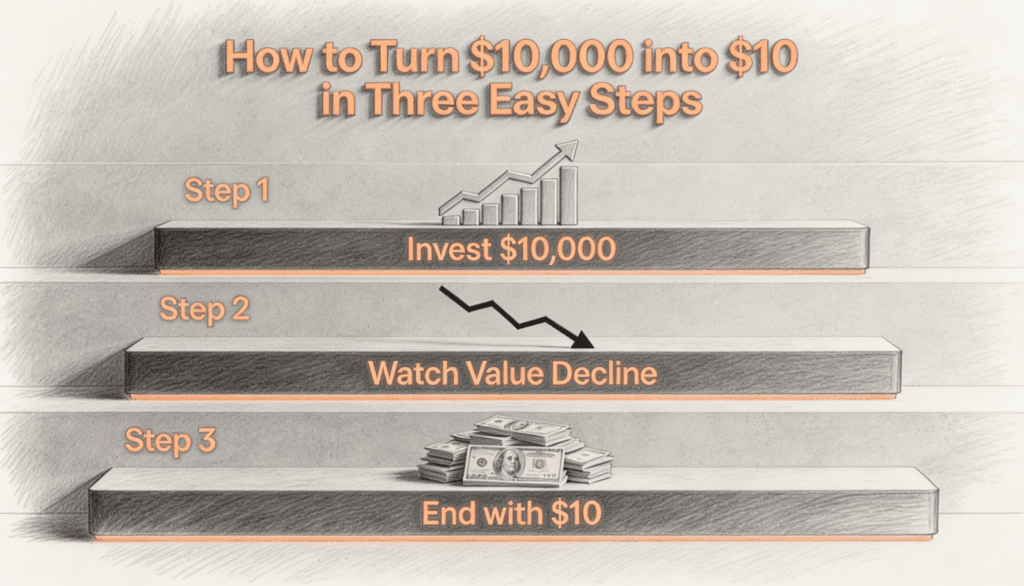
The title of this article promises to teach you how to turn $10,000 into $10 in three easy steps. The real joke, if you can call it that, is that nobody sets out to do this. Every person who loses money in a pump and dump scheme was trying to do the opposite. They were trying to turn $10,000 into $100,000.
The distance between those two outcomes is not intelligence, or education, or even information. It is the willingness to sit with uncertainty, to resist narratives that feel too clean, and to accept that the most dangerous investment advice is the kind that makes you feel like you already knew it all along.
That might not be as exciting as a hot stock tip. But your $10,000 will thank you for the boredom.