Table of Contents
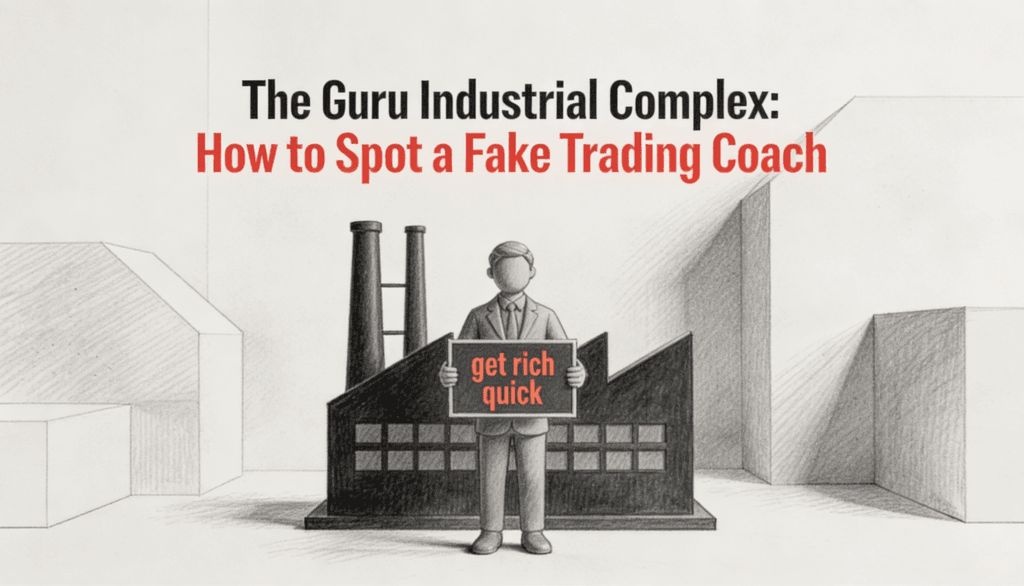
There is a particular kind of person who has never consistently made money in the markets but has figured out how to make a fortune teaching others to do what they themselves cannot. This is not a bug in the system. It is the system.
Welcome to the guru industrial complex, where the product is confidence and the customer is confusion.
The Oldest Trick in a New Costume
During the California Gold Rush of 1849, the people who made the most reliable money were not the miners. They were the ones selling pickaxes, shovels, and denim pants. Levi Strauss did not pan for gold. He sold pants to the people who did. This is not a metaphor for trading gurus. It is a literal description of their business model.
The fake trading coach does not need to trade well. They need to teach well, or more precisely, they need to perform well. The distinction matters. A good teacher helps you understand something. A good performer helps you feel something. And in the world of retail trading, feelings sell subscriptions.
The modern version of this is a person with a rented Lamborghini, a screen showing green candles, and a webinar funnel that would make a Silicon Valley growth hacker weep with admiration. The gold is not in the ground. The gold is you.
Why the Market for Fake Expertise Exists
Before we sharpen our pitchforks, it is worth asking a genuinely uncomfortable question: why does this market exist at all?
The answer sits at the intersection of two forces. First, financial literacy in most countries is embarrassingly low. Schools teach quadratic equations but not how a credit card works. People arrive at adulthood financially illiterate and then encounter markets that are complex, volatile, and designed by people with physics PhDs. The knowledge gap is enormous.
Second, legitimate financial education is boring. It tells you to diversify, think long term, and keep your costs low. Nobody has ever gone viral saying “buy an index fund and wait 30 years.” That is like telling someone the secret to a great body is eating vegetables and sleeping eight hours. It is true. It is also terrible content.
Into this gap walks the guru, offering excitement dressed up as education. They fill the vacuum that schools and institutions left behind, and they do it with the production value of a Netflix documentary. The demand is real. The supply is just fraudulent.
The Anatomy of a Fake Trading Coach
Spotting a fake guru is not about any single red flag. It is about recognizing a pattern, a constellation of behaviors that, taken together, paint a very specific picture.
They sell the lifestyle, not the strategy. Real expertise is boring to display. A genuine quantitative trader’s screen looks like a spreadsheet having an existential crisis. A fake guru’s screen looks like a video game. When someone spends more time showing you their car than their risk management framework, you are watching an advertisement, not a lesson.
Their track record is a highlight reel. Everyone who has ever traded has winning trades. Even a broken clock is right twice a day, and even a random strategy will produce occasional spectacular returns. The question is never “have you made money?” The question is “have you made money consistently, over years, adjusted for the risk you took?” A screenshot of a single winning trade proves nothing. A verified, audited, multi year track record proves everything. Notice which one the gurus show you.
They create urgency where none exists. The markets will be open tomorrow. They will be open next week. They will be open next year. There is no rush to learn, no limited time offer on financial knowledge. When someone tells you that you must join their course right now or miss out forever, they are using scarcity tactics borrowed from mattress sales. The S&P 500 does not care about your enrollment deadline.
They make it sound easy. This might be the most reliable indicator of all. Trading is genuinely difficult. The majority of active traders lose money. This is not opinion. It is statistical fact replicated across every market and every time period ever studied. Anyone who presents trading as simple, intuitive, or easy to master is either lying or delusional. Neither quality is ideal in a teacher.
The Psychology They Exploit
The guru industrial complex runs on a fuel that psychologists have studied for decades: the Dunning Kruger effect meets survivorship bias, wrapped in a layer of confirmation bias.
Here is how it works in practice. A new trader knows nothing, which paradoxically makes them confident because they do not yet understand how much they do not know. The guru validates this confidence. “You can do this,” they say. “The institutions do not want you to know these secrets.” This framing is intoxicating. It transforms ignorance from a problem into a virtue, from something to fix into proof that you are an outsider who just needs the right key.
Then comes the survivorship bias. The guru shows you testimonials from students who made money. They do not show you the hundreds who lost their savings. This is like evaluating skydiving safety by only interviewing people who survived.
Finally, confirmation bias seals the deal. Once someone has paid for a course, they are psychologically invested in believing it works. They notice the wins and forget the losses. They attribute success to the system and failure to their own execution. The guru’s product is, in a strange way, unfalsifiable. If you win, the course worked. If you lose, you did not follow it correctly.
This is a neat trick. It is also the exact structure of every belief system that resists scrutiny.
The Credentials Question
Here is where things get interesting and somewhat counterintuitive. Having legitimate credentials does not make someone a good trading coach. And lacking credentials does not automatically make someone a fraud.
Some of the best traders in history had no formal financial education. Some of the worst investment advice has come from people with impressive degrees and institutional pedigrees. The 2008 financial crisis was not caused by amateurs on YouTube. It was engineered by credentialed professionals at the most prestigious firms on the planet.
So credentials alone are not the filter. What matters is verifiable performance. Can this person demonstrate, with independent verification, that they have actually done what they claim to teach? Not once. Not in a screenshot. Over years. With drawdowns included. With losing periods visible.
The uncomfortable truth is that most people who are genuinely good at trading do not teach, because the money is better in trading. This does not mean all teachers are frauds. But it does mean you should ask a pointed question: why is this person teaching instead of trading? Sometimes the answer is legitimate. They enjoy teaching. They have enough wealth and want to give back. They are building a media business alongside their trading. All reasonable.
But sometimes the answer is simpler and less flattering. They teach because they cannot trade.
The Language of Deception
Fake gurus have developed a vocabulary that sounds technical but communicates nothing. Listen for these patterns.
Vague claims of proprietary methods. “My system” or “my strategy” without any specificity is a red flag. Real strategies can be described in concrete terms. Moving average crossovers, mean reversion, momentum factor investing. These are real things with real definitions. “My secret sauce” is not.
Conspiracy framing. “The banks do not want you to know this.” “Wall Street is rigged against retail traders.” There are legitimate criticisms of market structure and institutional advantages. But when someone uses conspiracy language to position their $297 course as the antidote to systemic oppression, they are selling a narrative, not a strategy.
False precision. “This setup has a 94.7% win rate.” Really? Over how many trades? In what market conditions? With what position sizing? Over what time period? Precise numbers without context are not data. They are decoration.
How to Actually Find Good Financial Education
The irony of the guru industrial complex is that genuinely useful financial education is mostly free. Not cheap. Free.
University lectures on finance are available on YouTube. The SEC publishes guides on investing basics. Books by people like Burton Malkiel, John Bogle, and Morgan Housel cost less than a single month of most guru subscriptions and contain more actionable wisdom than entire course libraries.
The problem is that good financial education does not feel exciting. It tells you that most people should not trade actively. It tells you that the most important financial decisions are about savings rate and time horizon, not about chart patterns. It tells you that the vast majority of professional fund managers cannot beat the market, so what makes you think a course will help you do it?
This is not what people want to hear. But it is what they need to hear.
If you do want to learn active trading, look for people who publish verified track records through third party services. Look for people who talk about their losses as much as their wins. Look for people who tell you it is hard, that most people fail, and that you should start with money you can genuinely afford to lose. The honest teacher is the one who occasionally talks you out of trading.
The Deeper Problem
The guru industrial complex is ultimately a symptom of a larger failure. When societies do not teach financial literacy, they create a vacuum. When that vacuum gets filled by entertainers pretending to be educators, the result is a transfer of wealth from the financially vulnerable to the financially cynical.
This is not just a consumer protection issue. It is an education issue, a regulation issue, and frankly, a cultural issue. We have built a world where “financial advisor” requires licensing but “trading coach” requires nothing more than an internet connection and a ring light.
The people most harmed by fake gurus are not wealthy hobbyists looking for an edge. They are people who genuinely need financial knowledge. People with small savings looking for a way out. People who trust that expertise is being offered when entertainment is being sold.
The best defense is not cynicism. It is literacy. Learn enough about markets to recognize when someone is saying nothing with great confidence. Learn enough about psychology to recognize when your own desires are being weaponized against you. Learn enough about incentives to always ask the one question that fake gurus cannot answer honestly.
Where does your money actually come from?
If the answer is “from teaching people to trade” and not “from trading,” you have learned everything you need to know.