Table of Contents
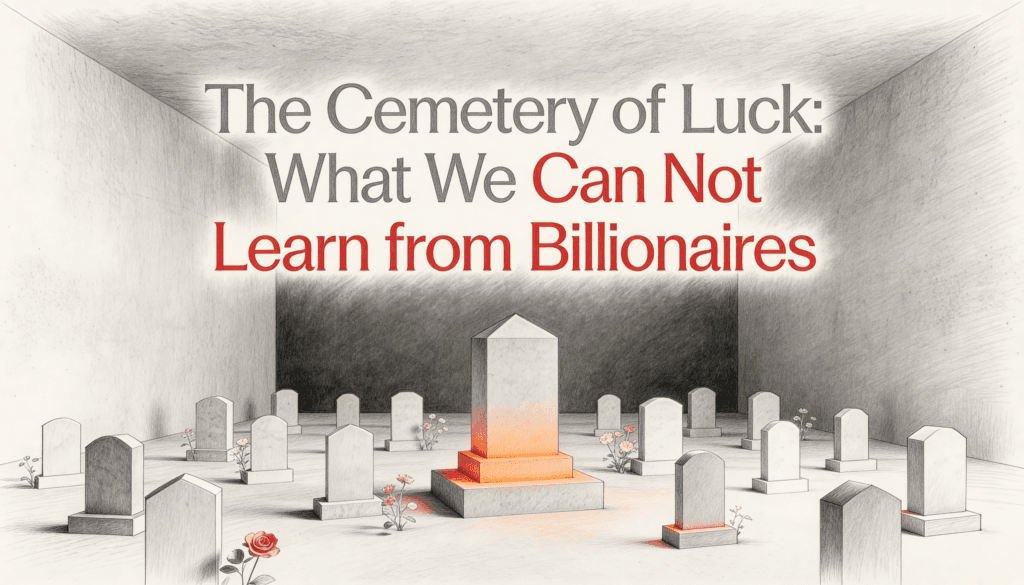
There is a graveyard no one visits. It has no headstones, no flowers, no mourners. It is filled with people who did everything right and still lost. People who were just as smart as Warren Buffett, just as bold as Elon Musk, just as visionary as Steve Jobs. You have never heard of them. That is the point.
Every year, a new crop of books hits the shelves promising to decode the habits, routines, and mindsets of the ultra successful. Wake up at 5 AM. Read fifty books a year. Take cold showers. Meditate. Say no to almost everything. The implication is always the same: do what they did and you will get what they got.
This is one of the most dangerous ideas in modern culture. And it survives because the dead do not write memoirs.
The Graveyard You Will Never See
The concept comes from Nassim Taleb, who borrowed it from ancient history. The Romans had a term for it. Cicero told the story of Diagoras, who was shown painted portraits of people who prayed to the gods and survived a shipwreck. “See,” he was told, “look at all those who were saved by prayer.” Diagoras asked the obvious question. Where are the portraits of those who prayed and drowned?
This is survivorship bias, and while the term gets thrown around casually now, most people have not actually internalized what it means. It is not just a statistical error. It is a philosophical problem about how humans construct meaning from incomplete evidence. We look at winners and reverse engineer their success into a recipe. But the recipe is missing its most important ingredient: many people who followed the same recipe and ended up with nothing.
Think of it like studying only the lottery winners to understand how to pick numbers. You would notice patterns. Maybe several of them bought tickets on Tuesdays. Maybe they all used birthdays. You could write a very convincing book about it. The book would be useless.
The Narrative Machine
Humans are storytelling animals. We can not help it. When we see an outcome, we instinctively search backward for causes. This is useful when the relationship between action and outcome is tight and repeatable. Touch a hot stove, get burned. That cause and effect chain is reliable. You can learn from it.
But wealth creation does not work like a hot stove. It operates in a domain where the relationship between action and outcome is loose, delayed, noisy, and mediated by forces completely outside anyone’s control. Interest rate changes. Regulatory shifts. A pandemic. A competitor who happens to stumble at exactly the right moment. The neighbor who introduced you to the investor at a barbecue.
When billionaires tell their stories, they do what all of us do. They create coherent narratives. They connect dots that were not actually connected at the time. Jeff Bezos will tell you he saw the potential of the internet early. He will not tell you about the hundreds of other people who saw the same potential, started similar companies, and failed. Not because they were dumber. Because the wind blew a different direction that day.
Risk Is Not What You Think It Is
Here is where things get genuinely interesting. Most people think of risk as the probability of something bad happening. That is half the picture. Risk also includes the magnitude of what happens when things go wrong. And in many domains that produce enormous wealth, the magnitude is total.
Consider venture capital. The standard model is that most investments fail. A few do okay. One or two return the entire fund many times over. Venture capitalists know this. They build their entire strategy around it. But here is the part that rarely gets discussed: the founders on the losing end of those bets often used the same playbooks, had similar credentials, and worked just as hard as the ones who succeeded.
The difference was frequently not skill. It was timing, market readiness, or which journalist happened to write about them that week.
This creates what you might call an asymmetry of attribution. When things go well, we credit the individual. When things go badly, we blame circumstances. The billionaire was a genius. The bankrupt founder was unlucky. But often they were the same type of person facing the same type of odds, and the coin just landed differently.
The Dangerous Advice Industry
So what happens when you build an entire industry around studying the survivors? You get advice that is confidently wrong.
You get told to drop out of college because Gates, Zuckerberg, and Jobs did. Nobody mentions the millions of dropouts working jobs they hate. You get told to take massive risks because the billionaires took massive risks. Nobody lines up the people who took the same risks and lost their homes.
There is a particularly cruel irony here. The advice industry sells certainty to people who are living in uncertainty. It says: follow these steps. But the steps were extracted from a sample that was filtered by an outcome. It is like studying the traits of people who survived being struck by lightning and concluding that those traits are what saved them.
The fitness industry has a milder version of the same problem. The person with perfect genetics who works out becomes a fitness influencer. The person with different genetics who does the same workout gets mediocre results and quits. Then the influencer sells a program based on what worked for them. This is not malice. It is genuine ignorance about the role their biology played.
Scale that up to finance and the stakes become enormous.
What the Cemetery Actually Teaches
If we can not learn from billionaires, what can we learn? Oddly enough, the cemetery itself is the lesson.
First, it teaches humility about outcomes. Not the false humility of billionaires who say “I was lucky” while clearly believing they were not. Real humility. The kind that acknowledges your career, your portfolio, your business might be going well partly because of forces you did not choose and can not replicate.
Second, it teaches you to focus on process rather than outcomes. This is the single most important inversion in thinking about risk. You can not control outcomes. You can control your process. A poker player who makes the mathematically correct call and loses is still a good poker player. A poker player who makes a terrible call and wins is still a bad one. In the short run, results are noisy. Over time, process wins.
Third, it teaches you to think about survival first. This is something the billionaire advice books almost never discuss, because survivors do not think much about survival. They think about winning. But in any domain with high variance, the primary goal should be staying in the game long enough for your process to play out. You can not compound returns if you go to zero. You can not build a business if you bet everything on one product launch and it fails.
The Uncomfortable Middle
Here is the part most writers leave out because it does not sell books. The real path to financial resilience is boring. It is not dramatic. It does not make for a good podcast appearance.
It looks like saving consistently. Diversifying. Avoiding catastrophic losses. Not quitting your job to start a company unless you have a genuine edge and a safety net. Not putting your life savings into a single stock because someone on the internet said it was going to the moon.
Nobody gets famous for this. There will never be a bestselling book called “How I Earned Moderate Returns Consistently Over Thirty Years By Not Doing Anything Stupid.” But that book would be more honest and more useful than almost everything in the business section of your local bookstore.
The cemetery of luck is filled with people who swung for the fences. Some of them were brilliant. Some of them worked harder than anyone you know. The ones who survived and thrived are the ones standing on stage telling you to swing for the fences too. They do not mention the graveyard behind them because they genuinely do not see it.
What We Owe the Invisible
Perhaps the most philosophical dimension of all this is what it says about how we assign worth. We live in a culture that treats wealth as evidence of virtue. If you are rich, you must have done something right. If you are not, you must have done something wrong. This is a comforting story for the wealthy and a punishing one for everyone else.
But if a significant portion of extreme outcomes is driven by variance rather than skill, then our entire moral framework around wealth needs examination. We are not saying skill does not matter. It does. Preparation matters. Hard work matters. Good decisions matter. But they matter the way buying a lottery ticket matters. It is a necessary condition, not a sufficient one.
The honest position is uncomfortable. It means sitting with the idea that you might do everything right and still not get the outcome you want. It means the billionaire might have done a few things right and gotten an outcome wildly disproportionate to their input. It means the world is less fair and less legible than we want it to be.
But there is freedom in that discomfort. If outcomes are partly random, then you are released from the tyranny of comparing yourself to people whose results you could never have replicated anyway. You can focus on what you can control. You can play the long game. You can stay in the game.
The cemetery of luck will never be a tourist attraction. But understanding that it exists might be the most valuable financial insight you will ever encounter. Not because it tells you what to do. Because it tells you what not to believe.