Table of Contents
There is an old joke among traders that the carry trade works beautifully until it does not. It is the financial equivalent of picking up nickels in front of a steamroller, a strategy mocked for its apparent simplicity and feared for its occasional cruelty. And yet, despite the warnings, despite the blowups, despite the academic papers warning of fat tails and skewed distributions, the carry trade remains one of the most persistent and quietly profitable strategies in global markets. It refuses to die. More interestingly, when used with intention rather than greed, it can act as something almost no one credits it for being: a stabilizer.
This is the part most investors miss. The carry trade is treated as a speculative bet, a tool for hedge funds and macro traders chasing yield differentials between currencies, bonds, or commodities. But when you zoom out and view it as a structural component of a portfolio rather than a standalone wager, something interesting happens. It begins to behave less like a gamble and more like an income engine that hums quietly in the background, smoothing returns during the long stretches when markets do nothing dramatic. Which, if we are honest, is most of the time.
The Misunderstood Nature of Carry
Before going further, it helps to strip the concept down. A carry trade, in its purest form, is borrowing something cheap and owning something that pays more. You finance a position at a low cost and collect the difference. That difference is the carry. It can be the interest rate gap between the Japanese yen and the Mexican peso. It can be the spread between short term Treasuries and high yield corporate bonds. The form changes, but the spirit is the same. You are getting paid to wait.
The reason this strategy gets a bad reputation has less to do with the strategy itself and more to do with how people use it. Leverage is the usual culprit. When traders pile on borrowed money to amplify a small spread into a large gain, they also amplify the small loss into a portfolio ending event. The 2008 unwinding of the yen carry trade was not a failure of carry as a concept. It was a failure of restraint. There is a meaningful difference between collecting rent and betting the house.
Once you separate the structure from the abuse, carry reveals itself as something more useful. It is a way to generate return from time rather than from price movement. Most investments rely on something happening. A stock must go up. An idea must be validated by the market. Carry, in contrast, makes money when nothing happens. It is the rare strategy that rewards boredom.
Why Stability Comes From Unlikely Places
Investors tend to look for stability in obvious places. Government bonds. Cash. Gold. Defensive sectors. These assets share a common trait, which is that they are expected to either hold their value or appreciate when other things fall apart. The problem is that everyone knows this, and so these assets are usually expensive precisely when you need them, and they often disappoint precisely when you reach for them. The 2022 bond market collapse was a polite reminder that the things we call safe are only safe under specific conditions.
Carry trades, paradoxically, offer a different kind of stability. Not the stability of preserving capital during a panic, but the stability of producing return when nothing else is. They smooth the long flat stretches between crises. They turn the dull periods, which make up the majority of any investing lifetime, into productive ones. And in doing so, they reduce the psychological pressure that pushes investors into bad decisions during quiet markets, when boredom and underperformance start to feel like the same thing.
This is the underappreciated psychological dimension of carry. The reason most portfolios underperform is not because investors fail to pick the right assets. It is because they cannot sit still. They watch a flat market for three quarters and decide they need to do something. They chase a hot sector, they sell their winners too early, they buy a story that turns out to be fiction. A portfolio that quietly earns yield in the background gives the investor permission to do nothing, which is often the most valuable thing a strategy can do.
The Counterintuitive Diversification
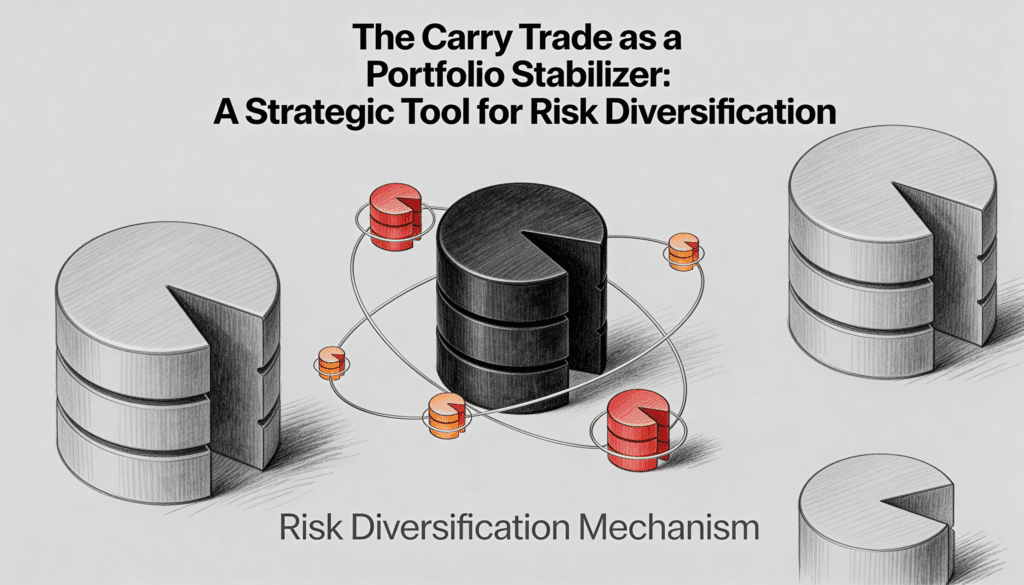
There is a peculiar feature of carry trades that does not get enough attention. When constructed thoughtfully across different asset classes, they tend to have low correlations with each other and with traditional risk assets. A currency carry strategy does not behave like an equity portfolio. A commodity carry does not behave like a credit carry. A volatility carry, which involves selling insurance against market swings, has its own rhythm entirely.
This means a diversified basket of carry trades can produce a return stream that looks almost nothing like the stock market or the bond market. For an investor whose entire wealth rises and falls with the broader economy, that is a powerful thing. It is not a hedge in the traditional sense. It will not save you in a crash. But it gives the portfolio a second engine, one that runs on a different fuel. And when one engine sputters, the other can keep the plane in the air.
The Hidden Cost of Avoiding Carry
Most retail investors avoid carry trades entirely, often without realizing it. They hold cash that earns less than inflation. They hold long duration bonds without thinking about the shape of the yield curve. They hold equity indices without understanding that part of their return comes from a form of carry, namely the dividend yield earned for holding a basket of cash producing businesses. The carry is everywhere, but the explicit harvesting of it is rare.
This avoidance has a cost. The investor who refuses to think in terms of carry leaves money on the table during the quiet periods. They depend entirely on capital appreciation, which is to say they depend entirely on being right about the future direction of prices. Every position becomes a conviction trade. Every loss becomes a referendum on your judgment. The investor who incorporates carry, even modestly, takes some of that pressure off. They are not asking the market to validate their views every quarter. They are asking it only to refrain from blowing up. The bar is lower, and so the disappointment is rarer.
The Strategic Use, Not the Speculative One
The speculator looks at a wide interest rate gap and sees a chance to get rich quickly with borrowed money. The strategist looks at the same gap and sees a long term return enhancer that should be sized to survive the inevitable bad year. The speculator gets headlines. The strategist gets compound returns.
A few principles separate the two approaches. The first is sizing. A carry position should be small enough that its worst plausible loss does not derail the broader portfolio. The second is diversification across types of carry. Currency carry, credit carry, volatility carry, and commodity carry have different drivers and different failure modes. Owning a mix dilutes the risk that any single one detonates. The third is patience. Carry strategies pay off over years, not weeks. The investor who measures them month to month will inevitably abandon them at the worst time, usually right before they recover.
There is a fourth principle that gets less attention but matters most. The carry strategist must respect the regime. Carry trades do well in calm markets and poorly in volatile ones. This is not a flaw. It is a feature. The investor who understands this will reduce exposure when volatility rises and add to it when calm returns. The investor who does not will be the one carrying the largest position into the storm.
The strategy itself is not the source of disaster. The blindness to context is.
A Final Reframing
If there is a single shift in thinking that this article aims to encourage, it is this. Stop seeing the carry trade as a speculation and start seeing it as a structure. A small, disciplined, diversified allocation to carry strategies can act as a stabilizer in ways that traditional defensive assets often cannot. It produces return during the long quiet periods. It diversifies away from the equity and bond markets. It rewards patience in a way that few other strategies do. And perhaps most importantly, it gives the investor a reason to stay calm during the stretches.
The steamroller is still there, of course. It always will be. But the investor who picks up nickels with care, who sizes the position properly, who respects the rhythm of volatility, and who diversifies across the many forms carry can take, will find that the nickels add up to something meaningful. Not glamorous. Not exciting. Just steady. And in a world that confuses excitement with progress, steady is often the most valuable thing a portfolio can offer.