Table of Contents
The Currency That Refuses to Be Categorized
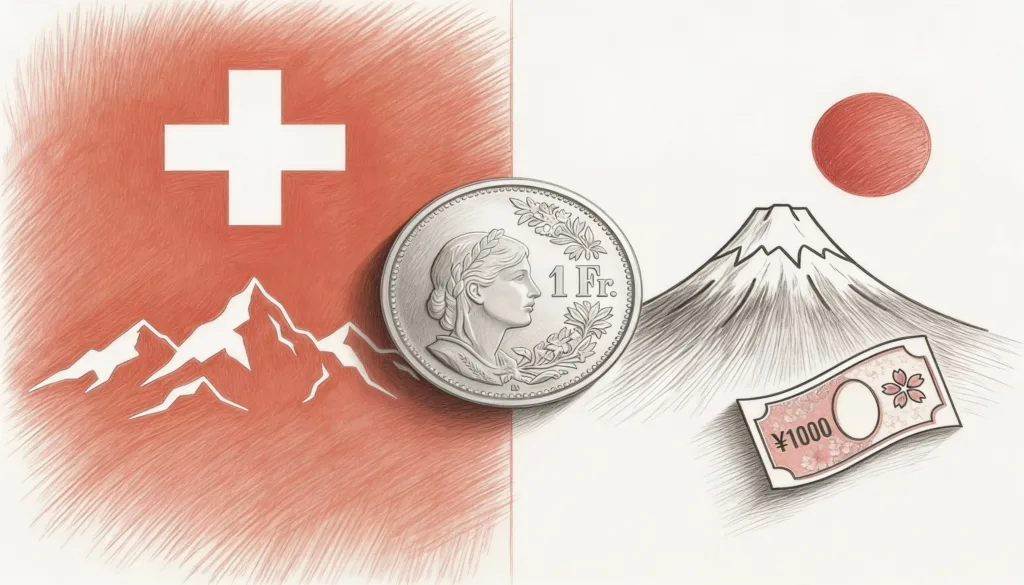
The Swiss franc breaks the rules that govern every other major currency. It functions as a funding currency for carry trades, yet it also serves as one of the world’s premier safe haven currencies, and these two roles should logically cancel each other out. A funding currency is supposed to be the thing you sell. A safe haven is supposed to be the thing you buy. The franc somehow occupies both seats at once, and this contradiction explains behavior that confuses traders who treat it as a simple substitute for the Japanese yen.
If you already understand the mechanics of the yen carry trade, you know the basic choreography. Borrow where money is cheap, deploy where returns are richer, pocket the spread, and pray the funding currency stays weak. The yen has played this role for thirty years with remarkable consistency. The franc looks like a twin from a distance. Low yields, current account surplus, a central bank that fought appreciation for years. But the franc’s dual nature means it follows a script the yen never reads, and the divergence becomes most visible precisely when it matters most: during a crisis.
This piece assumes you have moved past the basics. We are going to examine why the franc can be a funding currency and a safe haven simultaneously, why that duality is structurally stable rather than a temporary anomaly, and what it means for anyone positioning around either currency.
Why the Yen and the Franc Are Not Interchangeable
The financial industry sorts currencies into tidy categories the way a grocer sorts produce. Safe havens go here, high yielders go there, funding currencies fill the bin in between. The yen and the franc usually land in the same bin because they share surface characteristics. Both offer low yields. Both have served as the borrowing leg of carry trades. Both tend to appreciate when global risk appetite collapses.
August 2024 exposed how misleading that classification can be. The Bank of Japan raised rates by a sliver, an amount markets had largely anticipated, and the yen surged with enough force to detonate carry positions across the planet. The unwind was violent, reflexive, and self reinforcing. The franc, meanwhile, strengthened during the same window, but it moved with a different cadence. It rose the way a tide rises, not the way a dam bursts.
That difference is not cosmetic. It reflects two entirely different reasons for appreciation. The yen rose because leverage was being forcibly unwound. The franc rose because capital was actively seeking shelter. One movement was technical and mechanical. The other was fundamental and deliberate. Treating these two currencies as interchangeable funding vehicles ignores the deeper architecture that produces such different crisis behavior.
The Geography Beneath the Money
Money carries the imprint of where it comes from. Switzerland is small, landlocked, mountainous, and historically surrounded by larger powers in conflict. That geography turned the country into a vault. Difficult terrain protected Swiss independence for centuries and nurtured a culture of armed neutrality that allowed the country to provide financial services to all sides while remaining outside their wars. Wealth flowed into Switzerland not because Swiss yields were generous but because Swiss institutions were secure.
Japan’s geography produced the opposite imperative. An island chain poor in natural resources cannot survive without trade. Japan built its modern economy on importing raw materials and exporting finished goods, which required a currency that lubricated exchange rather than one that hoarded value. The yen needed to be liquid, abundant, and useful for transactions. Its role in global finance grew directly from Japan’s identity as a manufacturing and exporting giant.
These origins still echo through every trading session. The franc appreciates because people purchase it for protection. The yen frequently weakens during global expansions because it flows outward to finance trade and investment elsewhere. When the yen does strengthen sharply, the cause is usually the unwinding of accumulated leverage rather than a genuine flight to safety.
The Mechanics of the Franc’s Dual Identity
Here is where the franc separates itself from every textbook funding currency. To understand the duality, you have to look at who supplies franc liquidity and who demands it, because these are different populations acting for different reasons.
The franc functions as a funding currency only at the margin, and only during periods of calm. The Swiss National Bank held interest rates negative for years, which created a window where borrowing francs was genuinely cheap. Speculators used that window. They borrowed francs to fund positions in higher yielding assets, just as they borrowed yen. But the supply of franc funding was always shallower than the supply of yen funding, and the reason reveals everything about the currency’s character.
The yen seeks a home. The franc has already found one. That single distinction explains why one currency funds the world while the other merely shelters it.
Japanese capital is structurally restless. A persistent current account surplus combined with an aging population and decades of near zero domestic yields creates an enormous pool of savings that must be deployed abroad. Japanese life insurers, pension funds, and retail investors cannot simply hold yen cash. They need returns, so they export capital, and that export is the deep wellspring of yen funding. Borrowing yen aligns with what Japan needs to do anyway.
Swiss capital behaves differently. Switzerland also runs a surplus, but its capital is conservative by mandate. The wealth parked in Switzerland is there because it values preservation above return. This capital does not crave yield, which means it does not provide cheap funding eagerly. The result is a thin and conditional funding market. The franc lends only reluctantly, almost as a byproduct of being the place wealth goes to rest.
The Safe Haven Bid That Never Sleeps
Now consider the demand side. The franc’s safe haven status rests on something no central bank can manufacture and no policy can erase: a credible promise of continuity. When eurozone tensions flare, when banking systems wobble, when geopolitical risk climbs, institutions buy francs as insurance. This is portfolio allocation, a deliberate decision, not a forced liquidation.
The franc therefore lives with a permanent latent bid. Even while speculators borrow it during calm periods, a deeper layer of capital stands ready to buy it the moment the world turns dangerous. This is why the dual identity is stable rather than contradictory. The funding role operates on the surface and depends on benign conditions. The safe haven role operates underneath and depends on fear. The two activate at different moments, which is exactly why they coexist.
The yen has no equivalent latent bid of comparable strength. When the yen appreciates in a crisis, the buying comes almost entirely from carry traders scrambling to repay borrowed positions. There is no vast reservoir of capital that wants to own yen purely for safety. The franc rises on demand. The yen rises on the withdrawal of supply.
Two Central Banks Fighting Opposite Battles
Every central bank claims to pursue price stability. The methods diverge wildly, and the Swiss National Bank and the Bank of Japan have spent years fighting battles that mirror each other in reverse.
The SNB spent years trying to weaken its own currency, a strange task for the guardian of a safe haven. It imposed negative interest rates, intervened aggressively in foreign exchange markets, and accumulated a balance sheet swollen with foreign assets. The motive was economic survival. Switzerland exports watches, pharmaceuticals, and precision machinery, and a strong franc makes those products expensive abroad. So the SNB found itself battling the very quality that made the franc desirable.
The market essentially humored the central bank. Traders understood that in a genuine panic, Switzerland would remain Switzerland. The institutions would still function, the neutrality would still hold, and capital would still flow toward safety regardless of where the SNB set rates. The central bank could push against franc strength during calm periods, but it could never abolish the underlying safe haven demand.
The Bank of Japan fought the opposite war. For decades it struggled to manufacture inflation in an economy that seemed allergic to it, deploying ultra low rates, quantitative easing, and yield curve control with escalating creativity. The yen weakened across this stretch, but not because anyone feared Japan. It weakened because Japanese savings were correctly understood to be hunting for returns abroad.
Why Borrowing Francs Always Felt Tense
This is where carry psychology splits cleanly. Borrowing yen felt comfortable because the BOJ appeared committed to zero rates indefinitely and because a weak yen served Japanese exporters. The central bank was not resisting the currency’s use as funding. It was practically endorsing it. Capital outflows were a feature, not a flaw.
Borrowing francs always carried a hum of anxiety. The SNB maintained negative rates reluctantly, fighting market forces that wanted to push the franc higher the entire time. A sudden shift in global sentiment could overwhelm the SNB’s interventions in an afternoon. The central bank was swimming against the tide rather than floating with it. Yen carry trades felt like drifting downstream. Franc carry trades felt like borrowing money from a lender who was visibly unhappy about lending it to you.
How the Two Currencies Behave When Trades Unwind
The true test of any financial relationship arrives when it breaks. Carry trades look elegant until they collapse, and the manner of collapse reveals the essential nature of each currency.
Yen unwinds tend toward the violent because of how positions accumulate. When rates stay pinned at zero for years, leverage piles up. Hedge funds layer on exposure, retail investors in Tokyo buy foreign bonds, and the whole structure becomes top heavy with everyone leaning the same direction. When the underlying assumption cracks, the unwind cascades. Repaying yen loans requires buying yen, which pushes the yen higher, which deepens carry losses, which forces more buying. The polite term is a reflexive loop. The honest term is a stampede.
August 2024 illustrated the dynamic with brutal clarity. The rate hike was tiny and widely expected, yet the yen exploded upward because the position was so enormous that even marginal unwinding moved the market, and because every trader knew every other trader might bolt for the same narrow exit. The first one out does fine. The last one gets crushed.
A trader can often manage a gradual franc appreciation. A yen unwind offers fewer escape routes, because the speed itself overwhelms hedging strategies and shreds the correlation assumptions that made the portfolio look diversified.
Franc movements follow a calmer script. The franc strengthens in crises, but usually with velocity rather than violence. Franc carry positions are smaller to begin with, and the appreciation is driven by deliberate safe haven buying rather than forced deleveraging. The SNB may step in to soften the move, adding a buffer that the yen rarely receives. The flows are large but measured, which gives traders room to hedge, trim, and wait.
The Endgame Each Trade Must Face
Every carry trade lives with one uncomfortable question. How does this position exit gracefully? The yen and franc give completely different answers.
The yen carry trade has always pointed toward a single endgame: Japanese policy normalization. When will the BOJ finally raise rates? For thirty years the answer was “not yet,” but not yet was never the same as never. Traders made a timing bet, watching BOJ communications, inflation prints, and political pressure, hoping to earn enough carry to cover eventual losses and to exit before the discrete event arrived. When normalization finally came, it was a date on a calendar, a knowable trigger to front run.
The franc faces a more existential endgame. What would make Switzerland no longer safe? That question has nothing to do with interest rates and everything to do with the country’s fundamental character changing. Perhaps Swiss neutrality erodes, perhaps European integration absorbs the country, perhaps a crisis overwhelms even Swiss stability. These scenarios feel remote, almost fantastical, which is precisely why the franc remains a haven. There is no policy timetable to anticipate. The franc strengthens whenever the world grows more dangerous, and the world’s capacity to grow more dangerous has no ceiling.
The Policy Coordination Problem
Funding currencies operate inside policy frameworks, and the coordination between monetary and fiscal authorities shapes how each currency behaves under pressure.
Japan has shown a striking degree of alignment between the BOJ and its fiscal authorities. When growth falters, both sides ease together. The BOJ holds rates down and buys bonds while the finance ministry spends. This consensus makes yen policy predictable, and predictability breeds crowding. If everyone believes the authorities will keep the yen weak, the trade fills up, and the eventual policy shift catches enormous positioning offside. The 2024 chaos was no surprise in principle. Everyone knew zero rates could not last forever. The timing and the crowding made it devastating.
Switzerland’s policy coordination is looser and more complicated. The SNB is genuinely independent, and the finance ministry cannot direct it. Yet Switzerland operates inside European realities without being part of the European Union, which means franc strength is partly an imported problem. When the eurozone shudders, capital pours into Switzerland, forcing the SNB to respond to instability it neither created nor controls.
This produces a peculiar asymmetry. The SNB’s response to franc strength is consistent and known: it will resist appreciation. There is a floor to how weak the franc can become but effectively no ceiling on how strong it can spike during a genuine crisis. Traders can predict the central bank’s posture without being able to predict the external shocks that override it.
The Hierarchy of Purpose
Both currencies fund different things, in different ways, for different reasons. The yen funds carry trades because Japan generates capital that must seek returns and runs a central bank comfortable with outflows. The franc funds positions only grudgingly, as a side effect of being the world’s safe deposit box.
The hierarchy here is not one of quality or safety. It is a hierarchy of function. The yen is a working currency. It circulates, facilitates, and lubricates global finance. The franc is a storage currency. It accumulates, preserves, and endures. You can borrow yen at scale because the borrowing aligns with Japanese institutional needs. You can borrow francs only when you are willing to bet against Switzerland’s safe haven status, and few traders make that bet in size.
This is why crisis responses diverge so sharply. The yen spikes because leverage unwinds. The franc rises because demand increases. One mechanism is technical, the other fundamental. They may both appreciate during stress, but the engines driving the appreciation share almost nothing.
What This Means for Positioning
For anyone trading these currencies, the duality demands separate playbooks. Yen funding requires constant attention to positioning data, watching for consensus trades that have grown overcrowded, and bracing for sudden policy shifts that arrive as discrete events. The risk is concentrated and reflexive, and the defense is to exit before the herd does.
Franc positions require a different discipline entirely. Here the work is reading geopolitical risk, tracking safe haven flows, and accepting that conventional risk models break during genuine crises. The franc will not punish you with a sudden mechanical unwind, but it will surprise you with appreciation whenever fear spreads, because the latent safe haven bid never fully sleeps. Using the same approach for both is like reaching for a screwdriver and a hammer interchangeably because they both involve striking something.
The deeper lesson is that currencies are never neutral. They encode national strategies, cultural attitudes toward debt and risk, and collective choices about what kind of society to build. Some societies choose to lend, and their currency becomes a tool of global circulation. Others choose to keep, and their currency becomes a vault. The franc is rare because it does both at once, lending at the surface and sheltering underneath, which is exactly why it changes everything for anyone who assumed a funding currency and a safe haven could never be the same thing.