Table of Contents
The Involuntary Subsidy: How Japan’s Surplus Quietly Funds the West
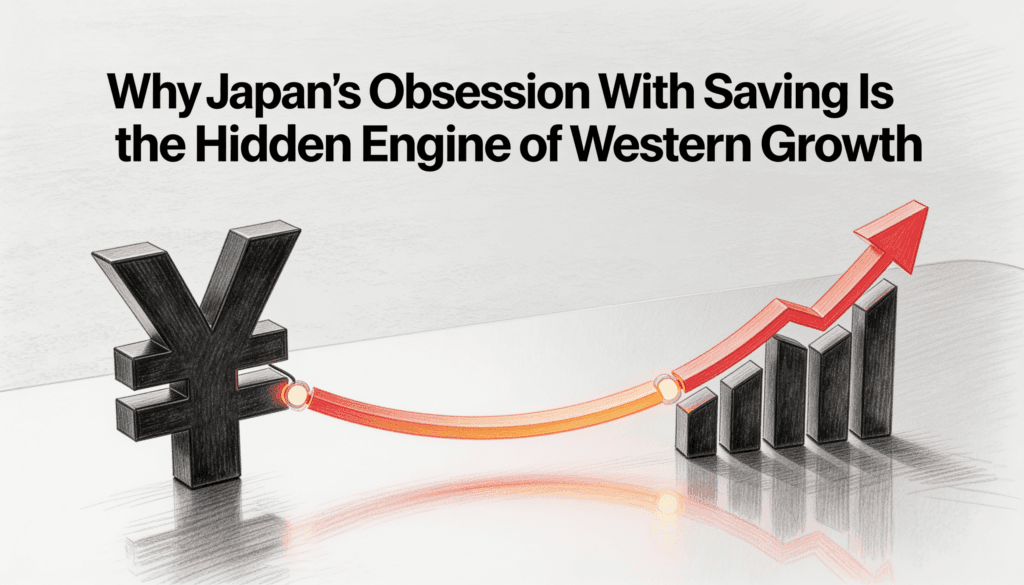
There is a quiet joke that runs underneath the entire global financial system, and almost nobody outside of a few trading desks finds it funny. The joke is that the most exciting, future facing, world changing companies on Earth are largely being financed by the most cautious, risk averse, demographically aging society on the planet. Silicon Valley dreams in code. Japanese savings in Tokyo introduces themselves in yen. And somewhere between those two states of mind, an enormous amount of money quietly travels every day, making both sides slightly richer and slightly more dependent on each other than either would like to admit.
What is happening here is something deeper than a clever trade. It is a structural transfer of wealth driven by the Japan current account surplus, a vast pool of national savings that has nowhere productive to go at home and therefore migrates abroad. Japan produces far more money than it can usefully spend or invest within its own borders. That excess does not vanish. It flows outward, becoming an involuntary subsidy to the rest of the world, especially America in the West. One side accumulates patience and surplus capital with very little appetite for adventure. The other side carries boundless ambition and a chronic shortage of the calm money needed to fund it. They do not particularly understand each other. They do not need to. The current account surplus is the bridge between them.
Once you understand that this surplus is the engine, the rest of the global financial picture starts to make sense in a way that the daily headlines never quite manage.
The Strange Geography of Money
Capital, despite what textbooks suggest, does not really flow toward opportunity in any romantic sense. It flows toward the path of least resistance, and that path is shaped by interest rates, currency stability, and the personality of the savers who produced the money in the first place. Japan has been producing savers for half a century. An aging population, a cultural memory of asset bubbles that burst spectacularly in the early nineties, and a central bank that kept rates near zero for what felt like geological time have all combined to create a country where money sits in bank accounts earning almost nothing and feels grateful for the privilege.
A persistent current account surplus is, at its core, a statement that a country saves more than it invests domestically. Japan does exactly this, year after year. Its households save. Its corporations hoard cash. Its pension funds and insurance companies accumulate liabilities that stretch decades into the future, and they need somewhere to put the money in the meantime. The domestic economy, mature and slow growing, simply cannot absorb all of it. So the surplus spills over the borders.
Where the Surplus Goes
Meanwhile, on the other side of the Pacific, you have an economy built on the opposite instinct. America does not save. It borrows, builds, and bets. Its universities produce founders the way Japan produces engineers. Its venture capital ecosystem treats failure as a credential rather than a stain. And critically, its companies need enormous amounts of capital to keep doing what they do, whether that means building data centers the size of small cities or repurchasing their own shares to keep their stock prices behaving.
So Japanese pension funds, insurance companies, and individual investors do the obvious thing. They take their yen, convert it into dollars, and buy American assets. Treasury bonds, corporate debt, equities, real estate. They earn a yield they could never dream of at home. The Americans receive capital at a price they could never extract from their own savers. The surplus that Japan cannot spend becomes the financing that America cannot generate on its own. Everybody benefits, until the day they do not.
A current account surplus is not a trophy. It is unspent national wealth searching for a home, and when the home market is too small, that wealth becomes a gift to whoever is willing to borrow it.
The Quiet Engine Nobody Talks About
Most discussions of global finance focus on the loud parts. The Federal Reserve announces something. Markets move. A chief executive says something controversial on a podcast. Tariffs get threatened. These are the things that fill financial television because they are easy to point at. But underneath all of that noise, the actual machinery of the global economy is running on something much quieter, which is the steady migration of savings from places where they are abundant to places where they are productive.
Japan now ranks among the largest creditor nations on Earth. Its citizens and institutions hold a staggering quantity of foreign assets, much of it dollar denominated. This is not a portfolio preference in any meaningful sense. It is the only choice that makes economic sense when your domestic bonds pay a yield that would embarrass a savings account. The Japan current account surplus has been compounding for decades, and the accumulated stock of overseas holdings is now so large that it functions as a permanent fixture of global capital markets.
The Future Underwritten by the Past
The result is something genuinely strange when you stop and look at it. The most innovative companies in the world, the ones supposedly defining the future, are partially financed by the most conservative pool of capital in the world. The future is being underwritten by people who would never personally bet on it.
There is a kind of philosophical beauty to this if you squint. Innovation, by its nature, is wasteful. Ten startups fail for every one that succeeds. Trillions of dollars get poured into technologies that may or may not pay off for decades. This kind of capital allocation requires either a culture of irrational optimism or a culture of patient, almost reluctant saving that produces so much surplus money that some of it can afford to disappear without anyone noticing.
America provides the optimism. Japan provides the patience. Neither could fund the future alone. The surplus is the silent partner in every American moonshot, the anonymous backer whose name never appears on the building.
The Surplus as a Worldview
Economists love the phrase current account because it sounds technical and harmless. It is, in plain terms, a measure of whether a country sends more money abroad than it brings in, after accounting for trade, investment income, and transfers. When the number is positive and stays positive for decades, it reveals something profound about the personality of a nation.
The Japanese surplus is what you get when you take a society that has been burned by speculation and asked to be careful, and you let it accumulate wealth without ever quite trusting itself to spend that wealth at home. The American deficit is what you get when you take a society that has been rewarded for speculation and asked to be bolder, and you let it consume more than it produces, confident that someone else will lend it the difference. The gap between those two attitudes is the gap that funds the modern world.
Why Divergence Is the Whole Point
What makes this fascinating is that the imbalance is not a malfunction. It is the entire mechanism. If Japan suddenly developed an appetite for domestic spending, or if America suddenly developed a habit of saving, the surplus would shrink and the great flow of capital across the Pacific would slow. With it would die a quiet but enormous engine that finances everything from American mortgages to the next generation of semiconductor factories.
The system depends on these two countries staying profoundly different from each other. Convergence would be disruptive. This is the part that almost nobody states out loud.
The global financial system, in its current form, requires cultural divergence to function. It needs societies that save without spending and societies that spend without saving. It needs old countries with too much money and young ideas with too little of it.
The surplus, then, is more than an accounting figure. It is a worldview made measurable, the residue of a national temperament that prefers security over adventure, exported to whoever is willing to take the opposite side.
The Hidden Fragility
Of course, marriages of opposites remain stable until they are not. The relationship between Japan and the rest of the world has a long and embarrassing history of working perfectly for years and then unraveling in a single bad afternoon. The surplus that flows so reliably outward depends on a delicate balance of currency values, interest rate differentials, and the willingness of Japanese institutions to keep accepting foreign risk in exchange for foreign yield.
When the yen suddenly strengthens, every Japanese investor who sent money abroad to chase higher returns discovers that the currency move has eaten their gains and then some. Positions get unwound. Foreign assets get sold and the proceeds repatriated. Markets convulse. The financial press writes a few articles about volatility and then moves on, because nobody really wants to dwell on the fact that the global financial order rests partly on the assumption that this enormous pool of savings will keep flowing in exactly the same direction.
The Summer of 2024 and the Warning It Sent
The summer of 2024 offered a small taste of this when the Bank of Japan made the smallest of policy adjustments and global markets briefly lost their composure. It was a reminder that the surplus is not just a source of cheap financing for the West. It is a source of systemic exposure. When a single nation holds trillions of dollars in foreign assets, even a modest change in its behavior can move oceans.
This is the irony at the heart of the whole arrangement. The very reliability that makes the Japanese surplus so valuable to American borrowers is the reliability that makes any disruption to it so dangerous. Calm waters teach you to forget what storms look like. By the time you remember, you are already wet.
There is also a slower danger lurking underneath the fast one. Japan is aging rapidly. An aging population eventually stops accumulating savings and starts drawing them down. Retirees spend the wealth they spent their working lives building. If the surplus that has financed the West for a generation begins to shrink because Japanese savers finally start consuming what they saved, the consequences will not arrive as a single dramatic afternoon. They will arrive as a slow, grinding rise in the cost of capital across the developed world.
What This Means for the Rest of Us
If you are an investor, or even just somebody trying to understand why your mortgage rate moves the way it does, the relationship between Japan and the West is worth thinking about carefully. Most people imagine that interest rates are set by central bankers in conference rooms. In a sense they are. But the deeper reality is that interest rates reflect the global supply and demand for savings, and that supply is dominated by a handful of aging societies with too much money and not enough places to put it.
When the Japanese surplus flows into American assets, it pushes down American yields. That makes American mortgages cheaper, American stocks more expensive, and American risk taking more affordable. When that flow slows or reverses, the opposite happens. Your borrowing costs rise not because your local banker decided to be unkind, but because a pension fund in Osaka decided to keep its money closer to home this year.
The Two Forces Shaping the Next Decade
This is a useful frame for thinking about the years ahead. The two great forces shaping financial markets are demographic aging in the developed world and concentrated technological investment in a handful of American companies. Those two forces meet inside the current account balance. One side produces the surplus savings. The other side consumes them. The open question is whether that meeting can continue to be peaceful, or whether at some point the supply of Japanese savings will simply begin to dry up as the country grows older.
For ordinary investors, the practical lesson is that diversification across geographies and currencies matters more than most people assume. The hidden plumbing of global capital can shift in ways that no domestic news cycle will warn you about. Understanding where the surplus comes from, and what could interrupt it, gives you an edge that purely domestic thinking never will.
Your mortgage rate is a global price. Somewhere in that number sits a Japanese saver who chose to lend abroad rather than spend at home, and the day that saver changes their mind, you will feel it in your monthly payment.
The Quiet Lesson
There is a tendency to think of finance as a zero sum game, a place where every dollar you earn is a dollar somebody else lost. But the relationship between Japanese savers and Western borrowers is a reminder that the most important financial relationships are not adversarial at all. They are symbiotic. Each side needs what the other has and would be poorer without it. The Japanese saver receives a return they could never earn at home. The American borrower receives capital they could never raise domestically. The surplus is the medium through which that exchange happens, paid willingly by both sides.
In the end, the Japan current account surplus is not really about trade statistics or interest rate differentials. It is about the fact that no single country contains all the temperaments needed to run a modern economy. You need savers and spenders, builders and bankers, dreamers and skeptics. When those types are concentrated in different geographies, the financial system finds a way to connect them. The connection looks like an accounting entry. It functions like a lifeline.
And as long as that surplus keeps flowing, the future will keep getting financed by the past, the bold will keep being funded by the cautious, and Japan will keep performing its quiet, profitable, slightly absurd role as the involuntary subsidizer of Western ambition. The country that trusts the future least will keep paying to build it.
Until one day, of course, the savers grow old enough to want their money back. But that is a problem for another article.