Table of Contents
The Question That Refuses to Die
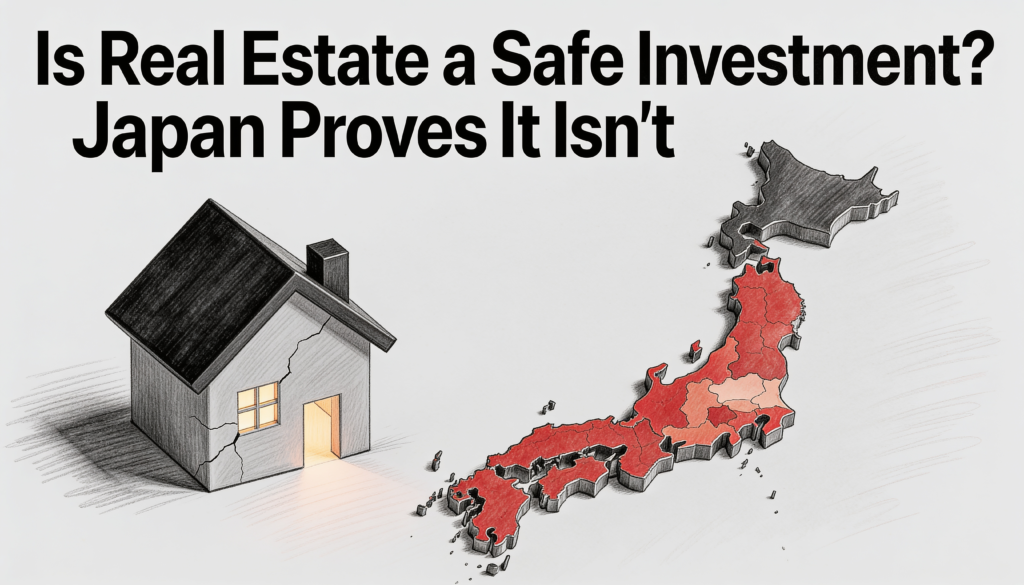
Ask a hundred people whether real estate is a safe investment, and most will answer yes without hesitation. Land feels permanent. It cannot be emailed to another country, deleted by a software update, or wiped out by a single bad quarter. Yet the most disciplined, hardworking, and land-loving nation on earth proved that this belief can be catastrophically wrong. Japan offers the most complete real-world experiment ever conducted on the question of whether property is truly safe, and the results are sobering.
Between 1985 and 1991, Japan inflated the largest real estate bubble in modern history. When it collapsed, it did not bounce back in a few years. It stayed broken for three decades. If you want an honest answer to the question of whether real estate is a safe investment, you do not need a forecast. You need a history lesson, and Japan wrote it in painful detail.
The Theology of Soil
To understand what happened in Japan, you cannot begin with interest rates or monetary policy. You have to begin with faith. Because what Japan experienced was not merely a financial bubble. It was a religious event dressed in the language of economics.
The Japanese relationship with land borders on the spiritual. Japan is a mountainous archipelago where only about thirty percent of the terrain is habitable. Scarcity was not a theory. It was geography. And from scarcity grew a conviction so deep it stopped being an assumption and became invisible, the way gravity is invisible.
Land always goes up. Land is always worth more tomorrow. Land is the one thing they are not making more of. You hear the same argument at dinner parties in London, Sydney, and San Francisco today. But Japan took it further than anyone. The nation did not just believe land was valuable. It believed land was value itself. The purest store of wealth. Safer than gold. More permanent than any currency.
Real estate did not feel like an investment to a generation of Japanese citizens. It felt like a law of nature. And for a while, every single data point confirmed it.
This matters because the belief that an asset has transcended ordinary risk is the precondition for every bubble. The moment people stop asking whether a price is reasonable and start treating it as a fact of life, the trap is already set.
The Machine Starts Humming
The mid 1980s handed Japan a set of circumstances that, in hindsight, look almost satirically dangerous. The Plaza Accord of 1985 strengthened the yen dramatically, which threatened Japanese exports. The Bank of Japan responded by cutting interest rates to stimulate the domestic economy. Money became extraordinarily cheap.
Cheap money is not inherently destructive. It is a tool. But tools behave differently depending on the hands that hold them, and Japan’s hands were already shaped by decades of land worship. When borrowing costs dropped, the money did not flow evenly across the economy. It poured, with the force of a broken dam, into real estate and stocks.
The Feedback Loop That Builds Every Bubble
Here is where the mechanism began, and it is worth pausing on because this exact loop appears in every bubble ever inflated, yet somehow surprises people every single time:
- Banks lent money against land.
- Land prices rose because of the lending.
- Rising land prices made the collateral worth more.
- More valuable collateral justified more lending.
- More lending pushed prices higher.
The loop fed itself with the quiet efficiency of a perpetual motion machine. Except perpetual motion machines do not exist. By the late 1980s, the grounds of the Imperial Palace in Tokyo were famously said to be worth more than all the real estate in California. This was not a joke. People cited it as evidence of Japan’s superiority, not as a warning sign. The number was a source of national pride, not national alarm.
Think about that for a moment. A garden in the middle of a city, valued higher than the entire landmass of one of the world’s largest economies. And the predominant reaction was satisfaction.
When Everyone Is Right, Everyone Is Wrong
One of the underappreciated features of bubbles is how rational they feel from the inside. This is not because people become stupid. It is because, for a period of time, the stupid thing is actually the smartest thing to do.
If you were a Japanese businessman in 1988 and you did not borrow against your property to buy more property, you were leaving money on the table. Your competitors were leveraging. Your neighbors were getting rich. The banks were practically begging you to take their money. Saying no was not prudence. It was self sabotage.
Bubbles do not punish the irrational. They punish the early rational. The person who says this makes no sense in year two of a five year bubble looks like a fool for three years, and three years is long enough to lose your clients, your reputation, and your nerve.
This is the answer to anyone who asks why intelligent people keep buying overpriced property. They are not ignoring the risk. They are responding logically to incentives that reward the gamble right up until the moment those incentives reverse. Is real estate a safe investment when the safest-looking move is the one that ruins you? That is the question Japan forces us to confront.
The Moment the Music Stopped
The Bank of Japan eventually noticed that things had gone sideways. In 1989, it began raising interest rates from 2.5% to 3.25%. Subsequently the ODR was raised four times reaching 6.0% in August 1990. The Nikkei stock index peaked on the last trading day of the decade, a piece of timing so poetic it feels scripted.
What followed was not a crash in the dramatic, cinematic sense. There was no single Black Monday. Instead, Japan experienced something arguably worse. A slow, grinding deflation that lasted not months, not years, but decades.
The Scale of the Damage
Property values in major cities fell by sixty to eighty percent and then simply stayed there. The Nikkei did not recover its 1989 peak for over thirty years. An entire generation was born, grew up, entered the workforce, and began raising children of their own before the stock market returned to where their parents had watched it peak.
The human cost was staggering and largely invisible from the outside. Homeowners found themselves owing more than their properties were worth. Companies that had used real estate as collateral discovered their balance sheets were fiction. Banks sat on mountains of bad loans they refused to acknowledge, creating what economists politely called zombie banks. These institutions were not alive enough to lend productively and not dead enough to be cleared from the system. They just sat there, consuming resources and blocking recovery like a fallen tree across a road that nobody wanted to chainsaw.
The Psychology of the Aftermath
What happened to Japanese society after the bubble is, in many ways, more instructive than the bubble itself. A generation of citizens internalized the lesson that ambition is dangerous. That borrowing is reckless. That the future is not necessarily better than the present.
The cultural shift was profound. Japan went from a nation of aggressive optimism to one characterized by caution, deflation, and what economists would later call a liquidity trap but what ordinary people simply experienced as a loss of confidence so deep it became structural.
Young Japanese workers, watching their parents’ wealth evaporate, developed an entirely different relationship with risk. They saved obsessively. They avoided debt. They rented instead of buying. They delayed marriage and children. The demographic consequences are still unfolding today, as Japan contends with one of the lowest birth rates on the planet and a rapidly aging population.
It is darkly fascinating that the safest possible investment, the one thing everyone agreed could never lose value, ended up producing a generation that trusts nothing.
The Lesson Nobody Learns
Here is the uncomfortable truth about the Japanese bubble. It was not a Japanese problem. It was a human problem that happened to express itself in Japan. The same fundamental error, the belief that a particular asset class has transcended the normal rules of valuation, has appeared before and since.
- American housing in 2008.
- Dutch tulips in 1637.
- Cryptocurrency in 2021.
The asset changes. The rhetoric changes. The underlying cognitive mistake does not. Each time, participants construct elaborate explanations for why this situation is different. Japan had unique geography. American housing was backed by sophisticated financial engineering. Crypto had revolutionary technology. The explanations are always convincing. They have to be. Unconvincing narratives do not inflate bubbles.
Why Japan Is the Definitive Case
What makes the Japanese case particularly instructive is its duration and depth. Other bubbles pop and recover within a few years. Japan’s bubble popped and then proceeded to demonstrate, with excruciating patience, that asset prices can remain below their peak for longer than most people remain in their careers.
The market can stay deflated longer than you can stay alive. That is not a comfortable thought, but comfort is not what we are after here.
So is real estate a safe investment? The honest answer is that property is safe only when its price reflects genuine value, and dangerous precisely when everyone agrees it cannot fall. The feeling of safety is not a measure of actual safety. Frequently, it is the opposite.
What the Land Remembered
There is one final detail about the Japanese bubble that deserves attention because it reveals something about the nature of all bubbles that tends to get overlooked.
The land itself did not change. Not one square meter of Tokyo became less useful, less accessible, or less desirable because of the bubble. The buildings still stood. The trains still ran. The location advantages remained. What changed was purely a story, a collective agreement about what the land was worth that inflated beyond recognition and then collapsed.
Value is a negotiation, not a measurement. It is something we agree upon together, and agreements can be revised. The most dangerous moment in any market is when participants forget that prices are opinions, not facts.
When the number on the screen starts to feel as solid and permanent as the ground beneath your feet, you are no longer investing. You are believing. Japan forgot this distinction. Then it remembered, painfully, over the course of a lost decade that stretched into two, then three.
So before you accept the comfortable idea that property cannot lose, remember the simplest fact from the most expensive lesson in financial history. The land is still there. The wealth is not. That is the real answer to whether real estate is a safe investment, and it is one no listicle and no estate agent will ever tell you.