Table of Contents
There is a particular kind of ambition that does not announce itself. It does not wear expensive suits or speak in loud, confident tones at dinner parties. It sits quietly in a back office, learns the plumbing of a system everyone else ignores, and then, one day, decides to use that plumbing to flood the building.
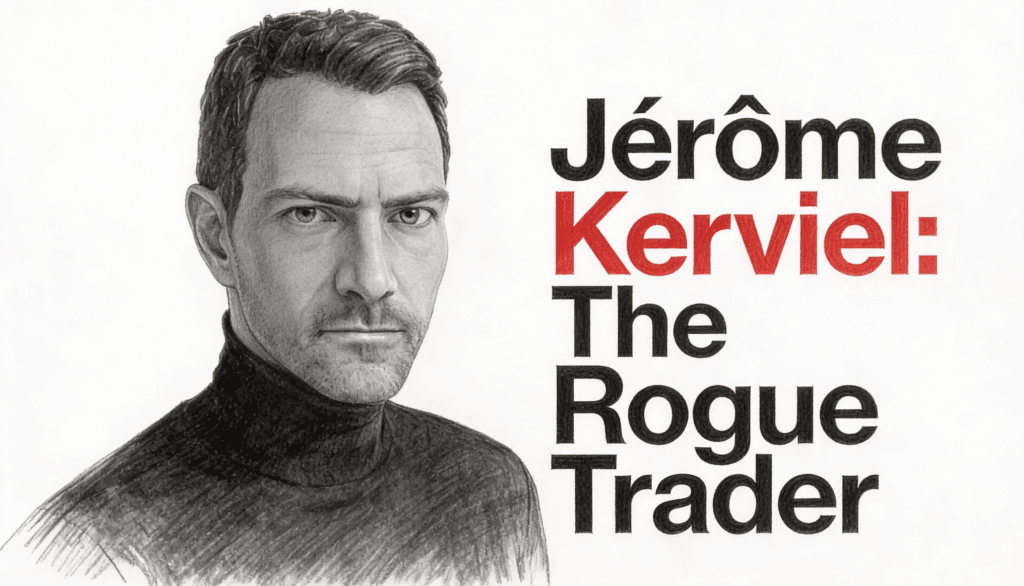
Jérôme Kerviel was that kind of ambitious.
The Nobody Who Became Everybody’s Problem
Kerviel grew up in Pont l’Abbé, a small town in Brittany, France. His mother was a hairdresser. His father was a blacksmith. This is not the origin story of a Wall Street villain. This is the origin story of a man who was supposed to stay in his lane, do modest work, and never make the news.
He studied finance at the University of Lyon, where his professors later described him as unremarkable. Not bad. Not brilliant. Just there. The program itself was designed, with the help of France’s major banks, to produce middle and back office workers. In other words, the people who process the trades, not the people who make them.
Kerviel joined Société Générale in 2000, right where the system intended him to land: in compliance. He spent five years in the middle office, learning how the bank’s controls worked, which alerts triggered when, and how long it took for various checks to kick in. He was essentially studying the immune system of the institution from the inside.
Then, in 2005, he was promoted to a junior trading desk. And the immune system had just trained its own virus.
The Architecture of Invisibility
Here is what makes the Kerviel story different from most rogue trader tales. He was not some hotshot with a golden reputation burning through risk limits while management looked the other way because he was making them rich. He was a nobody. His salary was modest. His bonus in 2006 was smaller than what some traders spent on dinner.
But he understood something that most people in finance underestimate: the back office is the skeleton of the entire organism. If you know how the bones connect, you know exactly where to apply pressure without setting off alarms.
Kerviel began placing unauthorized trades in late 2006. Small ones at first. Then larger. He masked them by creating fictitious offsetting trades, ghost transactions that existed only to make the real ones invisible. When the bank’s automated controls were about to flag a position, he would close it and open a new one just in time. The bank’s chairman later compared this pattern to a mutating virus. That metaphor was more accurate than he probably intended.
By the end of 2007, Kerviel had built up hidden profits of roughly 1.4 billion euros. Read that again. He was making the bank enormous sums of money, and they did not know it. Or, depending on who you believe, they chose not to know it.
This is where the story stops being about one man and starts being about something much larger.
The Question Nobody Wanted to Ask
During the investigation and trial, an internal report revealed that 74 separate alarms had been triggered by Kerviel’s trading activity. Seventy four. His managers failed to follow up on any of them.
Now, there are two ways to interpret this. The first is the official story: Kerviel was so cunning, so skilled at deception, that he fooled everyone around him. The second interpretation is less flattering to the institution: the bank did not investigate because the trades were profitable, and profitable trades do not generate curiosity in the same way that losing ones do.
This is a pattern you see across industries, not just finance. When someone is generating results, the system develops a convenient blindness. Sports teams overlook misconduct from star players. Companies ignore toxic executives who hit revenue targets. Hospitals protect surgeons with high case volumes. The incentive structure does not reward asking uncomfortable questions about people who are making you money.
Kerviel understood this, perhaps instinctively. He was not just exploiting a technical weakness in the bank’s controls. He was exploiting a psychological one. As long as the numbers went up, the institution’s curiosity went down.
When the Music Stopped
By January 2008, Kerviel had accumulated positions worth nearly 50 billion euros. To put that in perspective, it was more than the entire market value of Société Générale itself. One junior trader, with a modest salary and no particular reputation, had quietly bet more than the bank was worth.
He was betting that European stock markets would bounce back after a dip. This time, the call was wrong.
The bank discovered the positions over a weekend in January 2008 and faced an existential decision. They could not hold those positions. The exposure was larger than the bank’s total capital. So they began unwinding everything, selling into a market that was already falling.
Over three days, Société Générale lost 4.9 billion euros closing out Kerviel’s trades. European markets dropped sharply. The sell off was so severe that the U.S. Federal Reserve cut interest rates in an emergency move, partly in response to the turbulence. One man’s bets, placed from a desk in Paris, had rippled across the Atlantic.
There is something almost absurd about this. The financial system prides itself on sophistication, on risk models, on layers of oversight. And yet a single trader, using skills he learned in the compliance department, managed to hold the equivalent of a small country’s GDP in hidden bets. The system was not defeated by a mastermind. It was defeated by its own indifference.
The Trial and the Transformation
Kerviel was charged with breach of trust, forgery, and unauthorized use of computers. He admitted to exceeding his limits. But his defense was interesting: he claimed his managers knew what he was doing and that he was nothing more than a single cog in a broken machine.
The court did not buy it. In 2010, he was sentenced to five years in prison, with two years suspended, and ordered to repay the full 4.9 billion euros in losses. Even the bank’s own spokesperson called the restitution “symbolic.” To repay that amount on a normal salary, Kerviel would have needed roughly 49,000 years. That is not justice. That is performance art.
But the legal story did not end there. In 2014, France’s highest court upheld his criminal conviction but threw out the restitution order, calling it disproportionate and noting that the bank bore some responsibility for its own failures. By 2016, a French appeals court reduced his civil damages to one million euros and formally acknowledged Société Générale’s “deficiencies” in oversight. The same court also found that the bank had fired him unlawfully.
The narrative had quietly shifted. The rogue trader was still guilty. But the institution that created the conditions for the fraud was no longer innocent either.
The Pilgrimage Nobody Asked For
And then things got strange.
After meeting Pope Francis outside the Vatican in February 2014, Kerviel decided to walk from Rome to Paris. On foot. Roughly 1,400 kilometers. He called it a march against the “tyranny of the markets.”
Whatever you think of Kerviel, this is a remarkable piece of personal rebranding. A man convicted of one of the largest trading frauds in history had recast himself as a pilgrim, a crusader against the very system that produced him. He attracted a cult following. Some compared him to Robin Hood. Others were less generous.
The truth, as usual, sits somewhere uncomfortable. Kerviel was not a hero. He broke the law, manipulated data, and risked the livelihoods of thousands of employees at his bank. But he was also not the sole author of the disaster. He was the product of a system that rewarded risk taking without asking where the risk was coming from, that built controls it did not bother to monitor, and that treated middle office workers as invisible until one of them proved he was not.
What Kerviel Actually Teaches Us
The standard lesson from the Kerviel case is about risk management and internal controls. Banks need better systems. Alarms need to be followed up. Traders need to be monitored. That is all true. It is also boring, and it misses the deeper point.
The real lesson is about institutional blindness, the kind that is not accidental but structural. Large organizations do not fail to detect problems because they lack tools. They fail because their incentive systems are designed to look away from profitable activity. The controls exist. The willingness to use them often does not.
This is not unique to banking. Think about how social media companies handle misinformation that drives engagement. Think about how regulators approach industries that generate tax revenue. Think about how universities manage departments that bring in large grants. The pattern is universal: when the money flows, the scrutiny stops.
Kerviel sat at the intersection of two forces. One was his own ambition, which was real and ultimately destructive. The other was an institution that, for all its sophistication, could not bring itself to question why a junior trader was generating returns that defied explanation.
The 74 ignored alarms are not a footnote in this story. They are the story.
The Uncomfortable Mirror
There is a concept in psychology called the bystander effect. When many people witness a problem, each individual assumes someone else will handle it. The more witnesses, the less likely anyone is to act.
Société Générale had thousands of employees. It had compliance departments, risk teams, automated systems, and management layers. And yet 74 warnings about the same trader went uninvestigated. Everyone assumed someone else was handling it. Or everyone assumed that because the trades were profitable, there was nothing to handle.
Kerviel held up a mirror to an industry that did not like what it saw. He showed that the gap between “could not have known” and “chose not to know” is often razor thin. He showed that the most dangerous person in a bank is not the one with the biggest ego. It is the one who understands the plumbing.
And perhaps most uncomfortably, he showed that the system’s greatest vulnerability was not technical. It was cultural. It was the shared, unspoken agreement that as long as the numbers look right, nobody needs to look too closely at how they got that way.
That agreement did not end with Kerviel. It did not end with the financial crisis. It is alive and well in every institution that measures success primarily by output and treats oversight as a cost center rather than a safeguard.