Table of Contents
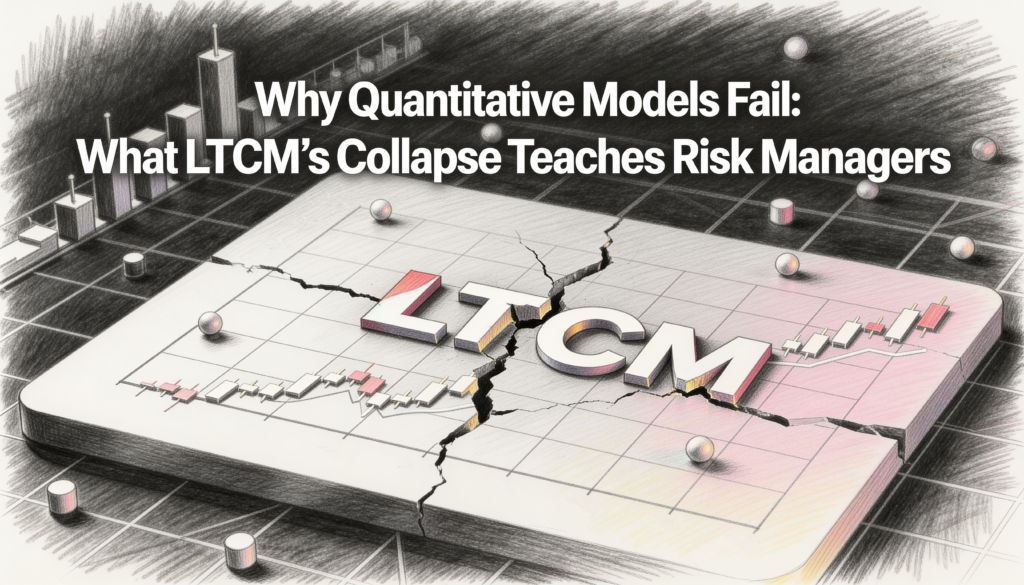
Why Quantitative Models Fail: The Lesson Hidden Inside LTCM’s Collapse
In the autumn of 1998, two Nobel Prize winners and the sharpest mathematical minds on Wall Street watched billions of dollars evaporate in a matter of weeks. The collapse of Long Term Capital Management has been retold a thousand times as a parable about hubris, but the real lesson is far more useful to anyone who manages risk today. Quantitative models fail not because the mathematics is wrong, but because the world refuses to behave the way the equations assume it will.
To understand why quantitative models fail, you have to understand what LTCM was actually doing. The black box was never truly black. It simply required thinking differently about what trading means, what a hedge protects, and what a model can honestly promise. This article uses the LTCM disaster as a window into model risk in finance, the limitations of Value at Risk, and the specific dangers of convergence arbitrage.
The Business of Selling Tomorrow
LTCM was not trading stocks or bonds in the way most people picture trading. They were trading something far more abstract: the idea that tomorrow will look like yesterday.
Think about it this way. If you buy a coffee shop, you are betting that people will keep wanting coffee. LTCM was betting that financial markets would keep behaving like financial markets. That prices which had wandered apart would wander back together. That chaos would return to order. That gravity would reassert itself. This sounds reasonable until you realize it is one of the most dangerous assumptions in all of finance.
Their main strategy was called convergence arbitrage. The name sounds sophisticated, but the concept is simple. Find two things that should cost the same but do not. Buy the cheap one. Sell the expensive one. Wait for reality to fix the discrepancy.
How Convergence Arbitrage Actually Worked
The U.S. Treasury issues new bonds regularly. The newest bond, fresh from the auction, trades actively because everyone wants it, and that demand creates a premium. The bond issued three weeks earlier is nearly identical. Same maturity, same government standing behind it. But nobody cares about it anymore, so it trades at a discount.
LTCM would buy the forgotten bond and short sell the popular one. When the new bond became old news, the prices would converge and LTCM would profit from the gap closing. The beauty of this trade is that it does not care which direction interest rates move. If rates go up, both bonds fall. If rates go down, both rise. The gap is what matters. This is what people mean when they say a trade is hedged.
But hedged against what, exactly? That single question is where the entire story of why quantitative models fail begins to unfold.
The Paradox of Perfect Hedges and the Limits of VaR
LTCM thought they had hedged against market risk. They had not. They had hedged against normal market risk, and the difference is everything.
Imagine you are worried about rain, so you buy an umbrella. You are hedged against getting wet. But what happens when the rain comes sideways in a hurricane? The umbrella becomes a liability. It catches the wind and pulls you into the storm. LTCM had built umbrellas for drizzle. When the hurricane arrived, their hedges did not simply fail. They amplified the damage.
The greatest danger of a quantitative model is not that it is wrong, but that it is reliably right during the ordinary days and catastrophically silent about the extraordinary ones.
The fund expanded far beyond simple bond trades. They traded Italian government bonds against German bonds, betting the two would converge as Europe integrated. They traded interest rate swaps, betting the gap between swap rates and Treasury yields would narrow. They found companies with dual listings and bet the prices would align.
One famous trade involved Royal Dutch Shell, jointly owned by Royal Dutch Petroleum in the Netherlands and Shell Transport in England. Same cash flows, different prices. LTCM bet the prices would converge and committed over two billion dollars to that single idea.
Why Value at Risk Gave False Comfort
This is the core of VaR limitations. Value at Risk tells you the most you are likely to lose on a normal bad day, perhaps the worst day out of every hundred. It says nothing meaningful about the one day out of ten thousand. LTCM’s models said the portfolio might lose two percent in a bad month. It lost forty four percent in August 1998 alone.
Value at Risk measures risk under the assumption that the future resembles the recent past. It uses historical correlations and historical volatility as inputs. When a genuine crisis arrives, those inputs become worthless precisely when you need them most. Correlations that were supposed to be low spiked toward one. Events that were supposed to be rare started happening every single day. This is the central limitation of VaR, and it is why risk managers who trust it blindly are building castles on sand.
The Illusion of Diversification
Here the intellectual mistake becomes painfully clear. LTCM spread their money across dozens of markets and hundreds of trades. They held positions in Europe, Asia, and the Americas. Bonds, stocks, derivatives. The portfolio looked beautifully diversified.
But every single trade relied on the same hidden assumption: that spreads would narrow, that volatility would calm, that liquidity would return. They were making one bet, expressed a thousand different ways.
It is like a restaurant chain that serves Italian food in Rome, French food in Paris, and Japanese food in Tokyo, then claims to be diversified. You are not diversified across cuisines. You are diversified across the single bet that people will keep eating out.
When Russia defaulted on its debt in August 1998, investors panicked. They did not want clever arbitrage trades. They wanted safety. They sold anything complicated and bought anything simple. Every spread that LTCM had bet would narrow instead widened. The Italian bonds they owned fell while the German bonds they had shorted rose. The old Treasuries they owned fell while the new ones they had shorted rose. Every trade moved against them at the same moment.
True diversification is not about owning many positions. It is about owning positions that do not all depend on the same belief about how the world behaves.
LTCM had achieved geographic diversification and instrument diversification. But they had zero philosophical diversification, and that is the kind that actually protects you.
Sellers of Liquidity and the Leverage Multiplier
LTCM described itself as a seller of liquidity. This phrase sounds like jargon, but it captures what they were really doing.
Liquidity is the ability to buy or sell something quickly without moving its price. A popular stock is liquid; you can sell a million shares and barely budge the price. An obscure bond is illiquid; selling even a small amount can cause the price to collapse. Investors pay a premium for liquidity, accepting lower returns on things they can easily sell. This creates an opportunity for those willing to be patient and illiquid.
LTCM was offering to be patient. They bought illiquid positions and waited for them to appreciate, earning the liquidity premium in exchange. But here is the twist. You can only sell liquidity if you never need it yourself. The moment you need to sell quickly, you become a buyer of liquidity, and buyers of liquidity pay dearly.
When their positions moved against them, creditors demanded more collateral. To raise cash, LTCM had to sell their illiquid positions, but there were no buyers except at terrible prices. They had become forced sellers of the very illiquidity they had been harvesting. The business model inverted overnight.
How Leverage Turned a Whisper into a Scream
Small price differences do not generate large profits. An old Treasury might trade only a few basis points apart from a new one. Even if you are right, you have made a tiny amount of money. Unless you borrow.
LTCM borrowed aggressively. For every dollar of their own money, they controlled roughly thirty dollars of positions. Think of leverage as a microphone. It makes quiet sounds loud. If the market whispers in your favor, leverage turns it into a shout. If the market whispers against you, leverage turns it into a scream.
The mathematics creates a brutal asymmetry. With thirty to one leverage, a loss of just over three percent wipes out your entire capital. And once you are down, the climb back is steeper than the fall: a fifty percent loss requires a one hundred percent gain just to recover. Leverage magnifies this asymmetry until a routine market move becomes an extinction event.
The Smart Money Problem: Why Intelligence Made It Worse
The deepest irony of LTCM is that being brilliant made the problem worse, not better.
The fund employed genuinely extraordinary people. Myron Scholes and Robert Merton had won the Nobel Prize for their work on option pricing. David Mullins had been vice chairman of the Federal Reserve. John Meriwether was a Wall Street legend. Their intelligence gave them credibility, and that credibility let banks lend to them on favorable terms with minimal margin and minimal oversight. Their reputation was their collateral.
But intelligence bred overconfidence. They believed their models captured reality. When reality diverged from the models, they assumed the models were right and reality was temporarily wrong. So they doubled down. They increased positions as spreads widened, certain that convergence was coming.
This is a common and dangerous pattern. Experts develop strong beliefs about how things work, and when evidence contradicts those beliefs, they find reasons to dismiss it. The evidence is noisy. The sample is small. This time is different. LTCM saw the widening spreads of 1998 as the opportunity of a lifetime rather than a warning. They were right that it was the trade of a lifetime. They were simply wrong about which direction the lifetime would go.
The Long Term Irony
The name Long Term Capital Management is itself revealing. The long term referred to their investment horizon. They made trades that might take months or years to pay off, and they structured the fund so investors could not easily withdraw. They wanted patient money for patient strategies.
But the name turned bitterly ironic. When the crisis hit, the long term became irrelevant. Creditors wanted money now. The market wanted positions closed now. Theory said spreads would eventually converge; practice said they needed liquidity immediately.
Markets can stay irrational longer than you can stay solvent. Being right eventually means nothing if you cannot survive until eventually arrives.
LTCM was almost certainly right about their core thesis. The spreads did eventually converge. The Italian bonds did align with the German bonds. The old Treasuries did trade close to the new ones. But LTCM was not around to collect. The bailout consortium that took over their positions made billions as those very trades converged.
The Market as Opponent and the Wisdom Question
There is a romantic notion in finance that markets are impersonal forces, that you are not competing against people but simply discovering prices through collective wisdom. LTCM’s collapse proved this wrong. Markets are intensely personal and deeply adversarial.
When LTCM became desperate, other traders smelled blood. Competitors who ran similar strategies saw LTCM’s positions and bet against them, knowing the fund would eventually have to liquidate. Some of LTCM’s own creditors were simultaneously lending to them and trading against them. This is not illegal or even unusual. It is simply how markets work. Your distress is someone else’s opportunity. LTCM had grown so large that in certain markets they had become the market, and when they tried to exit, the only buyers were those who knew they were desperate.
Should Versus Could: The Heart of Model Risk in Finance
Here is what makes LTCM intellectually fascinating. They were not wrong about finance. They were wrong about the world.
Their models understood bond math perfectly. Option pricing theory was sound. Statistical analysis was rigorous. The problem was never technical knowledge. It was philosophical wisdom. They knew how markets should behave. They did not know how markets could behave.
Should is about theory, which assumes rationality, equilibrium, and continuity. Could is about reality, which includes panics, contagion, and discontinuity. LTCM built a castle of knowledge without a foundation of wisdom. Knowledge tells you what usually happens; wisdom tells you what might happen. Knowledge is powerful but can be fragile. Wisdom is modest but flexible.
This is the fundamental truth about model risk in finance: models describe, they do not predict. They tell you what relationships existed, not what relationships will exist. LTCM confused a description of the past with a prophecy of the future. They did not fail because they made one stupid trade. They failed because they made a hundred smart trades that all shared a single fatal assumption.
What LTCM Teaches Every Risk Manager Today
The bailout prevented systemic collapse. The banks that had lent to LTCM would have faced enormous losses, and those losses might have triggered further failures across the entire financial system. But the rescue also created moral hazard. If you are too big to fail, you have every incentive to take bigger risks. The profits are yours; the losses belong to everyone.
Nothing fundamental changed afterward. The same strategies continued. The same leverage returned. Ten years later, the same patterns produced the global financial crisis. Different instruments, identical philosophy.
For modern risk managers, the lessons are concrete. Stress test against scenarios your historical data never witnessed, because the worst day is always outside the sample. Treat correlation as a number that breaks during crises rather than a constant you can trust. Respect liquidity as a separate and primary risk, not an afterthought. Remember that leverage converts survivable mistakes into fatal ones. And never confuse the precision of a model with the certainty of an outcome.
LTCM proved that intelligence without humility is dangerous, that mathematical sophistication does not eliminate risk, and that past patterns never guarantee future outcomes. The only real mystery is why so many people keep believing it is more complicated than that.