Table of Contents
There is a particular kind of financial strategy that sounds, on first hearing, like the universe is offering you a small miracle. You borrow money in a place where it is cheap, you park that money somewhere it pays you more, and you pocket the difference. No factory required. No product to sell. No customers to please. Just the gentle hum of interest rate differentials doing the work while you sleep.
This is the carry trade, and it has seduced more investors than almost any other strategy in modern finance. It is the financial equivalent of finding a vending machine that gives back more change than you put in. The problem, as anyone who has ever leaned too eagerly on such a machine knows, is that vending machines sometimes fall on you.
Before you place your first carry trade, there are five elements you must inspect with the patience of a customs officer and the suspicion of someone who has been lied to before. Skip any of them, and you are not investing. You are auditioning to become a cautionary tale.
1. The Currency Pair, or Why You Are Really Betting on Two Stories at Once
Most beginners think of a carry trade as a single decision. You pick the high yielder, you pick the low yielder, you sit back. But a currency pair is never one thing. It is two national stories pressed against each other, and the spread between their interest rates is only the surface of what you are buying.
When you borrow in yen to buy Mexican pesos, you are not just collecting a rate differential. You are taking a position on Japanese monetary policy, Mexican political stability, the global appetite for risk, the price of oil, the mood of American consumers, and the next sentence that comes out of a central banker’s mouth in a country you may never have visited. The yield is the bait. The currency movement is the hook.
This is the part newcomers underestimate most. The interest you earn accumulates in slow, polite drips. The currency moves against you the way weather changes in the mountains. Suddenly, and with no apology. A carry trade that pays you eight percent a year can lose you twenty percent in a week if the pair turns. The math is humbling. You are not earning yield. You are renting it, and the landlord can raise the price without warning.
Before you commit, ask yourself a strange question. If the interest rate differential were zero, would you still want to own this currency pair? If the answer is no, you are not making an investment decision. You are making a yield decision, and yield decisions made in isolation are how people end up writing regretful essays about what they learned.
2. Volatility, or the Quiet Before the Apology
There is an old observation in markets that carry trades go up the stairs and down the elevator. The metaphor is overused because it is accurate. Returns accumulate slowly and predictably for months, sometimes years, and then unwind in a few violent days when everyone reaches for the exit at the same time.
What you need to check before entering is not just the current volatility of the pair. That figure tells you how the market is behaving right now. What matters more is how this pair behaves when things get ugly somewhere else in the world. Some currency pairs are quiet most of the time and erupt during global stress. Others move steadily through almost any weather. The difference between these two types is the difference between a strategy you can hold and a strategy that will eventually hold you hostage.
Low volatility is not the same as low risk. It is often the opposite. The longer a market stays calm, the more leverage builds up inside it, because more people convince themselves that calm is the natural state. When the calm breaks, the unwind is brutal precisely because so many participants had been lulled into the same trade.
If you are looking at a carry trade and the historical volatility looks reassuringly low, treat that as a yellow flag rather than a green one. Ask what conditions produced the calm and whether those conditions are still in place. Markets that have been quiet for a long time are not safer. They are simply more crowded.
3. The Funding Currency, or What You Owe Versus What You Own
The funding currency is the one you borrow. It is the engine of the trade, and it deserves more attention than it usually gets. Most analysis focuses on the high yielder because that is the exciting part. The funding currency is treated as a kind of background prop, an inert thing you use to access the real action.
This is a serious misunderstanding. The funding currency is not background. It is half the trade, and historically it is the half that causes the damage.
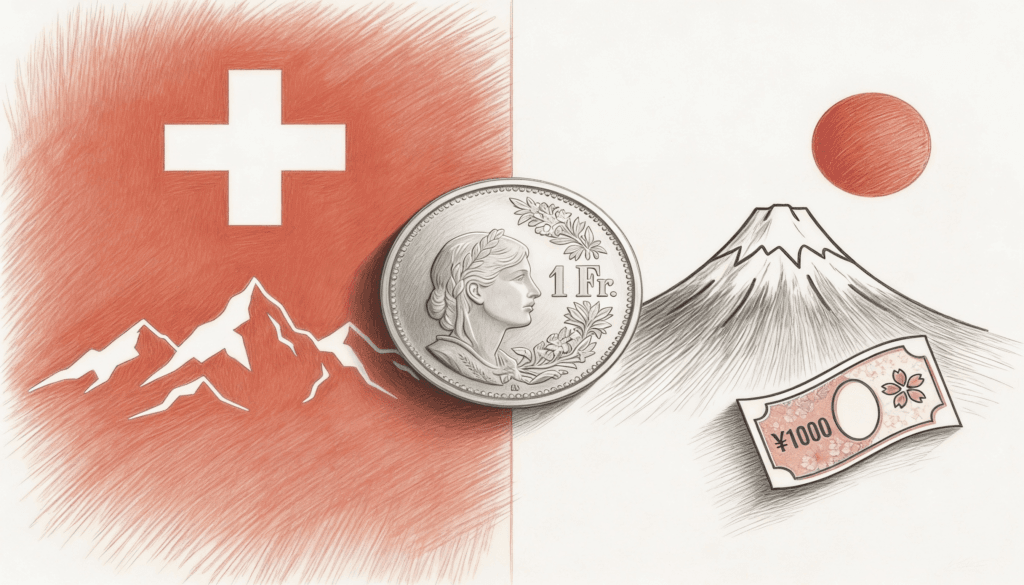
Think about what actually happens when a carry trade goes wrong. The high yielder weakens, yes. But often the more dramatic move is in the funding currency, which strengthens sharply as traders unwind their positions and rush to buy it back. The currencies most commonly used for funding, such as the yen and the Swiss franc, have a tendency to rally violently during global stress. These currencies are seen as safe havens precisely because investors retreat to them when they are frightened, and that retreat is what crushes the carry trader on the other side.
So before you enter, examine the funding currency with the same scrutiny you give the high yielder. What is the central bank likely to do? What is the inflation picture? How does this currency behave when global risk appetite collapses? You are not borrowing a neutral instrument. You are shorting a country, and countries have a way of refusing to stay short.
4. Leverage, or the Difference Between a Strategy and a Wager
Leverage is the element most newcomers handle the worst, partly because brokers make it so easy and partly because the math at the start of the trade looks so generous.
Without leverage, a carry trade earning three or four percent above your borrowing cost is a modest, almost boring proposition. It is the kind of return that makes you wonder why you bothered. With leverage of ten or twenty times, that same trade suddenly produces returns that look like they belong in a hedge fund pitch deck. The temptation is obvious. The trap is also obvious, though only in retrospect.
Here is the part worth sitting with. Leverage does not just multiply your gains. It compresses your time. Without leverage, a ten percent adverse move in the currency pair is a setback. With twenty times leverage, the same ten percent move ends the trade and possibly your account. You no longer have the luxury of waiting for the market to come back to you, because you will not be in the market when it does.
The right amount of leverage for a first carry trade is almost certainly less than your broker will allow you to take. This is not because brokers are malicious. It is because they are in the business of facilitating trades, and you are in the business of surviving them. These are different jobs, and they produce different recommendations about how much rope is appropriate.
A useful exercise is to calculate not what you stand to gain at your chosen leverage, but how large an adverse move would close your position. If that number is uncomfortably small, you are not running a carry trade. You are running a short fuse, and the only question is what lights it.
5. Your Exit Plan, or the Conversation You Owe Yourself in Advance
The fifth element is the one nobody wants to discuss because it requires admitting, before you have made any money, that you might need to leave. Yet the exit plan is the difference between a carry trade and a gradual accident.
Most people enter carry trades with a clear idea of what success looks like and a vague idea of what failure looks like. They have a target yield in mind. They have an expected holding period. What they often lack is a specific, written, dispassionate statement of the conditions under which they will close the position and walk away. Without that statement, the exit becomes an emotional decision made in a moment of stress, and emotional decisions in carry trades tend to be late ones.
A proper exit plan covers three scenarios. The first is the trade working as expected, in which case you need a rule for taking profits or trimming the position so that your gains do not silently transform back into losses. The second is the trade moving against you, in which case you need a price level or a fundamental change that triggers an exit without negotiation. The third, and the one most often ignored, is the trade going nowhere for long enough that the opportunity cost outweighs the small yield you are collecting. Time is a position too, and it can be a losing one.
Writing this plan before you enter is not pessimism. It is the only way to ensure that the version of you who designed the strategy is the one making decisions, rather than the version of you who is panicking at three in the morning watching a chart.
A Final Thought on the Nature of Easy Money
Carry trades persist as a strategy not because they are easy but because they look easy. The yield is visible. The losses, when they come, are episodic. This creates a pattern where months of small gains are erased by a few days of large losses, and where the average participant remembers the months and forgets the days. The strategy survives because human memory has a kind of mercy that markets do not.
There is a deeper point hiding in all of this. Finance is full of opportunities that pay you to take on a risk that is hard to see. The carry trade is the purest example. You are being paid, in essence, to be the person willing to hold the currency that everyone else does not want to hold for some reason. The reason is usually buried in capital controls, political fragility, inflation history, or some other unpleasant fact that the yield is compensating you for. The yield is not free money. It is a wage for accepting an inconvenience that the market has priced.
This does not mean the trade is a bad one. It means the trade is a real one, with real costs that arrive at unpredictable moments. Treating it as a free lunch is the surest way to discover that the bill has been accumulating quietly the whole time.
If you check these five elements with patience and honesty, the carry trade can be a legitimate part of how you think about returns. If you skip them, you have not built a strategy. You have built a story you tell yourself about why this time will be different, and markets have a particular fondness for proving such stories wrong.
Enter slowly. Borrow modestly. And remember that the most expensive words in finance are the ones that begin with this looks safe enough.