Table of Contents
Somewhere in a glass tower, a chief financial officer is staring at a spending decision. The money will leave the company either way. The work will get done either way. But where that spending lands on the financial statements is a choice, and that choice can transform an ugly quarter into a celebrated one. It can turn a struggling executive into a visionary. It can make a mediocre business look like a growth story.
Welcome to the strange world of capital expenditures versus operating expenses, where the same dollar can wear two different costumes depending on how management feels about its bonus this year.
The Magic Trick Hiding in Plain Sight
Most investors treat the distinction between CapEx and OpEx as a yawn inducing accounting detail. It is the financial equivalent of the safety briefing on an airplane. You know it is important, but you have heard it before, and the wine is already on its way.
This is exactly what management is counting on.
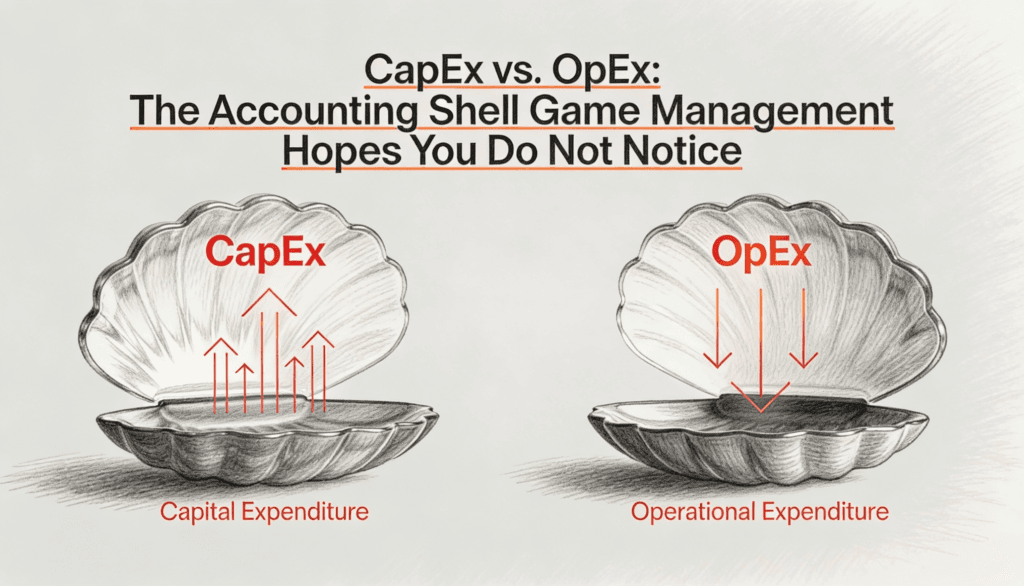
Here is the trick in its simplest form. When a company spends money on something that will be useful for many years, like a factory or a delivery truck, it can spread that cost across those years instead of taking the hit all at once. That is CapEx, capitalized on the balance sheet and slowly bled into the income statement through depreciation. When a company spends money on something that benefits only the current period, like salaries or electricity, the entire cost shows up immediately. That is OpEx.
The logic seems clean. The reality is anything but.
The line between these two categories is not drawn in stone. It is drawn in pencil. And management is the one holding the eraser.
Why This Matters More Than You Think
Consider what happens when a cost gets capitalized instead of expensed. Reported profits go up because only a small slice of the spending hits this years income statement. Cash flow from operations looks healthier because the spending gets moved to the investing section of the cash flow statement. Return on assets can look more impressive in the short term. Earnings per share rises. The stock often follows.
Now consider what happens when you reverse the trick. If a company starts expensing things it used to capitalize, profits suddenly look worse, even though nothing has actually changed about the business.
This is the part most people miss. The underlying economic reality of the company is identical in both cases. The same money was spent on the same things. But the story told to shareholders is dramatically different.
It is a bit like the difference between paying for a vacation on your credit card and paying in cash. Either way, the money is gone. But one method lets you pretend, for a little while, that you are still rich.
The Software Company Sleight of Hand
The cleanest example of this game lives in the software industry. When engineers build new software for a company to sell, their salaries can be capitalized as the creation of a long lasting asset. When those same engineers fix bugs and keep things running, their salaries are expensed.
Now imagine you are a chief financial officer trying to hit a quarterly target. You glance at your engineering team. Some of them are building shiny new features. Some are maintaining old code. The rules give you wiggle room about what counts as which. A few well placed reclassifications, a slightly more generous interpretation of what counts as new development, and suddenly your profit margins look better than your competitors.
You did not invent anything. You did not sell more. You just told the same story with different words.
This is not necessarily fraud. Most of it is perfectly legal and well within the rules. That is what makes it so dangerous. The rules themselves leave room for creativity, and creativity in accounting is rarely creativity in the investors favor.
The Lens of Incentives
If you want to see this game clearly, you have to put on the lens of incentives. Almost everything in corporate behavior makes more sense when you ask a single question. Who benefits from the way this is being reported?
Executives are paid on metrics. Often these metrics are tied to reported earnings, return on capital, or stock price. Each of these can be influenced by where the line between CapEx and OpEx is drawn. An executive who capitalizes aggressively can show stronger near term profits, which can lead to a bigger bonus, which can lead to a happier executive.
The shareholder, meanwhile, is left with a slightly distorted picture of what their company is actually doing. They see profits. They do not always see that some of those profits exist only because spending was tucked behind a balance sheet curtain to be dealt with later.
The Telecom Lesson Nobody Wants to Remember
Back when WorldCom collapsed, the headline was fraud, but the mechanism was almost mundane. The company took billions of dollars in regular operating costs, things like leasing network capacity, and capitalized them. Suddenly expenses looked smaller, profits looked bigger, and the company looked healthier than it actually was.
This was not some exotic financial weapon. It was the same trick described above, pushed past the legal line. The interesting thing is not that it was illegal. The interesting thing is how close it sits to behavior that is entirely legal. The difference between aggressive accounting and fraud is sometimes a matter of degree rather than kind.
This is why thoughtful investors learn to look at companies with a slight squint. Not because they expect to find another WorldCom under every rock. But because they understand that the gap between what is reported and what is real is wider than it appears, and that the rules give management plenty of room to widen it further when convenient.
The Quiet Tax of Capitalization
There is another wrinkle worth thinking about. When a company capitalizes spending, it is essentially borrowing from its future selves. Today looks better. But for the next several years, that capitalized cost slowly drips down through depreciation, dragging on future earnings.
This creates a strange dynamic. Companies that capitalize aggressively often look great for a while and then puzzlingly stagnant later, as the cumulative weight of past depreciation finally catches up. Management calls this a tough environment. Sometimes it is. Sometimes it is just the bill arriving.
You can almost think of CapEx as a way of taking out a small loan from your future income statement. The cash is gone now, but the pain is delayed. And like any borrower, the company that does this too much eventually finds that the future is just a series of presents arriving in line.
The Investor Lens
How should a normal investor actually think about all this? Not by becoming a forensic accountant. Most of us do not have the time or the appetite for that. But there are a few mental habits worth developing.
The first is to pay attention to cash flow more than to earnings. Earnings can be massaged in a hundred ways. Cash is harder to fake. If a company is reporting strong profits but its operating cash flow is consistently weaker, something is being smoothed over. Not always something sinister. But always something worth understanding.
The second is to watch for sudden changes in accounting policy. When a company quietly announces that it will now capitalize certain costs it used to expense, that is rarely a neutral decision. It is usually a signal that earnings would have been disappointing under the old method. The change makes the numbers look better without changing the business at all.
The third is to compare similar companies in the same industry. If one company is showing dramatically better margins than its peers, ask why. Sometimes the answer is that it is genuinely a better business. Sometimes the answer is that it is more aggressive about what it capitalizes. The two look identical on the surface and are wildly different underneath.
The Deeper Idea
Step back far enough and you start to see that this whole CapEx versus OpEx question is really about something larger. It is about the difference between economic reality and reported reality. These two things overlap most of the time, but they are not the same thing, and the gap between them is where a lot of investment mistakes get made.
A company is, at its heart, a machine for turning inputs into outputs and selling those outputs for more than they cost. The financial statements are a story about that machine. But stories can emphasize different things. They can leave certain details in the shadows. They can present the same facts in ways that produce very different impressions.
The accounting profession was built to make these stories as honest as possible. And on the whole, it does a reasonable job. But the choices that remain available to management are large enough to matter, and the incentives to use those choices in flattering ways are strong enough to predict.
This does not mean every company is hiding something. Most are not. But the existence of so much flexibility in how spending is categorized should make every investor a little more humble about what the numbers actually say.
What This Means for You
You do not need to memorize accounting rules to use any of this. You just need to remember a simple idea. The financial statements you read are not a photograph of a business. They are a portrait, painted by people who have an interest in how the subject looks.
Most of the time, the portrait is reasonably accurate. Sometimes it is flattering. Occasionally it is so flattering that it has lost its connection to the subject entirely. Your job, as someone trying to make sensible decisions with your money, is to develop a feel for which kind of portrait you are looking at.
The CapEx versus OpEx distinction is one of the easiest places to start training that eye. Look for companies whose reported profits track closely with their cash. Look for companies whose accounting policies stay stable through good years and bad. Look for management teams who talk about their business in plain language, not in the dense fog of adjusted figures and special items.
These are not foolproof signals. Nothing in investing is. But they tilt the odds in your favor, and over a long enough stretch, tilted odds are the entire game.
The shell game will keep going. The cups will keep moving. But once you understand the trick, you stop being the one losing the bet.