Table of Contents
The Most Expensive Emotion in Investing
There is a particular kind of pain that financial markets have perfected over centuries, and it has almost nothing to do with losing money. It is the pain of watching someone else get rich while you stand there holding your wallet and your regret. Economists have a clinical label for nearly every human behavior, but the rest of us just call it FOMO, the fear of missing out, and while it sounds like a harmless internet acronym, it is quietly one of the costliest emotions a person can carry into a brokerage account.
Most articles about FOMO investing treat it as a beginner mistake, a phase you grow out of once you learn enough. That framing is wrong, and the wrongness is the whole point of this piece. FOMO is not a knowledge problem. It is a wiring problem. It runs on the same ancient machinery that kept our ancestors alive, and that machinery does not switch off because you read a few books on valuation. Understanding why you chase the market is far more useful than promising yourself you never will again.
This article is about the psychology of chasing performance, the hidden ways it charges you twice, and why the people who feel most certain are almost always the ones paying the highest price. We are going to take FOMO seriously as a force, not laugh at it as a flaw.
What FOMO Actually Costs You
When you buy an asset because everyone around you seems to be making money on it, you are not really buying the asset. You are buying insurance against the feeling of being the only person at the dinner party who missed the boat. The investment is incidental. The emotional relief is the real product, and you are paying retail for it.
This is why chasing the market is so expensive. You pay twice. You pay once for the asset, which is usually overpriced by the time the story has reached your ears, and you pay again for the psychological comfort of finally joining the crowd. A person in the grip of FOMO has already decided to buy. The only remaining question is the price, and the answer is almost always too high.
FOMO buyers are not early. They are paying full price for the privilege of arriving late, then calling it conviction.
Think of it like showing up late to a concert. The good seats are gone, the opening act is over, and you paid full price anyway. The difference in financial markets is that the concert sometimes ends right after you sit down, and the people who sold you the ticket are already in the parking lot.
The Hidden Tax of Excitement
Behavioral economists talk about something worth borrowing here, the idea of regret aversion. It is the amount people will quietly pay just to avoid feeling stupid later. Regret is not a side effect of FOMO. Regret is the engine. The fear of looking back and seeing the gain you could have captured is so vivid that it overpowers the much duller fear of overpaying.
Notice how strange this is. A future feeling, a feeling that does not even exist yet, reaches into the present and rewrites your decision making. You are not responding to data. You are responding to a hypothetical version of yourself who is disappointed. That phantom person is the most expensive advisor you will ever hire.
Why the Timing Is Always Backwards
One of the most counterintuitive features of FOMO is that it tends to peak at exactly the worst possible moment. When an asset has already run up hard, when the news cycle has caught on, when a relative who has never owned a single share is suddenly handing you tips at a barbecue, that is the precise instant FOMO becomes most persuasive. The certainty feels overwhelming. How could this possibly stop going up?
Certainty in markets is almost always a contrarian signal. The more obvious an opportunity looks, the more people have already acted on it, and the less room remains for the move to continue. By the time the story is everywhere, by the time it is impossible to avoid, the opportunity has been priced in, frequently several times over. The crowd that feels safest is usually the crowd standing to the exit it cannot see.
The more obvious a trade looks, the more fully it has already been priced. Obviousness is not opportunity. It is a receipt for someone else’s profit.
This is the cruel symmetry of chasing performance. The emotional signal that screams buy is strongest right where the financial logic is weakest. Your gut is not a contrarian. Your gut is a follower, and by the time it feels comfortable, the easy money has already changed hands.
The Tax You Pay Even When You Win
Here is a part most discussions miss entirely. FOMO charges you even when the trade works out. Suppose you chase an asset and it keeps climbing. You made money, so where is the cost? The cost is the lesson you just taught yourself. You learned that chasing works, that the screaming gut feeling was right, that discipline was for cowards. You walked away rewarded for the exact behavior that will eventually ruin you.
Markets are merciless teachers because they reinforce bad habits at random intervals, which is the most addictive reinforcement schedule known to psychology. A slot machine that paid out every time would bore you. A slot machine that pays out unpredictably owns you. FOMO works the same way, and that occasional winning chase is what keeps people coming back to lose far more later.
Why Smart People Lose Too
It is tempting to assume that chasing the market is a problem for amateurs and that sophisticated investors are immune. The actual evidence points the other way. Some of the most spectacular financial collapses in history were engineered by extremely intelligent people who absolutely knew better and felt the pull anyway. Intelligence does not protect you from FOMO. In certain ways it makes you more dangerous to yourself.
The reason is uncomfortable. Smart people are exceptionally good at constructing reasons for things they were going to do emotionally regardless. Give an intelligent person a feeling and a spreadsheet, and within twenty minutes they will produce a thesis that makes the feeling look like analysis. The intelligence does not override the emotion. The intelligence serves it, dressing impulse in the costume of logic.
The Power of a Good Story
FOMO is fundamentally about narrative. Humans are storytelling animals, and markets are storytelling machines. When a story is good enough, when it has heroes and momentum and an unmistakable sense of inevitability, even careful thinkers begin to feel that staying out is the irrational choice. The narrative rewrites the math, and once the math has been rewritten, the price you pay stops feeling like a price. It begins to feel like a ticket to the future.
A good enough story does not just persuade you to ignore the price. It convinces you the price was never the point.
This is why warnings rarely work in the moment. Telling someone caught in a powerful market story to consider valuation is like telling someone in love to consider the divorce statistics. The information is true and completely beside the point, because the person is not operating in the realm of information. They are operating in the realm of identity. To pass on the trade now feels like betraying the kind of person they want to be, the bold one, the early one, the winner.
The Crowd Is Not Your Friend
There is comfort in numbers, and that comfort is the trap. When thousands of people are buying the same thing for the same emotional reason, it feels like validation. It is actually concentration of risk. Crowds do not reduce danger in markets. They manufacture it, because a crowd that all bought for the same reason will all want to sell for the same reason, and they will all want to sell at the same moment.
The lonely feeling of sitting out a popular trade is precisely the feeling that protects your capital. Discomfort and safety are correlated in investing far more often than comfort and safety. When everyone agrees, almost no one is left to buy from, and the only direction with any room to move is down.
The Anatomy of a Chase
It helps to slow down the moment of chasing and watch it frame by frame, because FOMO feels instantaneous but is actually a sequence. Seeing the steps lets you interrupt them.
- Exposure. You encounter a price that has already moved a great deal, usually through a headline, a chart, or a friend who cannot stop talking about it.
- Comparison. You instinctively compare your situation to the person who got in earlier, and you come up short. This comparison is automatic and largely involuntary.
- Projection. You imagine the price continuing along the same path and picture yourself either rich or foolish depending on what you do next.
- Justification. Your mind assembles reasons that make the emotional decision look analytical, often surprisingly sophisticated reasons.
- Action. You buy, and a wave of relief washes over you. That relief, not the asset, was the thing you were chasing all along.
The relief at the end is the tell. When buying an investment makes you feel calmer rather than thoughtful, you have almost certainly been chasing a feeling rather than weighing an opportunity. Good decisions rarely feel like rescue. They feel like patience.
The Reset That Nobody Notices
Every time FOMO pulls someone out of a steady plan and into a frantic one, a hidden clock resets. Wealth in markets is built largely by compounding, and compounding is brutally unforgiving of interruption. Every panic sale, every chase at a peak, every leap into a fresh asset because the old one became boring, interrupts the one force in finance that genuinely rewards doing nothing.
This is the quiet tragedy of the chaser. They are usually working incredibly hard. They are reading, watching, refreshing, reacting, and that effort feels like diligence. In reality, the effort itself is the leak. The energy spent trying to capture every move is the very thing preventing the slow accumulation that actually creates wealth. They are running on a treadmill and mistaking the sweat for progress.
What FOMO Costs Beyond Money
The financial price of chasing the market is real, but it is not even the largest bill. The bigger cost is everything FOMO consumes that never appears on a brokerage statement. Consider what an investor in the permanent grip of FOMO actually spends.
- The hours lost staring at screens that do not know you exist.
- The sleep surrendered to worry about timing a move you cannot control.
- The relationships strained by stress over numbers that fluctuate regardless of your attention.
- The mental bandwidth devoured by a market that continues with perfect indifference to whether you are watching.
This is the true ledger. FOMO charges you money, and then it charges you peace of mind, and then it charges you time, and it returns none of it. The cruelest part is that the market does not even register your sacrifice. You can pour your entire emotional life into a chart, and the chart will move exactly as it would have moved if you had been asleep.
The market never asked you to watch it. The watching was your idea, and the watching is where most of the damage gets done.
The Question Worth Asking
The next time you feel the urge to do something dramatic with your money, it is worth pausing to ask one quiet question. Who is this excitement actually for? The asset does not need you to be excited. The market does not need you to be brave. The excitement serves only one party, and it is rarely your future self.
Naming the feeling robs it of some of its power. When you can look at the impulse and say plainly, this is regret aversion, this is a story doing my thinking for me, this is the crowd offering me comfort in exchange for risk, the feeling loosens its grip. You do not have to defeat FOMO. You only have to see it clearly enough that it stops disguising itself as analysis.
Replacing the Chase With a System
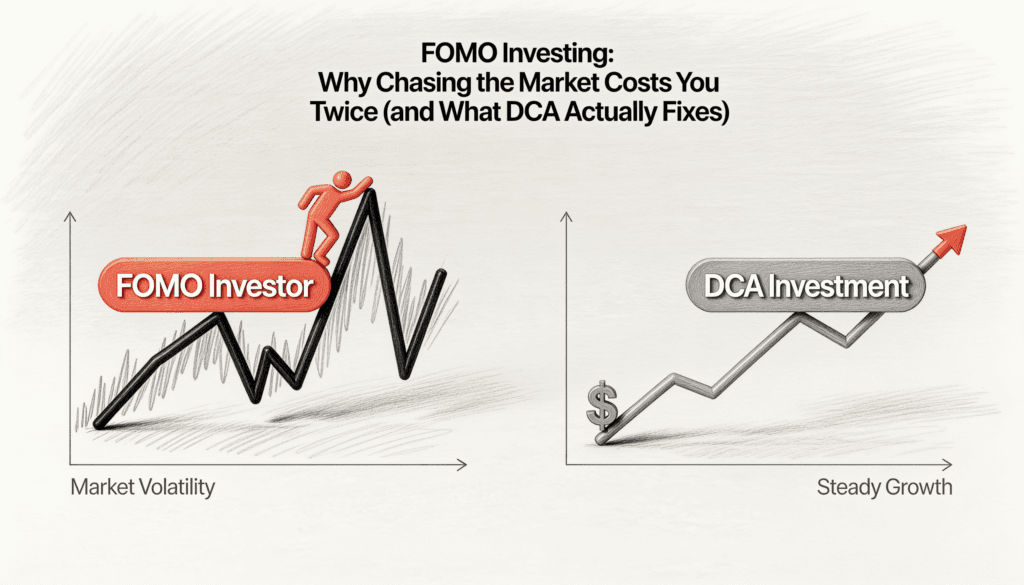
The opposite of FOMO is not willpower, because willpower fails reliably under emotional pressure. The opposite of FOMO is a system that removes the decision from the moment entirely. The most reliable defense against chasing the market is to make the act of investing automatic and unconscious, so that there is no moment of choice for the emotion to hijack.
When your investing happens on a schedule rather than on a feeling, the screaming gut signal has nowhere to land. You cannot chase a peak if your contributions arrive on the same date no matter what the price is doing. You cannot panic out at a bottom if you never built the habit of reacting in the first place. The genius of any rules based approach is that it makes interruption nearly impossible, because you are not making a decision at all. The decision was made once, calmly, long ago, and now it simply runs.
Why Boring Wins
The people who end up genuinely wealthy through investing are rarely the ones who looked exciting along the way. They are usually the ones who looked, frankly, a little dull. They were not predicting anything. They were not chasing anything. They were letting the slow math do its quiet work in the background while everyone else burned capital fighting their own emotions.
This is hard to accept because boredom feels like failure to a brain built for action. Sitting still while others appear to be winning triggers every instinct you have. Yet that boredom is the discipline, and the discipline is the edge. The investor who can tolerate being unexciting has access to a return that the chaser can never touch, the return of not sabotaging themselves.
The Life You Keep
There is a final return that almost never gets measured, and it may be the most important one. When you stop chasing, you get your attention back. You get your evenings back. You get the part of your mind that was permanently half occupied with prices, and you get to point it at your work, your family, and your actual life.
FOMO will never disappear. It is wired into the same circuitry that kept our ancestors paying attention when the rest of the tribe started running. The instinct is older than money itself, and no amount of reading will surgically remove it. What you can do is stop obeying it. Every time you chase, you pay in money and in peace. Every time you sit still inside a plan you built when you were calm, you save both.
The supreme irony is that the people who try hardest to be early almost always arrive last, exhausted and overpaying. And the people who never tried to be early at all, who simply kept showing up quietly while the crowd burned itself out, somehow end up exactly where they wanted to go. The market rewards patience precisely because patience is so rare, and FOMO is the reason it stays that way.