Table of Contents
Your Brain Is Trading Without Your Permission
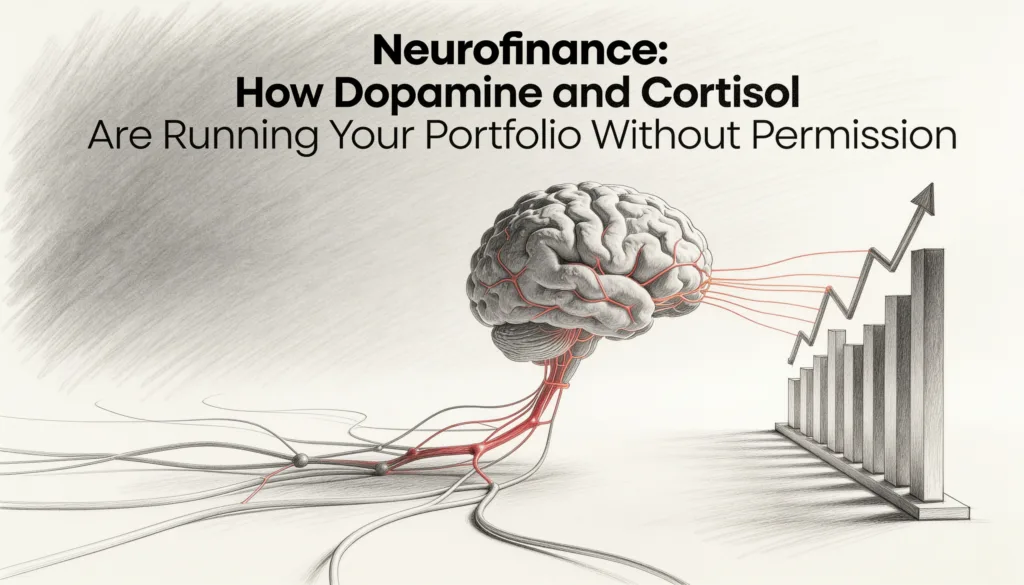
Your portfolio does not care about your feelings. But your feelings care deeply about your portfolio, and that single mismatch explains more bad investment decisions than any chart pattern ever will. This is the territory of neurofinance, the study of how brain chemistry shapes the way we handle money, and it might be the most underexplored edge available to an ordinary investor today.
We spend enormous energy learning to read candlestick patterns, moving averages, and earnings reports. We study markets as if they were machines with clean inputs and clean outputs. But the person sitting at the keyboard, the one making the actual decisions, is running on two hundred thousand years of neurochemistry that evolved to find berries and avoid lions. Nobody in the history of evolution was ever selected for the ability to hold a losing position through a quarterly drawdown.
What follows is not a trading strategy. It is a lens. A way of understanding why you keep doing the exact thing you swore you would never do again, and why the smartest people you know still panic at the worst possible moments. Two molecules in particular, dopamine and cortisol, are quietly running your portfolio without ever asking your consent. Once you can see them at work, you can finally start trading the market instead of trading your own nervous system.
The Dopamine Problem You Did Not Know You Had
Dopamine is the most misunderstood molecule in popular culture. People call it the pleasure chemical, and that label is almost entirely wrong. Dopamine is the anticipation chemical. It does not reward you for getting what you want. It rewards you for expecting to get what you want. When money enters the picture, that distinction becomes the difference between a calm decision and an expensive one.
The Monkeys That Explained Your Brokerage Account
Wolfram Schultz ran a famous series of experiments with monkeys to map exactly how this system fires. When a monkey received an unexpected squirt of juice, its dopamine neurons spiked sharply. But once the monkey learned that a light or a tone reliably predicted the juice, something remarkable happened. The spike moved. Dopamine stopped firing at the reward itself and started firing at the cue that predicted the reward.
The juice was identical. The chemistry had already moved on to the trailer instead of the movie. This is the engine that drives so much of investor behavior, and it operates entirely beneath conscious awareness.
The brain does not reward you for the win. It rewards you for the moment you believe the win is coming. By the time the win arrives, the chemistry has already left for the next anticipation.
Now apply this directly to your trading account. That small rush you feel when a stock you have been watching starts climbing before you even buy it is dopamine doing precisely what it evolved to do. It is not telling you that this is a sound investment. It is telling you that this looks like a pattern that previously led to reward. Your brain is running a prediction algorithm, not a valuation model, and the two have almost nothing in common.
Why Buying Feels Hollow
This is why the moment right after you click buy often feels strangely flat. You expected ownership to feel as good as the anticipation, and it almost never does. The neurochemistry of wanting and the neurochemistry of having are two completely separate systems wired into different circuits. Wanting is loud, urgent, and forward looking. Having is quiet and quickly taken for granted.
The market understood this long before neuroscience put names to it. Traders have always said buy the rumor, sell the news. That old piece of floor wisdom is an accidental description of a dopamine curve. The anticipation of an earnings beat moves the price. The actual confirmation, once it arrives, often deflates it, because the chemical reward was already spent during the waiting.
Why Losses Hit Harder, and It Has Nothing to Do With Weakness
Daniel Kahneman and Amos Tversky demonstrated something that should change how every investor thinks about risk. Losses feel roughly twice as painful as equivalent gains feel good. Lose one hundred dollars and the sting registers at about double the pleasure of finding one hundred dollars on the sidewalk. This is loss aversion, and it is not a character flaw or a sign of poor discipline. It is architecture, built into the hardware.
The Survival Logic Behind the Pain
From the standpoint of survival, this asymmetry makes perfect sense. For an ancestor living on the edge of starvation, missing a meal was far more dangerous than finding an extra one. The humans who treated threats as more urgent than opportunities were the ones who survived long enough to reproduce. You inherited their nervous system, and now you are using that same ancient circuitry to decide whether to rebalance your retirement account.
The consequences run deeper than simple fear of selling. Loss aversion makes you afraid to sell losing positions because selling makes the loss real and permanent. As long as you hold, the loss stays theoretical, almost imaginary. But the same instinct also makes you sell winners far too early, because every unrealized gain feels fragile, and locking it in quiets the anxiety that it might evaporate.
The Disposition Effect
The result is a bizarre behavioral cocktail that almost every investor experiences. People hold losing positions far too long while selling winning positions far too soon. They water the weeds and cut the flowers. Behavioral economists named this pattern the disposition effect, and it is so consistent across cultures, account sizes, and experience levels that it functions more like a biological law than a market quirk.
You are not holding that falling stock because of conviction. You are holding it because your amygdala cannot tell the difference between a saber toothed tiger and a red number glowing on a screen.
Understanding this does not automatically cure it. But naming the mechanism creates a small wedge of distance between the impulse and the action, and that distance is where rational decisions live.
The Cortisol Calendar Running Your Risk Tolerance
Dopamine gets most of the attention in popular writing, but cortisol may be the more dangerous molecule for investors. Cortisol is your primary stress hormone. In short bursts it sharpens focus and prepares you to act. In sustained doses it narrows your thinking, biases you toward familiar and conservative options, and pushes you to catastrophize about outcomes that have not happened yet.
Measuring Fear in the Bodies of Real Traders
John Coates, a former Wall Street trader who became a neuroscientist, did something that armchair theorists never bother to do. He measured the actual cortisol levels of London traders over several weeks of real trading. During periods of heightened market volatility, he found that traders’ cortisol levels rose by as much as sixty eight percent.
The truly important finding was what that elevated cortisol did to their judgment. High cortisol did not merely make the traders feel anxious. It physically changed how they processed risk. Traders with elevated stress hormones became dramatically more risk averse, and they became so at the exact moment when the best opportunities were appearing on their screens.
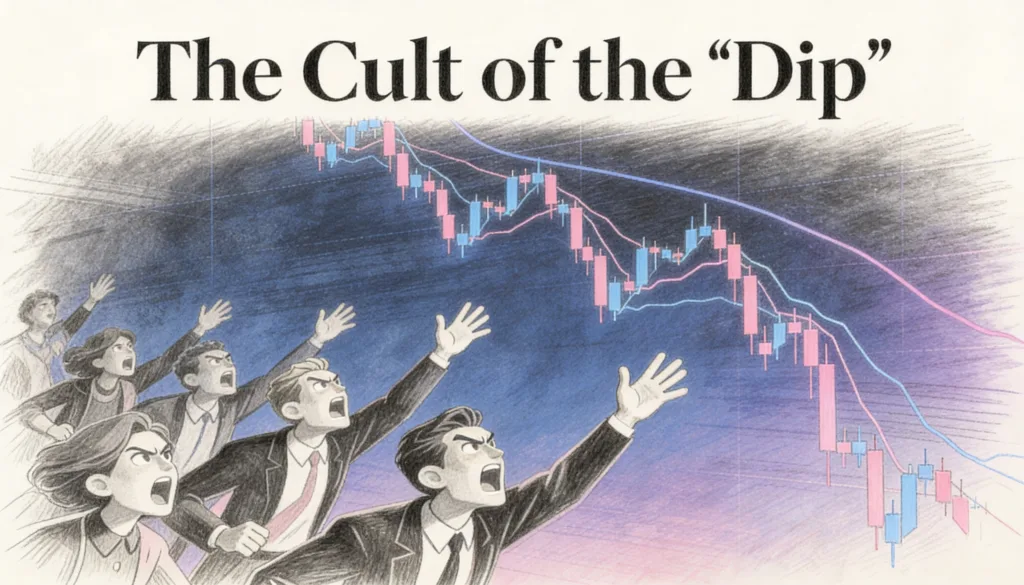
The moments that demand the most rational thinking are the precise moments when your body is least equipped to supply it. A market crash does not only destroy capital. It floods your bloodstream with a hormone engineered to make you sell everything and hide.
Why Some People Buy Panics
This reframes the popular image of the brilliant contrarian who buys when everyone else is selling. The people who calmly accumulate shares during a panic are not necessarily smarter or more informed than the people selling into it. They may simply have different cortisol baselines or better tools for managing the chemical surge. Their physiology lets their reasoning stay online while everyone else’s reasoning has been hijacked by a hormone designed for a world of predators and famine.
If you have ever wondered why your carefully built plan dissolves the instant the market drops eight percent in a morning, this is the answer. The plan was written by your prefrontal cortex. The selling was done by your stress response, and your stress response does not read plans.
The Illusion of Rational Conviction
Here is a thought that may be genuinely uncomfortable. That deep sense of conviction you feel about a particular stock, the feeling that you have figured out something the rest of the market has somehow missed, has a decent chance of being neurochemistry rather than insight.
Confirmation Feels Good for a Reason
When new information lines up with what we already believe, the brain releases a small dose of dopamine. Confirmation is chemically pleasant. This is precisely why confirmation bias is so stubborn and so difficult to defeat through willpower alone. When you seek out articles, forums, and analysts who agree with your thesis, you are not being intellectually lazy in the way that word usually implies. You are chasing a micro dose of neurological validation, and your brain delivers it on schedule.
Stack this on top of the endowment effect, our well documented tendency to overvalue things simply because we own them, and a rather unflattering portrait of the average investor emerges. You buy a stock. You immediately value it more highly because it now belongs to you. You hunt for information that supports your thesis because finding it produces a tiny pleasure. You quietly avoid contradictory evidence because it triggers a small stress response. And through all of this, you sincerely believe you are being objective.
Deep Conviction, Shallow Analysis
The market is crowded with people who hold passionate conviction built on remarkably thin analysis. From the inside, biology makes it nearly impossible to distinguish genuine insight from chemical comfort. They feel identical. The certainty that comes from rigorous research and the certainty that comes from never having seriously examined the opposing case produce the same warm sensation of being right.
This is the silent reason intelligent investors lose money. They mistake the feeling of certainty for the presence of evidence, and the two are produced by entirely different processes.
What Actually Helps You Trade Against Your Own Chemistry
If the underlying problem is biological, then the solutions must be at least partly biological too. You cannot reason your way out of a hormone surge in real time, but you can build systems that account for the chemistry before it arrives. These are not exercises in raw discipline. They are forms of neurological hygiene.
Put Distance Between Impulse and Action
The simplest intervention is also the most powerful. Build a deliberate gap between the impulse and the trade. Write down your full thesis before you execute anything, then wait twenty four hours before acting on it. The purpose is not to test your willpower. The purpose is to let dopamine and cortisol return to baseline so that your prefrontal cortex, which handles long term planning, can finally get a word in.
The prefrontal cortex is slower and quieter than the limbic system that generates fear and craving. It does not shout. It needs time and a relatively calm environment to function, and a twenty four hour delay gives it exactly that.
Reduce the Sensory Noise
Fewer screens, fewer notifications, fewer live price feeds. Every single data point that flashes across your phone is a potential trigger for a neurochemical response that you did not choose and cannot fully control. This is one reason the most successful long term investors tend to check their portfolios infrequently, sometimes only a handful of times per year.
They are not lazy or detached. They are protecting their nervous systems from a constant drip of triggers that would push them toward action when patience is the correct move. Checking less is itself a strategy.
The Bigger Lesson About Money and the Body
Finance loves to present itself as a discipline of pure numbers, and in many ways it is. The data is real, the spreadsheets are honest, and the math does not lie. But the person interpreting those numbers is not a spreadsheet. They are a biological organism carrying reward circuits that were shaped by millions of years of selection pressure that had absolutely nothing to do with equity markets, interest rates, or quarterly earnings.
The best investors are not the ones who somehow eliminate emotion entirely. That goal is impossible and probably undesirable, since emotion also carries genuine information. The best investors are the ones who learn to recognize their biological signals for what they truly are, which is data about their own internal state rather than data about the market in front of them.
Learn to Read Your Own Signals
Your pulse racing before you place a trade is not conviction. It is physiological arousal, and arousal feels the same whether you are about to make a brilliant decision or a catastrophic one. Your calm certainty about a long held position may not be the product of careful analysis. It may simply be the absence of any contradictory information that your brain quietly filtered out.
Your urge to sell everything during a downturn is not cowardice and it is not a moral failing. It is cortisol performing its evolutionary job inside a context the hormone was never designed to handle. Once you can label these signals accurately, they lose much of their power to control you.
Trade Your Pulse, Not the Chart
The practical takeaway from all of this neurofinance research is surprisingly simple to state and difficult to live. Do not trade the chart. Trade your pulse. Pay attention to what your body is doing the moment before you act, because that physical state is shaping your judgment far more than you realize.
Until you genuinely understand what your nervous system is doing to your decisions, those decisions are not entirely yours. They belong to a body that is still, at some ancient and persistent level, searching the horizon for berries and watching the tree line for lions. The investor who learns to hear that old machinery without obeying it has found an edge that no chart pattern can provide.