Table of Contents
Your Brain on a Market Crash: The Cortisol Problem No One Warned You About
Your body cannot tell the difference between a bear market and an actual bear. That is not a clever metaphor. It is a measurable biological fact, and it explains why intelligent people make catastrophically dumb financial decisions the moment their portfolios turn red. The same chemical cascade that kept your ancestors alive on the open savanna fires every single time your account drops three percent, and that ancient survival machinery is quietly sabotaging your ability to think clearly about money.
The hormone at the center of this story is cortisol, released by your adrenal glands whenever your brain perceives a threat. Cortisol does not pause to ask whether the threat is a predator lunging from the grass or a falling candlestick on a stock chart. It responds identically to both. And that response, once a triumph of evolutionary engineering, has become one of the most expensive liabilities in your financial life. The irony lands almost too perfectly. The system designed to keep you alive is the very system that convinces you to sell at the bottom.
If you have ever searched for why you panic during market crashes, or wondered how stress affects financial decisions, this is the answer your investing books never gave you. The problem is not your discipline. The problem is your chemistry.
The Chemistry You Never Signed Up For
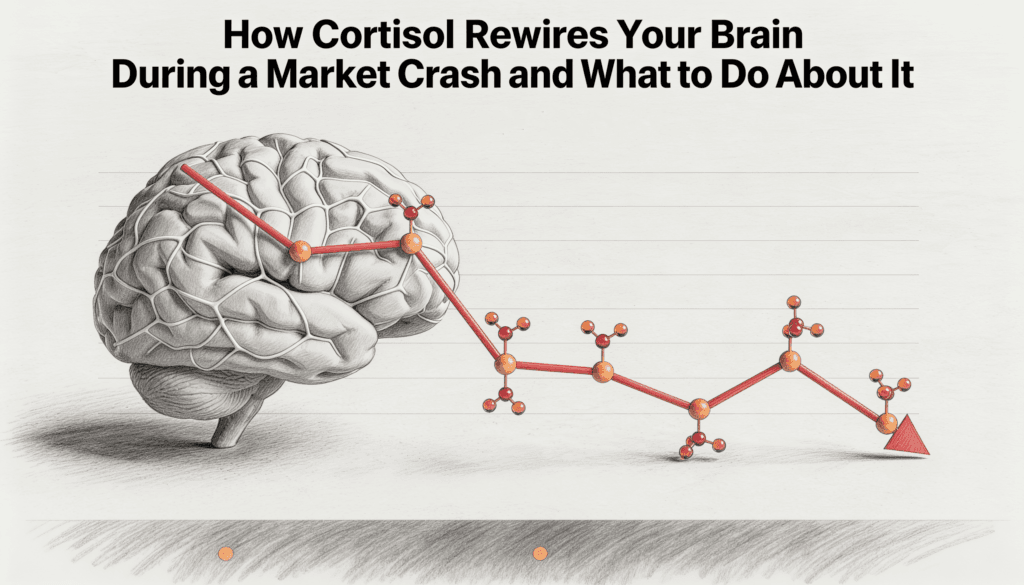
When cortisol floods your system, it triggers a predictable and rapid sequence of changes inside your skull. Blood flow shifts away from the prefrontal cortex, the region responsible for long term planning, abstract reasoning, and the careful weighing of probabilities. Those resources get rerouted to the amygdala, the part of your brain that handles fear, snap judgments, and the burning urge to do something immediately.
This reallocation is brilliant if you need to leap out of the path of an oncoming bus. It is a disaster if you need to decide whether to rebalance your retirement account during a downturn. Under the influence of cortisol, you become a measurably different investor than the calm version of yourself who built the plan in the first place.
You begin to overweight recent losses. You interpret ambiguous information as threatening. You become far more susceptible to herd behavior, because when the ancient brain seizes control, there is a deep evolutionary safety in doing whatever everyone else is doing, even when everyone else is panicking.
What the Research Actually Shows
Researchers at the University of Cambridge studied financial traders and found that those with elevated cortisol levels became significantly more risk averse. Not cautiously prudent. Irrationally timid. They started perceiving danger in legitimate opportunities and threats in ordinary market noise. The hormone did not make them careful. It made them afraid.
Fear dressed up as caution is one of the most expensive costumes in all of finance. It looks responsible from the outside while quietly destroying long term returns.
This distinction matters enormously. Caution is a deliberate choice made by a clear mind. The cortisol response only mimics caution. It feels like wisdom in the moment because your brain is generating a flood of justifications for why selling everything right now is the smart move. Those justifications are not reasoning. They are the chemical equivalent of static, and acting on them tends to lock in losses that a calmer version of you would have ridden out.
Why Your Portfolio Has a Nervous System
Here is the truth that almost all financial advice ignores completely. Your investment portfolio is not separate from your body. Every single decision you make about money passes through a brain that is soaking in real time neurochemistry. That neurochemistry shifts based on your sleep, your relationships, your job security, your diet, whether you exercised this morning, and whether you checked the futures market at four in the morning because you could not stop thinking about a single position.
We discuss markets as though they are purely intellectual exercises built from spreadsheets, ratios, and fundamentals. But the person reading the spreadsheet is an animal running on hormones. When that animal is stressed, the spreadsheet might as well be written in a foreign language, because the part of the brain that interprets it has gone temporarily offline.
The Feedback Loop That Accelerates
This creates a vicious cycle that almost nobody talks about openly. Financial stress raises cortisol. Elevated cortisol impairs your decision making. Impaired decisions lead to worse financial outcomes. Worse outcomes generate even more financial stress, which raises cortisol again. The loop does not gently correct itself over time. It accelerates.
Picture a car with a steering wheel that pulls harder to the left the faster you drive. Your instinct is to grip tighter and overcorrect. But overcorrecting at high speed is exactly how you end up in the ditch. The market crash is the curve in the road. Your cortisol is the pull on the wheel. And your panicked overcorrection is the move that wrecks the portfolio you spent years building.
Understanding this loop is the first step toward breaking it. Once you accept that your worst financial instincts arrive on a chemical tide rather than from sober analysis, you can start building systems that account for the tide instead of pretending it does not exist.
Stress Is Not an Equal Opportunity Destroyer
One of the more uncomfortable truths about cortisol is that it does not affect everyone equally. People who already live under chronic stress, whether from financial insecurity, demanding work, caregiving responsibilities, or ongoing health problems, begin each day with a higher baseline cortisol level. Their threat detection system is already running hot before they ever open a brokerage app.
This means the people who can least afford to make bad financial decisions are neurochemically primed to make the worst ones. Someone with a stable income, manageable debt, and a supportive home can absorb a market drop with relative calm. Their cortisol spikes, then returns to baseline quickly. Someone juggling debt, job uncertainty, and the ambient anxiety of modern precarity experiences the identical market drop, but their system goes haywire because it was already placed near the edge.
The market drop is the same for everyone. The internal experience of it is not. Two people can read the same headline and live in completely different chemical worlds.
The Flaw in Risk Tolerance Questionnaires
The financial industry rarely acknowledges any of this. Standard risk tolerance questionnaires ask how you would feel about a twenty percent decline in your portfolio. They never ask whether you slept last night. They never ask whether you are in the middle of a divorce, whether your rent just increased, or whether you have been caring for a sick parent for the past six months. Yet those factors will determine your actual behavior during a crash far more reliably than your theoretical comfort with volatility ever could.
A questionnaire measures your imagined response in a calm moment. Cortisol governs your real response in a frightening one. The gap between those two numbers is where most retail investors lose money, and it is almost never measured by the very advisors who claim to assess your risk profile.
The Athlete Connection: A Trained Nervous System
There is a revealing parallel in sports science that illuminates why some investors handle pressure so much better than others. Elite athletes do not perform well under pressure because they fail to feel stress. They feel it intensely, sometimes more intensely than amateurs. The difference lies in how their bodies process the stress once it arrives.
Through repeated exposure to high stakes situations, the bodies of elite performers learn to metabolize cortisol more efficiently. The spike still comes, but the recovery happens faster. They return to baseline while their competitors remain flooded and frozen. This is trained physiology, not raw talent and not the absence of nerves.
Acting Despite the Fear
Some of the greatest investors in history have described not the absence of fear during crashes, but the developed ability to act despite that fear. They notice the cortisol surge rising through their bodies and consciously choose not to obey it. This is not willpower in the way most people imagine willpower. It is a conditioned physiological response. The body has learned through direct experience that the threat is not lethal, that the red on the screen is not actual blood.
Warren Buffett famously advised investors to be fearful when others are greedy and greedy when others are fearful. That maxim is more than a clever line. It is a mental model that becomes far easier to execute once your nervous system has been trained through repeated survival of downturns.
This is why experience matters in investing in a way that has almost nothing to do with knowledge. A first time investor living through a thirty percent correction possesses exactly the same information as a veteran who has survived four previous ones. But their bodies are processing that identical information through completely different chemical environments. The veteran is not smarter. The veteran is calmer. And in markets, calm is the alpha that no spreadsheet can capture.
What Actually Helps and What Does Not
The standard advice for managing investment stress is almost aggressively useless. Stay the course. Think long term. Do not panic. This guidance is the financial equivalent of telling a person in the grip of a panic attack to simply relax. The words are technically correct and practically worthless, because they target the conscious mind while the actual problem is unfolding in the endocrine system, well below the reach of conscious instruction.
What genuinely helps is intervening at the biological level, where the trouble actually originates. Here is what the evidence supports.
Exercise as a Cortisol Regulator
Exercise is the most potent cortisol regulator available to you without a prescription. A single session of moderate exercise can lower your cortisol levels for hours afterward. Consistent exercise reduces your baseline cortisol over the long term, which means you begin every financial decision from a calmer neurochemical starting point. This is not wellness fluff dressed up as advice. It is a direct, measurable improvement in your capacity to make rational choices under pressure.
Sleep as the Ignored Lever
Sleep is the other major lever that most investors completely overlook. Cortisol follows a circadian rhythm, designed to peak in the early morning and decline steadily throughout the day. Sleep deprivation shatters this cycle, keeping cortisol elevated when it should be falling. Checking your portfolio after a terrible night of sleep is not merely unpleasant. It is biochemically reckless, because you are making consequential decisions while your stress hormone is artificially elevated and your prefrontal cortex is running on fumes.
Structured Decision Making
Structured decision making also helps, though not for the reason most people assume. Having predetermined rules for when you buy, sell, or rebalance is valuable not because the rules are flawless, but because following an existing rule demands far less prefrontal cortex activity than constructing a brand new decision from scratch. When cortisol runs high and your higher brain functions are compromised, a simple written checklist can stand in for the judgment you temporarily cannot access.
A rule written by your calm self is a gift to your panicked self. It allows the version of you who thinks clearly to make decisions on behalf of the version of you who cannot.
Create Friction With Your Portfolio
And then there is the simplest intervention of them all. Put the phone down. Build deliberate friction between yourself and your portfolio. Delete the app during volatile stretches. Set up a system where checking your balance requires genuine effort rather than a reflexive thumb swipe. You are not avoiding information by doing this. You are protecting your decision making architecture from chemical interference at the precise moments when that architecture is most vulnerable.
The Bigger Picture: A Cortisol Delivery System
There is something deeply strange about a financial system that demands rational behavior from its participants while doing everything in its power to trigger their irrational impulses. Twenty four hour news cycles. Real time portfolio tracking. Push notifications for every minor market hiccup. The entire infrastructure of modern investing functions, intentionally or not, as a remarkably efficient cortisol delivery system.
The people who profit most from this arrangement are rarely the ones absorbing the stress. Market makers, high frequency trading firms, and large institutional investors operate with systems and buffers that insulate them from the emotional weight of each individual tick. Retail investors get the raw, unfiltered feed piped directly into their nervous systems, with no insulation between the headline and the hormone.
Designing Around Your Biology
Understanding cortisol will not make you immune to its effects. You cannot reason your way out of a hormonal response any more than you can reason your way out of being hungry. But you can design your entire investment life around the reality of your biology rather than the comforting fantasy of pure rationality.
The best investors have figured out how to keep their chemistry from overriding their logic. They sleep well. They exercise consistently. They check their portfolios infrequently. They write rules they can follow when their judgment is compromised. They treat their nervous system as a core piece of their investment infrastructure rather than an inconvenient distraction to be ignored or willed away.
Your body is going to react to financial stress. That part is not optional and never will be. What you choose to do with that reaction is the only genuine edge you actually control. Master the gap between the cortisol surge and the decision, and you will have built something far more durable than any stock pick: a mind that stays yours even when the markets are doing everything possible to take it away.