Table of Contents
The Hidden Math: What Every Trade Actually Costs You Over Ten Years
Imagine two investors who start with exactly the same amount of money, the same intelligence, and the same access to the same stocks. Ten years later, one of them has roughly double the wealth of the other. The difference between them has nothing to do with stock picking skill and everything to do with arithmetic that almost nobody bothers to calculate.
This is the quiet tragedy of day trading versus compound interest. The damage does not announce itself. It does not show up as a dramatic loss on any single trade. It accumulates silently, trade by trade, tax bill by tax bill, spread by spread, until one day the gap between the patient compounder and the active trader becomes so wide that no amount of clever timing can close it.
Most discussions of this topic stay vague and philosophical. They talk about patience and discipline and the magic of compounding without ever putting real numbers on the table. This article does the opposite. We are going to model the actual cost of three specific frictions that day trading introduces, then show you exactly how much wealth those frictions destroy over a decade. By the end you will understand, in dollars and cents, why realized gains taxes, bid-ask spreads, and commissions form a slow leak that can drain a fortune before it ever has the chance to grow.
The Three Leaks That Drain a Trading Account
Before we run any numbers, you need to understand the three places where money escapes every time you close a position. Each one seems small in isolation. Together, compounded over years, they become enormous.
Leak One: Realized Capital Gains Tax
When you buy a stock and hold it, any gain on paper remains unrealized, which means it remains untaxed. The government cannot touch a profit you have not booked. This is the single most underappreciated advantage in all of personal finance, and it is the heart of why buy and hold compounding works so powerfully.
A day trader, by definition, realizes gains constantly. Every winning trade that closes within a year is taxed as a short term capital gain, which in the United States is taxed at your ordinary income rate. For a middle income earner that might be 22 to 24 percent. For a higher earner it can reach 32, 35, or even 37 percent federally, before state taxes are added.
Unrealized gains are an interest free loan from the government that compounds in your favor. Every time you sell, you pay that loan back and start over with less.
The buy and hold investor who waits more than a year pays the long term capital gains rate, which tops out at 20 percent for most people and can be 15 percent or even zero for lower brackets. The trader who never holds anything for a year pays the full ordinary rate, and pays it every single year.
Leak Two: The Bid-Ask Spread
Every stock has two prices at any moment. There is the price at which you can buy it, the ask, and the price at which you can sell it, the bid. The gap between them is the spread, and it is a hidden tax collected by market makers on every round trip.
For a heavily traded large cap stock the spread might be a single penny on a fifty dollar share, which sounds trivial. But spreads widen dramatically on smaller stocks, during volatile moments, and outside regular hours, which is exactly when day traders are most active. A spread of even one tenth of one percent, paid on both the entry and the exit, becomes a meaningful drag when you make hundreds of round trips a year.
Leak Three: Commissions and Per Trade Friction
Many brokers now advertise zero commission trading, and this has convinced a generation of traders that trading is free. It is not. Brokers earn money by selling your order flow, which subtly worsens your execution prices. There can be regulatory fees, data subscription costs, and the very real cost of slippage, which is the difference between the price you expected and the price you actually received. Even at a generous estimate of a few dollars of total friction per round trip, an active trader making a thousand trades a year pays thousands of dollars before earning a single profit.
Modeling the Real Cost Over Ten Years
Now we put numbers to the theory. We will build two simple models, starting both investors with one hundred thousand dollars and assuming the market delivers an average annual return of 8 percent before any costs. This is a deliberately fair assumption, because we are going to give the day trader the benefit of the doubt by assuming they earn the exact same gross market return as the patient investor. We are not even penalizing the trader for being wrong more often. We are only measuring the cost of the friction itself.
Investor A: The Buy-and-Hold Compounder
Investor A buys a diversified basket of quality companies and does almost nothing for ten years. They reinvest dividends, they ignore the daily noise, and they pay no capital gains tax until the very end because they never sell. Their money grows at 8 percent annually, fully compounded, with no leaks along the way.
The compounding math is straightforward. One hundred thousand dollars growing at 8 percent per year:
- Year 1: 108,000 dollars
- Year 3: 125,971 dollars
- Year 5: 146,933 dollars
- Year 7: 171,382 dollars
- Year 10: 215,892 dollars
At the end of year ten, Investor A finally sells and pays a 15 percent long term capital gains tax on their gain of 115,892 dollars. That tax is 17,384 dollars, leaving them with a net wealth of approximately 198,508 dollars. They paid tax exactly once, at the favorable long term rate, on a single enormous gain that had been compounding tax free the entire time.
Investor B: The Day Trader
Investor B earns the very same 8 percent gross market return, but they realize that return through constant trading. Let us assume their portfolio turns over completely several times per year, which is conservative for an active trader. We will apply three deductions to their annual return:
- Short term capital gains tax of 30 percent on every realized profit each year
- Bid-ask spread and slippage cost of roughly 1 percent of the portfolio annually, given high turnover
- Trading friction and order flow cost of roughly 0.5 percent of the portfolio annually
Here is what happens to Investor B’s effective return. Their 8 percent gross return loses 1.5 percent to spreads and friction immediately, dropping the working return to 6.5 percent. Then 30 percent of that realized gain disappears to taxes each year, because they hold nothing long enough to qualify for the long term rate. The after tax, after friction compounding rate becomes roughly 4.55 percent annually.
Watch what that does over the same decade:
- Year 1: 104,550 dollars
- Year 3: 114,283 dollars
- Year 5: 124,920 dollars
- Year 7: 136,548 dollars
- Year 10: 156,330 dollars
Because Investor B paid tax every year along the way, there is no large tax bill waiting at the end. Their final net wealth is approximately 156,330 dollars.
The Gap Nobody Calculates
Let us place the two outcomes side by side. Investor A ends with 198,508 dollars net of all taxes. Investor B ends with 156,330 dollars net of all taxes. The difference is 42,178 dollars, which is more than 42 percent of the original investment, vanished into friction and premature taxation.
Remember the crucial assumption here. Both investors earned the identical gross market return. Investor B was not a worse stock picker. Investor B did not have a single bad year that Investor A avoided. Investor B simply paid the toll of activity, and that toll alone destroyed nearly half of their starting capital in lost potential growth.
The day trader did not lose money to the market. They lost it to the act of trading. The market was generous to both. Only one of them kept what the market gave.
Stretching the Timeline to Twenty Years
The chart of these two paths tells the real story, because compounding is exponential and the gap does not grow in a straight line. It accelerates. If we extend both models to twenty years, Investor A’s pre tax balance reaches roughly 466,000 dollars, while Investor B’s balance crawls to roughly 244,000 dollars. The dollar gap between them has ballooned to well over 200,000 dollars. Picture two curves on a graph that begin at the same point and slowly separate. By year five they are clearly diverging. By year ten the space between them is a chasm. By year twenty they appear to belong to two entirely different financial universes, even though both investors started identically and earned identical gross returns.
Why the Tax Drag Is the Most Vicious Leak of All
Of the three leaks, the realized gains tax does the most damage, and it does so for a reason that deserves careful attention. When you pay tax on a gain, you are not only losing that money. You are losing every dollar that money would have earned for the rest of your investing life.
Consider a single 10,000 dollar gain. If you realize it and pay 3,000 dollars in tax, you have 7,000 dollars left to reinvest. The buy and hold investor who never sold keeps the full 10,000 dollars working. Over twenty years at 8 percent, that 3,000 dollar tax payment represents roughly 14,000 dollars of foregone future wealth. You did not pay 3,000 dollars. You paid 3,000 dollars plus everything those dollars would ever have become.
This is the deepest reason that tax deferral is the secret engine of long term wealth. The patient investor is not avoiding tax forever. They will pay eventually. They are simply allowing the government’s share to keep compounding on their behalf until the very last possible moment, and when they finally pay, they pay at the lower long term rate. The day trader does the reverse. They hand the government its cut at the highest possible rate, as early and as often as possible, and forfeit all the growth that money would have generated.
When Trading Friction Becomes Mathematically Impossible to Beat
There is a threshold that almost no day trader ever calculates, and it is the threshold that should govern the entire decision. To merely match the buy and hold investor, the day trader must outperform the market by enough to cover every leak we have modeled.
In our example, the combined annual drag of taxes, spreads, and friction reduced an 8 percent gross return to a 4.55 percent net compounding rate. For the trader to simply tie the buy and hold investor, who compounds at nearly 8 percent before their single end of period tax, the trader would need to generate a gross return of roughly 11 to 12 percent per year, every year, just to break even against doing nothing.
The question is never whether you can beat the market. The question is whether you can beat the market by enough to also cover the cost of trying. That second hurdle is where almost everyone fails.
This is the mathematical heart of the matter. The day trader is not competing against the market. They are competing against the market plus a 3 to 4 percent annual handicap of their own creation. Decades of academic research confirm what the arithmetic predicts. The overwhelming majority of active traders underperform a simple index held passively, and the gap is almost perfectly explained by costs.
The Cases Where the Math Changes
Honesty requires acknowledging the exceptions, because the math is not a moral judgment. It is simply arithmetic, and arithmetic can shift.
If you trade inside a tax advantaged account such as a Roth IRA, the realized gains tax leak disappears entirely, because gains inside that account are never taxed on the way out. That removes the single largest of the three leaks. The spread and friction costs remain, but the handicap shrinks meaningfully. This is why active strategies, if anyone insists on running them, belong inside sheltered accounts rather than taxable ones.
If you trade extremely liquid instruments with razor thin spreads and genuinely zero net friction, the second and third leaks shrink toward negligible. And if you happen to be among the rare few who can consistently generate gross returns far above the market average, the math can work in your favor. The trouble is that this last group is vanishingly small, and almost everyone believes they belong to it.
The Choice Is Yours, but the Math Is Not
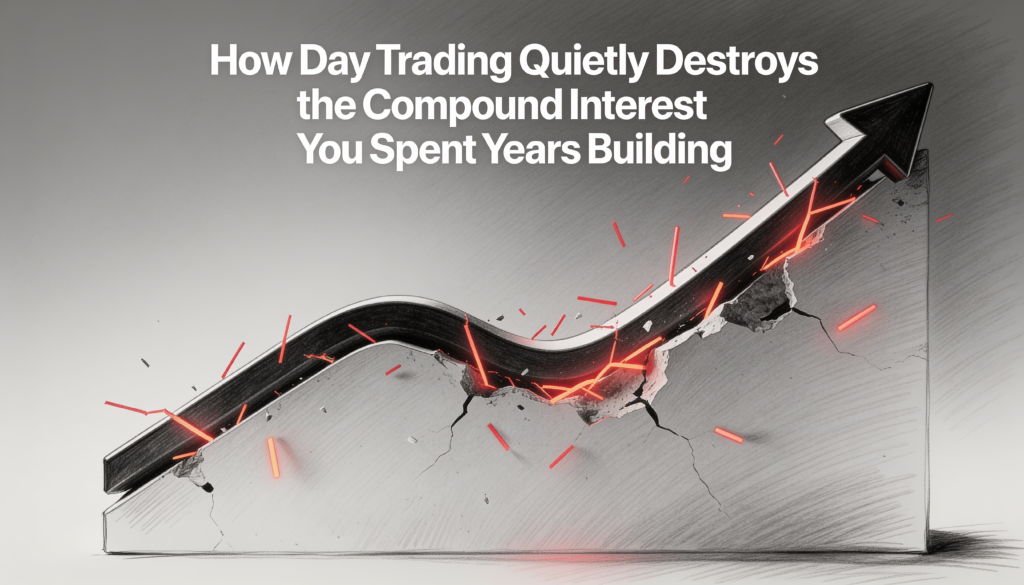
Day trading does not destroy your compound interest through a single dramatic blow. It destroys it the way water destroys stone, slowly, invisibly, and relentlessly. Each trade carves away a sliver of future wealth that you will never see, because you will never know what that money would have become if you had simply left it alone.
The buy and hold compounder wins not because they are smarter, braver, or more skilled, but because they refuse to pay the tolls. They let the government’s interest free loan keep working. They never hand a market maker the spread. They never feed the friction machine. They allow time and arithmetic to do the heavy lifting that no amount of frantic clicking can replicate.
We modeled two investors with identical talent and identical luck. One ended with nearly 200,000 dollars and the other with 156,000 dollars, and the entire difference came from costs that the second investor probably never noticed. Extend the timeline and the gap grows into something life altering. The lesson is uncomfortable precisely because it is so simple. Before you ask whether you can pick the right stocks at the right moment, ask whether you can afford the price of trying. For almost everyone, the most powerful move available is to do far less, far more patiently, and let compounding finish the work that activity only interrupts.