Table of Contents
Two Platforms, Two Personalities: How Reddit and Twitter Build Different Retail Investors
Hand the same question to two crowds and watch them split in half. The question is simple: what happens when ordinary people start talking about money in public? On one side sits a Reddit forum where anonymity is the default and chaos is the aesthetic. On the other sits a loose network of named accounts on Twitter where credibility is the currency and the tone leans closer to a graduate seminar than a casino floor.
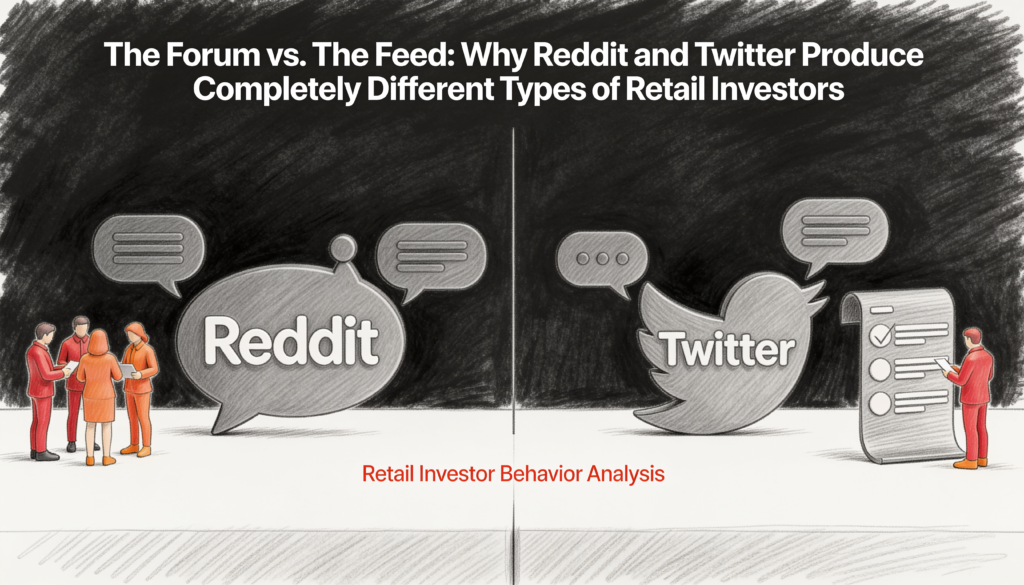
These are WallStreetBets and FinTwit, and they represent the two dominant cultures of modern retail investing. If retail finance had a single personality, these two communities would be its split halves. One is the id. The other is the superego. The fact that both grew enormous at the exact same moment tells you something important about what regular investors actually want. They want two things that cannot easily coexist: permission to gamble, and permission to learn. The platform architecture of Reddit and Twitter does not just host these desires. It manufactures them.
This is the part most analysis misses. People assume the cultures came first and the platforms simply provided a stage. The reality runs the other way. The upvote button and the follower count are not neutral tools. They are incentive engines, and they engineer two completely different kinds of retail investor before anyone types a single word.
The Architecture of Each World
WallStreetBets was born in 2012 as a small Reddit forum for people who wanted to talk about aggressive trades without being scolded by the risk management crowd. It stayed relatively obscure until 2020 and 2021, when the GameStop saga turned it into a cultural event. Almost overnight, it went from a niche corner of Reddit to one of the most discussed communities in financial history.
But the genuinely interesting story was never the GameStop trade itself. It was the structure underneath it.
How Reddit’s Upvote System Shapes Financial Behavior
Reddit forums are democratic by design. Posts rise or fall based on upvotes. There is no blue checkmark. There is no follower count that lends your opinion extra weight. A first time poster sharing a screenshot of a disastrous options trade gets the same shot at visibility as someone who has been a member for years. The content that wins is whatever the crowd finds most compelling.
And the crowd, it turns out, finds two things compelling above all else: spectacular gains and spectacular losses. This is not an accident. It is a direct consequence of the platform architecture.
Reddit rewards content that provokes a reaction. In finance, the strongest reactions come from extremes. A sensible, well diversified portfolio generates no engagement whatsoever. A person who poured their entire savings into weekly call options and either tripled the money or lost everything? That is content. The upvote system functions as a slot machine for attention, and it consistently pays out for the most extreme stories in the feed.
How Twitter’s Follower Count Builds a Hierarchy
FinTwit operates on entirely different physics. Twitter is an identity based platform. Your name, your face, your credentials, and your follower count all travel with everything you say. A tweet from someone with three hundred followers and a tweet from someone with three hundred thousand followers are not competing on equal footing, regardless of which one is more insightful.
This creates a natural hierarchy. FinTwit developed its own class structure, with professional money managers and financial media figures at the top, experienced retail investors and analysts in the middle, and newer participants at the bottom. It looks a great deal like the traditional financial world, simply compressed into a feed.
The upvote button rewards the most extreme story in the room. The follower count rewards the most consistent voice over time. Those two incentives do not produce the same investor. They produce opposites.
This is the foundation of everything that follows. Anonymity plus democratic ranking produces a culture of reckless honesty. Identity plus permanent follower counts produces a culture of careful reputation management. Neither culture chose its values from scratch. Each inherited them from the machine it lives inside.
What Each Culture Actually Values
Here is where it gets genuinely interesting. The two communities are not just using different platforms. They have developed fundamentally different value systems around money and investing, and those values flow directly from the incentives described above.
WallStreetBets Values Conviction
The highest form of praise on WallStreetBets is putting everything on a single idea and being right. The language reflects this. People do not discuss “positions.” They discuss “YOLOs.” The word itself carries the philosophy. You only live once, so why hedge?
There is an intellectual layer here that is easy to miss if you only see the memes. What WallStreetBets actually celebrates is a very specific kind of courage: the willingness to be catastrophically wrong in public. The forum’s famous loss porn tradition, where users post screenshots of devastating portfolio losses and receive thousands of upvotes and supportive comments, is unlike anything else in financial culture. In what other community is losing money treated as a form of entertainment and even honor?
This only makes sense once you understand the architecture. Because anonymity removes reputational cost, a member can post a six figure loss without career consequences. Because the upvote system rewards extremes, that loss earns visibility a balanced portfolio never could. The culture of public failure is not a quirk. It is the upvote engine working exactly as designed.
FinTwit Values Process
Compare this to FinTwit, which values process above outcome. The highest form of praise there is demonstrating that your thinking is rigorous and your framework is sound. FinTwit rewards threads. Long, detailed explanations of why a company is undervalued, why a macro trend matters, why a particular trade carries a favorable risk reward setup.
The tone is educational. The implicit promise is that if you follow the right people and absorb enough threads, you will become a better investor. This too flows from the architecture. Because your name and follower count are permanent, you cannot afford to look reckless. Careful, articulate analysis protects your reputation in a way that a wild gamble never could.
This is the core split. WallStreetBets says the market is a casino, so play accordingly. FinTwit says the market is a classroom, so study accordingly. Both are partially right. And the part each one gets wrong is the most revealing detail of all.
The Blind Spots Built Into Each Platform
Every incentive system produces its own characteristic failure. Reddit and Twitter are no exception, and their blind spots are mirror images of each other.
The Survivorship Bias of the Forum
WallStreetBets has a survivorship bias problem so severe that it has essentially become the community’s defining feature. For every user who posts a life changing gain, hundreds of others took the same bet and lost. But losses, despite the loss porn tradition, do not produce the same gravitational pull as gains.
A post showing someone turning ten thousand dollars into half a million gets shared across the entire internet. A post showing someone turning ten thousand into four hundred earns sympathy within the forum but does not leave it. The result is that WallStreetBets, viewed from the outside, looks like a place where aggressive bets pay off. From the inside, anyone paying attention knows the base rate of success is extremely low.
But knowing this and feeling it are different things. When the feed is full of rocket emojis and screenshots of six figure gains, the rational brain struggles to hold onto the statistics. The architecture amplifies winners and quietly buries the far larger crowd of losers.
The Credibility Inflation of the Feed
FinTwit has the opposite problem. It looks rigorous. It sounds rigorous. But it carries a credibility inflation issue that almost nobody discusses openly.
Because Twitter rewards consistency of posting and clarity of presentation, it is entirely possible to build a massive following by being articulate about ideas that do not actually work in practice. A well written thread about a stock that subsequently collapses does far less damage to your reputation than it should, because by the time the collapse arrives, the feed has moved on and you have published forty more threads about other things.
Being confidently wrong at high volume is, over time, more career enhancing than being carefully right at low volume. The platform’s memory is short. The follower count is permanent.
This is the same dynamic that plagues opinion journalism. FinTwit rewards the appearance of expertise at least as much as it rewards the reality of it, because the architecture remembers your follower count but forgets your worst call.
The Sociology of the Divide
There is a class dimension running underneath all of this that neither side enjoys acknowledging. The platforms do not only sort behavior. They sort people.
WallStreetBets skews younger, less wealthy, and more inclined to view the financial system as fundamentally rigged against them. The nihilistic humor, the anti institutional rhetoric, the willingness to treat investing like gambling: these are not merely aesthetic choices. They are expressions of a worldview. If the system is not going to let you win playing by its rules, you may as well play your own game and have some fun doing it.
FinTwit skews older, more established, and more inclined to believe that the financial system, while imperfect, can be navigated through skill and knowledge. The earnest educational tone, the respect for track records, the implicit assumption that markets are ultimately knowable if you do enough homework: these are the beliefs of people who have benefited enough from the system to consider it worth mastering.
The GameStop Moment and Its Aftermath
January 2021 was the moment the two cultures collided most visibly, and the collision exposed something neither community expected to learn about itself.
WallStreetBets orchestrated what was essentially a crowd sourced short squeeze on GameStop, driving the stock to absurd levels and inflicting billions in losses on institutional short sellers. FinTwit could not decide how to react. Some voices celebrated it as a genuine David and Goliath moment. Others dismissed it as reckless gambling dressed up as populism. A third group tried to analyze it in real time using their usual frameworks and discovered that those frameworks had absolutely nothing useful to say about a stock being driven by memes, momentum, and collective spite.
What FinTwit Learned
This was humbling for FinTwit. Its entire value proposition is that informed analysis produces better outcomes. Here was a situation where informed analysis was irrelevant. The stock moved because enough people decided it should move. Fundamentals had left the building, and the people who made the most money were the ones who understood crowd psychology rather than income statements.
What WallStreetBets Learned
WallStreetBets absorbed a harder lesson that took longer to arrive. Many of the people who bought GameStop at the peak never sold. They held on, waiting for another squeeze that never came, while the stock gradually drifted back toward something resembling its actual value.
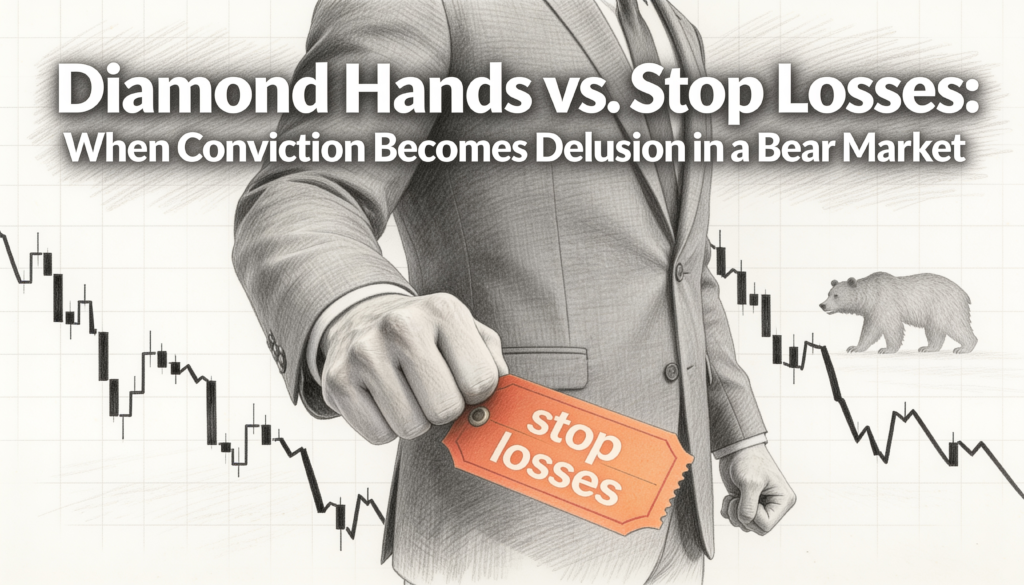
The forum’s mantra of diamond hands, meaning never sell regardless of what happens, proved to be excellent advice for the early participants and devastating advice for the late ones. The same architecture that rewarded conviction also punished the crowd that arrived after the conviction had already paid off.
Why Both Communities Will Survive
Neither community is disappearing, because each one satisfies a psychological need that the other cannot touch.
WallStreetBets gives people permission to be irrational. In a financial culture that constantly lectures you about compound interest and long term thinking, there is something genuinely liberating about a space that says yes, this is a gamble, we know, that is the entire point. For younger investors who feel priced out of the traditional wealth building path, this honesty about the nature of speculation is paradoxically more truthful than the polished advice they receive everywhere else.
FinTwit gives people permission to be serious. In a media environment that treats finance as either boring or scandalous, there is real value in a community that treats investing as a craft worth studying. For people who want to genuinely understand how markets work rather than simply bet on them, FinTwit offers something formal education often does not: real time commentary from practitioners who are putting their own money where their analysis is.
The Investors Who Use Both
The most revealing detail is this. The most successful retail investors tend to read both. They understand the market as a system worth studying and as a system that periodically stops being rational. They take FinTwit seriously without taking it too seriously. They enjoy WallStreetBets without ever letting it set their risk tolerance.
The forum and the feed are not really competitors. They are two halves of what it means to be a retail investor in an era where information is free, access is universal, and nobody has yet decided whether that is a gift or a trap.
The lesson is not to pick a side. It is to recognize that the platform you spend time on is quietly shaping the investor you are becoming. The upvote button wants you brave and broke. The follower count wants you articulate and overconfident. Understanding that architecture is the first real step toward thinking for yourself inside either one.