Table of Contents
Why Passive Income Strategy Selection Decides Your FIRE Timeline
There is a war happening in the comment sections of personal finance forums, and it reveals more about human psychology than either side would care to admit. The question at the center of it is deceptively simple: which passive income strategy actually gets you to financial independence fastest, with the least effort? This ranked guide answers that question directly, comparing the best passive income strategies for FIRE from lowest to highest effort, with each option rated on yield, effort, and scalability.
If you have ever watched the real estate crowd and the dividend investors argue, you already understand the stakes. One side buys properties, collects rent, and fixes toilets at midnight. The other buys shares, collects quarterly payments, and never receives a phone call from a tenant locked out at two in the morning. Both groups worship at the same altar of Financial Independence Retire Early. Both want enough passive income to escape the gravity of a nine to five job. Yet they cannot agree on the most fundamental question of all: where should the money go?
This is not really a debate about returns. It is a debate about identity, temperament, and how much of your life you are willing to trade for yield. So let us rank the real options honestly, from the strategy that demands almost nothing of you to the one that can quietly take over your weekends.
The FIRE Passive Income Ranking: Lowest to Highest Effort
Before we examine each strategy in depth, here is the framework this guide uses. Every passive income source for FIRE can be measured on three axes that matter more than any single headline return number.
- Yield: How much income the asset produces relative to the capital you invest.
- Effort: The ongoing time, attention, and emotional energy required to keep the income flowing.
- Scalability: How easily you can grow the income stream without proportionally growing your workload.
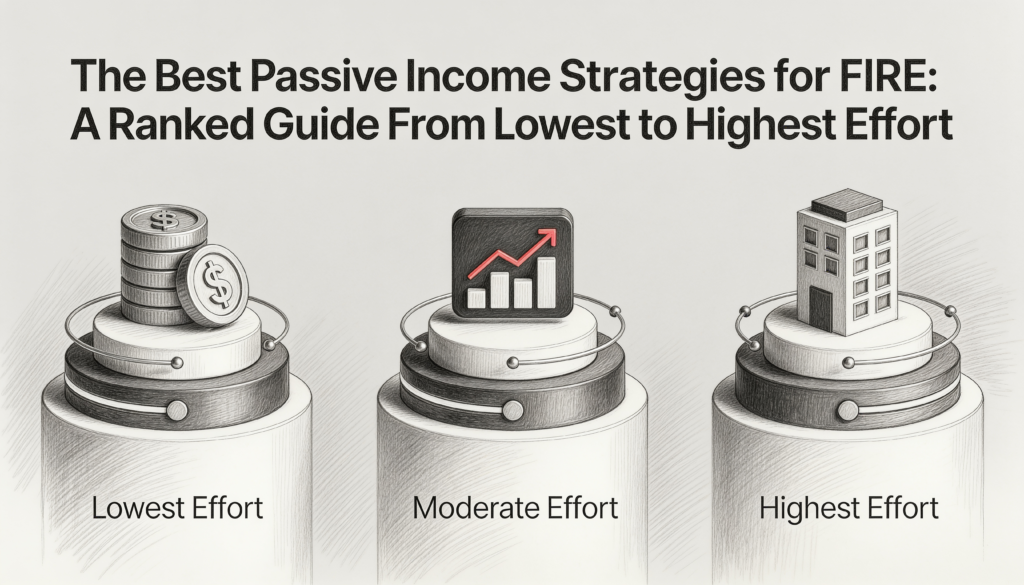
Ranked from lowest effort to highest, the four core FIRE passive income strategies are bond ladders, dividend portfolios, REITs, and rental properties. The most important insight is that effort and yield do not move together in a clean line. Sometimes you pay more effort and receive less. That is the trap this guide exists to help you avoid.
The strategy you cannot stick with is the worst strategy, regardless of what the math says. Temperament is not a footnote to the FIRE plan. It is the plan.
Rank 1: Bond Ladders (Lowest Effort, Lowest Yield)
A bond ladder is the closest thing to genuinely passive income that exists. You buy a series of bonds or Treasury instruments that mature at staggered intervals, for example one year, two years, three years, and so on. As each rung matures, you reinvest the principal into a new long rung, keeping the ladder rolling. The income arrives on a schedule you can predict almost to the dollar.
Yield: Modest. Depending on the interest rate environment, a Treasury or investment grade bond ladder might produce somewhere in the range of three to five percent. It will rarely make you rich, but it will rarely surprise you either.
Effort: Minimal. Once the ladder is built, you do almost nothing except reinvest maturing rungs. There are no tenants, no quarterly earnings calls, and no late night plumbing emergencies. For a retiree who values certainty above all, this is the quietest income stream available.
Scalability: Limited. You cannot leverage a bond ladder the way you can leverage property, and the yields do not compound aggressively. Bond ladders are excellent for preserving capital and smoothing income in early retirement, but they are a poor engine for building wealth from a small base. They shine as the stability layer of a FIRE portfolio rather than its growth core.
Rank 2: Dividend Portfolios (Low Effort, Moderate Yield)
Dividend investing occupies the sweet spot for many FIRE seekers. You open a brokerage account, buy shares of companies that have paid and increased their dividends for decades, and you wait. That is essentially the entire strategy.
The appeal is minimalism. You do not need to understand plumbing. You do not need to screen tenants. You do not need to know anything about local housing markets, zoning laws, or the specific type of mold that voids an insurance policy. You need to understand one thing: certain companies generate more cash than they need and return the excess to shareholders.
The dividend investor’s favorite companies tend to be boring. Utilities. Consumer staples. Healthcare. Companies that sell toothpaste and electricity and the things people need regardless of what the economy is doing. These are not the companies that make headlines. They are the companies that make money, quietly, year after year, while everyone else chases the latest exciting thing.
Yield: Moderate. Quality dividend portfolios often yield between two and four percent, with the additional benefit that strong dividend payers tend to grow their payouts over time. A dividend that rises faster than inflation is one of the most underrated assets in personal finance.
Effort: Low. After the initial research and purchase, your main job is reinvesting dividends and resisting the urge to tinker. The effort is intellectual rather than physical, which suits people who would rather read an annual report than inspect water damage.
Scalability: Excellent. You can add capital in any amount, at any time, with a few clicks. There is no minimum lot size the way there is with a building, and no geographic limit on where you can invest.
The person who started buying dividend stocks at twenty five and reinvested every payment is sitting at forty five with an income stream that looks suspiciously like a salary, except nobody can fire them from it.
There is a beautiful irony here. The FIRE movement attracts people who are, by definition, impatient with the traditional timeline of working until sixty five. Yet the dividend path to freedom requires extraordinary patience. You are essentially watching paint dry in a brokerage account and calling it a strategy. But paint does dry, and dividends do compound, and patience is the one ingredient the spreadsheets cannot supply for you.
Rank 3: REITs (Low to Moderate Effort, High Yield)
Real Estate Investment Trusts are the strategy both purist camps love to ignore, and that neglect is exactly why they deserve serious attention. A REIT is, in essence, a company that owns and operates income producing real estate and is legally required to distribute the majority of its income to shareholders as dividends.
When you buy shares of a REIT, you become a landlord and a dividend investor simultaneously. You collect rent indirectly, through dividend payments. You own real estate indirectly, through the stock market. You deal with zero tenants and zero toilets. The REIT investor has found a loophole in the tribal war.
Yield: High. Because REITs must distribute most of their income, their yields frequently land in the four to seven percent range, higher than most dividend stocks and most bond ladders. This makes them attractive for investors who need current income rather than long term growth alone.
Effort: Low to moderate. Buying a REIT requires the same effort as buying any stock, but the underlying volatility is higher than a Treasury ladder, so it demands a slightly stronger stomach and more attention to interest rate trends, which heavily influence REIT prices.
Scalability: Excellent. Like dividend stocks, REITs can be purchased in any amount and sold in seconds, giving you real estate exposure without the lumpy capital requirements of buying physical buildings.
The purists on both sides tend to dismiss REITs. Real estate investors say it is not real ownership. Dividend investors point out that REIT dividends are usually taxed as ordinary income rather than at the lower qualified dividend rate. Both objections carry weight. But for the person who wants exposure to both worlds without the full commitment of either, REITs represent a pragmatic compromise that neither tribe wants to endorse, because endorsing it would mean admitting the other side has a point.
Rank 4: Rental Properties (Highest Effort, Highest Potential Yield)
Rental property sits at the high effort end of the spectrum, and it is also where the largest returns and the largest headaches live together. You buy a unit. You find a tenant. The tenant pays rent. The rent covers the mortgage, the taxes, the insurance, and ideally leaves something extra in your pocket. Over time the mortgage gets paid down, the property appreciates, and you own a physical thing that generates income.
There is something deeply satisfying about collecting rent. It taps into a part of the human brain that predates stock markets by several thousand years. You own something real. You can touch it. You can stand on it and say, that is mine, and someone is paying me to use it. That is not a trivial psychological advantage, and it is the main reason real estate investors stay with the strategy even when the numbers suggest they should not.
But here is what nobody puts on their Instagram highlight reel. Rental properties are work. Serious, unglamorous, occasionally soul crushing work. The word passive is doing a tremendous amount of heavy lifting in the phrase passive income when applied to real estate.
Yield: Potentially the highest of any option on this list, especially when leverage is involved, but also the most variable. Vacancy, maintenance, and bad tenants can turn a projected eight percent return into a loss in a single bad year.
Effort: The highest. Vacancy rates eat into returns. Maintenance costs appear at the worst possible moments. Property taxes rise. Insurance rises. The roof does not rise. The roof goes down, slowly, and then all at once, and then you are writing a check that wipes out two years of rental income.
Scalability: Strong but labor intensive. Each additional property adds income and adds management burden. Scaling typically requires either hiring a property manager, which reduces your yield, or accepting that your passive income has quietly become a second job.
The Leverage Question That Changes Everything
There is one advantage that rental real estate holds over every other strategy on this list, and it is significant enough to reshuffle the entire ranking for the right investor. That advantage is leverage.
When you buy a rental property, you typically put down a fraction of the purchase price and borrow the rest. The tenant’s rent pays off the loan. You control an asset worth far more than the cash you invested. If the property appreciates, your return on invested capital is amplified dramatically, because you are earning gains on the full value of the property, not just on your down payment.
This is powerful. It is also dangerous. Leverage is the financial equivalent of a double edged sword that people keep picking up by the blade. When things go well, it makes you look like a genius. When things go badly, it makes you look like you need a second job.
Dividend investors, REIT holders, and bond ladder builders do not typically use leverage. They buy with cash, and their returns are whatever the assets return, nothing more and nothing less. This sounds modest until you consider that modest and consistent has a long history of winning over decades. Leverage is the single factor that can push rental property to the top of the yield ranking, but it is also the factor most likely to end a FIRE journey prematurely.
The Tax Conversation Nobody Enjoys
Every strategy on this list carries tax implications, and each tribe loves to claim that their approach is the most tax efficient. The truth is more complicated than either side admits.
Rental income is taxed, but landlords can deduct mortgage interest, depreciation, repairs, and a long list of expenses that often reduce taxable income to something surprisingly small. In some cases a profitable rental property can show a paper loss for tax purposes. This is legal and widely practiced. The tax code, whether by design or accident, rewards property ownership in ways that benefit the real estate investor enormously.
Dividend income is also taxed, though qualified dividends receive preferential rates. The dividend investor cannot deduct much. There is no depreciation schedule on a share of a consumer staples company and no maintenance expense to write off. The income shows up, you pay tax on it, and that is that. REIT dividends sit in a less favorable position, generally taxed as ordinary income, while bond interest is also typically taxed at ordinary rates unless you hold municipal bonds.
A tax deduction on a bad investment is still a bad investment. You do not win by losing money more efficiently.
On a purely tax basis, rental real estate often wins. But tax efficiency only matters if the underlying investment is sound. Choosing a strategy for its tax treatment alone is how people end up rich on paper and poor in reality.
What the Spreadsheets Will Not Tell You
The internet is full of comparison charts. Real estate returns versus dividend returns. Leveraged versus unleveraged. Before tax versus after tax. These charts are useful in the same way a map of a city is useful. They show you the streets but tell you nothing about the neighborhoods.
What the spreadsheets miss is the human element, and that is where these strategies diverge most dramatically. Rental real estate selects for a certain type of person. Someone comfortable with debt. Someone who does not mind confrontation. Someone who can look at a property in terrible condition and see potential rather than problems. Someone who, frankly, enjoys the game, the negotiation, the renovation, the deal.
Dividend and bond investing select for a different temperament. Someone who values simplicity. Someone who finds comfort in routine. Someone who would rather spend Saturday morning reading annual reports than driving across town to inspect water damage. Neither personality is superior. But you had better know which one you are before you commit serious capital to either path.
Matching the Strategy to the Person
Strip away the spreadsheets and the leverage ratios, and what you find underneath the tenants versus dividends debate is a disagreement about control. The real estate investor wants control. They want to choose the property, pick the tenant, set the rent, and decide when to renovate and when to sell. They are building a business and they want their hands on the steering wheel.
The dividend and REIT investor wants freedom from control. They want to own their time, not manage a portfolio of physical assets. They are willing to accept slightly less control over their investments in exchange for significantly more control over their calendar. Both are valid expressions of what financial independence actually means.
The Verdict: How to Choose Your FIRE Passive Income Strategy
Here is the conclusion neither tribe will enjoy hearing. The difference in long term returns between a well executed real estate strategy and a well executed dividend strategy is probably smaller than either camp believes. Both approaches, done competently over sufficient time, tend to produce enough income to fund a modest early retirement.
The person who retires at forty five on rental income and the person who retires at forty five on dividend income end up in roughly the same place. One has more stories about difficult tenants. The other has more free time. For most FIRE seekers, the smartest move is not picking one strategy but layering several: a bond ladder for stability, a dividend portfolio for growing income, REITs for higher current yield, and rental property only if you genuinely enjoy the work.
The real risk is not choosing the wrong strategy. It is choosing the right strategy and executing it poorly. The landlord who buys in the wrong market with too much debt. The dividend investor who chases high yields without checking whether the company can sustain them. Failure in both camps looks identical: not enough income to cover expenses, and a long walk back to the office.
So spend less time arguing about which path is superior and more time ensuring that whichever path you choose is walked with discipline, patience, and an honest assessment of your own temperament. Because the greatest risk in any investment strategy is not the market. It is the investor. And the investor, unfortunately, has to live with themselves, which turns out to be the hardest part of early retirement that nobody warned you about.