Table of Contents
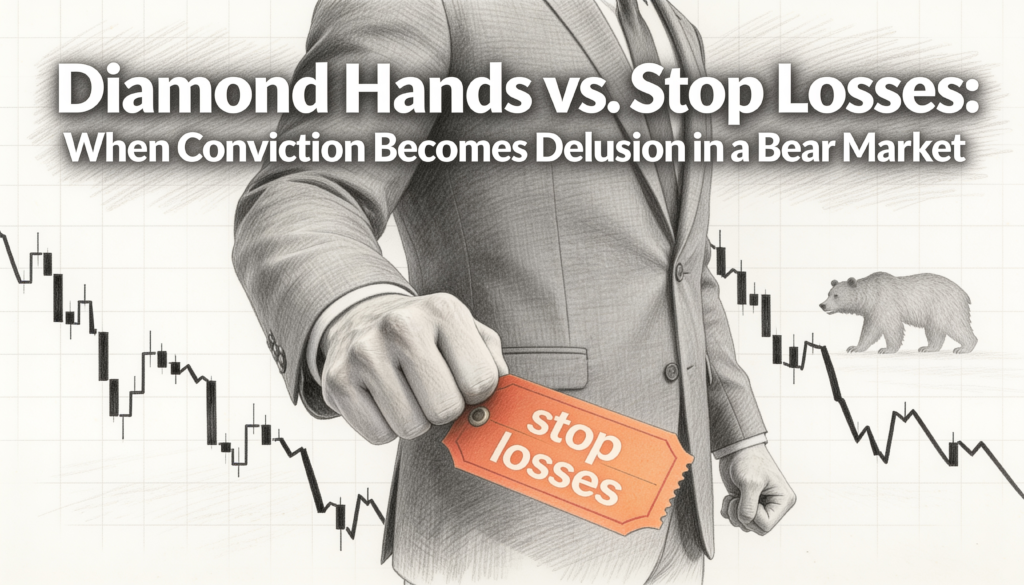
Diamond Hands vs. Stop Losses: The Decision That Defines Your Wealth
There is a phrase that has become something like a rallying cry in modern investing culture. Diamond hands. The idea is simple and seductive: hold your position no matter what, never sell, never flinch, and the market will eventually reward your courage. It sounds brave. It also sounds like something a person would say right before walking into traffic because they refuse to believe cars are real.
Let us be clear about what we are actually discussing. A 60 percent drawdown is not a bad week or a rough quarter. It is the destruction of more than half the value of your investment. If you had one million dollars, you now have four hundred thousand. And someone on the internet is telling you to hold. This article is not about whether markets recover, because they usually do. This is a decision framework for distinguishing between healthy long term conviction and destructive diamond hands, because the difference between the two is the difference between building wealth and watching it disappear.
The question that matters is not whether you have the nerve to hold. The question is whether holding is the rational decision for this specific asset, at this specific moment, given your specific circumstances. By the time you finish reading, you will have a concrete set of criteria to answer that question without relying on slogans, tribal loyalty, or the emotional fog that descends on every investor during a bear market.
The Math That Nobody Wants to Hear
Here is the part that makes diamond hands uncomfortable, and it is not complicated. If your investment drops 60 percent, it does not need to gain 60 percent to get back to where you started. It needs to gain 150 percent. Read that again. Your asset needs to more than double from its lowest point just to return you to zero. Not to profit. Simply to break even.
This is not a minor detail. This is the entire problem. Most people who repeat the diamond hands mantra treat a drawdown as if it were symmetrical. Down sixty, up sixty, back to normal. But losses and gains do not work that way. Losses are heavier than gains.
- A 25 percent loss requires a 33 percent gain to recover.
- A 50 percent loss requires a 100 percent gain to recover.
- A 60 percent loss requires a 150 percent gain to recover.
- A 75 percent loss requires a 300 percent gain to recover.
- A 90 percent loss requires a staggering 900 percent gain to recover.
The deeper the hole, the more exponentially difficult it becomes to climb out. This asymmetry is not a market quirk. It is arithmetic. And arithmetic does not care about your conviction.
The most dangerous lie diamond hands tells you is that a loss and a gain of the same percentage cancel each other out. They never do. The hole always demands more to escape than it took to fall in.
Understanding this asymmetry is the foundation of every sound decision in a drawdown. The investor who internalizes it stops cutting losses late and stops letting small wounds become fatal ones. The investor who ignores it convinces himself that recovery is just around the corner, when in fact the corner keeps moving further away with every additional percentage point lost.
Where the Metaphor Breaks Down
The diamond hands idea borrows its power from a metaphor about strength. Diamonds are the hardest natural material on earth. They do not crack. They do not bend. Therefore, goes the logic, you should not crack or bend either.
But there is something interesting about diamonds that the metaphor conveniently ignores. Diamonds are hard, yes. But hardness and toughness are not the same thing. A diamond can shatter. Strike one with a hammer at the right angle and it will break into pieces. Hardness means resistance to scratching. Toughness means resistance to fracturing under stress.
The distinction matters enormously. What investors actually need is not hardness. It is toughness, the ability to absorb shock without breaking apart. And sometimes absorbing shock means adapting your position rather than freezing in place while your portfolio disintegrates. Rigidity is not strength. Ask any structural engineer. The buildings that survive earthquakes are the ones designed to flex, not the ones that refuse to move.
Why Flexibility Beats Rigidity
A reed bends in the storm and survives. The oak stands rigid and snaps. This is not a poetic flourish. It is a description of how systems endure stress. An investor who reassesses, adapts, and occasionally retreats is not weaker than one who refuses to move. He is the one still standing when the storm passes. The willingness to change your mind when the facts change is the most underrated form of financial strength that exists.
The Survivorship Bias Problem
Every diamond hands success story you have ever heard has a twin you have not. For every person who held through a 60 percent crash and came out richer, there is someone who held through a 60 percent crash on an asset that never recovered. You simply never hear from the second person.
This is survivorship bias at its most seductive. We see the winners and build a philosophy around their experience. The investors who held Amazon through the dot com crash and emerged wealthy are legendary. But the investors who held Pets.com with identical conviction are invisible. They are not writing blog posts. They are not appearing on podcasts. They disappeared from the conversation along with their money.
When someone tells you that diamond hands always works, what they are really telling you is that diamond hands worked for the survivors. That is like studying only lottery winners and concluding that buying tickets is a sound retirement plan.
The lesson is not that holding is wrong. The lesson is that the stories you hear are systematically filtered to make holding look smarter than it was. Your decision framework must account for the assets that died silently, because those are the assets diamond hands culture never mentions.
The Psychological Traps That Disguise Themselves as Strength
There is a concept in psychology called the sunk cost fallacy. It describes our tendency to continue investing in something because of what we have already put in, rather than because of what we expect to get out. The more we have lost, the harder it becomes to walk away, because walking away means admitting the loss is real.
Diamond hands is the sunk cost fallacy wearing a costume. When your portfolio is down 60 percent, your brain does something fascinating and terrible. It reframes the situation so that holding feels like an active decision rather than a passive one. You are not failing to act. You are choosing to be strong. You are not watching your money disappear. You are demonstrating conviction.
This reframing is psychologically comforting, which is precisely why it is dangerous. Comfort and correctness are not the same thing. The most comfortable decision in a burning building is to stay in bed.
The Identity Problem
Something strange happens when holding becomes part of your identity. You stop evaluating the investment on its merits and start defending it as an extension of yourself. An attack on the asset becomes an attack on you. Selling becomes not just a financial decision but a betrayal of who you are.
This is not investing. This is religion. And like religion, it provides community, meaning, and a sense of belonging. The language is revealing. Paper hands is an insult. It means weakness. It means you are not one of us. When the social cost of selling becomes higher than the financial cost of holding, you are no longer making investment decisions. You are making social ones. Social decisions are wonderful for building friendships and catastrophic for building wealth.
The Opportunity Cost Nobody Mentions
Here is where diamond hands gets truly expensive, and it has nothing to do with the asset you are holding. When your capital is locked into a position that is down 60 percent, that capital is not only losing value. It is also unavailable for everything else.
Think of it this way. You are at a buffet. You filled your plate with something that turns out to be terrible. Diamond hands says keep eating, finish the plate. But the buffet is still open. There are other dishes, and some of them are extraordinary, and your stomach has a limited capacity. Capital is the same. It is finite. The money tied up in a losing position is not just shrinking, it is also idle, sitting in a hospital bed when it could be out working. Professional investors cut losses not because they lack courage but because they respect opportunity cost.
The Decision Framework: Conviction or Delusion
If diamond hands is not the answer and panic selling is not the answer either, what separates the two? The difference between healthy conviction and destructive delusion comes down to a series of honest questions. Work through each one before you decide to hold or sell.
Criteria That Justify Holding
You may have healthy long term conviction when most of the following are true:
- You own a broad, diversified index rather than a single speculative name. The S and P 500 has recovered from every major crash in its history. Individual companies go to zero constantly. Holding through a broad market decline is supported by decades of evidence. Holding through the collapse of a single company is supported by hope.
- Your original thesis remains intact. The fundamentals that made you buy have not deteriorated. Revenue, market position, and competitive advantage are still there. The price fell because of panic, not because the business is dying.
- The drawdown is driven by sentiment, not deterioration. Macro fear, rising rates, and general market panic are temporary. A collapsing product, fraud, or vanishing demand are permanent.
- The position is correctly sized. A 60 percent fall in this holding does not threaten your financial life, because you never concentrated too much capital in one place.
- You have time on your side. Your horizon is long enough that mathematical recovery is realistic.
Criteria That Reveal Delusion
You are likely trapped in destructive diamond hands when most of the following are true:
- You are holding because selling would feel like losing. The decision is emotional, not analytical. You cannot articulate a single fundamental reason to stay invested.
- The fundamentals have genuinely broken. The company is bleeding cash, losing customers, or facing existential threats, yet you cling to the price you paid.
- Your identity is wrapped up in the position. You defend the asset online, you mock people who sold, and the social cost of admitting a mistake feels unbearable.
- The position is dangerously oversized. A further drop would materially damage your retirement, your home, or your ability to function financially.
- You have no exit plan and never did. You bought on a feeling and you are holding on a feeling.
Conviction asks one question: has anything actually changed about the business or the broad market thesis I believed in? Delusion asks a different one: how do I avoid admitting I was wrong? Learn to tell which question you are answering.
The Role of Stop Losses
A stop loss is not an admission of cowardice. It is a pre committed decision made with a clear head before the crisis arrives. Professional traders decide their exit points before they enter a position. They know in advance what level of loss they are willing to accept. This is not weakness. It is engineering. You do not design a bridge during the earthquake.
For a single speculative position, a stop loss protects you from the asymmetry of losses described earlier. It caps the damage before a 30 percent decline becomes the 75 percent decline that requires a 300 percent recovery. For a broad index held inside a long term plan, a hard stop loss may be inappropriate, because the evidence supports riding out volatility. The instrument is not universally good or bad. It is appropriate or inappropriate depending on what you own and why.
The Stoicism Misunderstanding and the Cost of Time
Diamond hands culture loves to borrow from Stoic philosophy. Hold firm. Endure. What is outside your control does not matter. But this is a shallow reading of Stoicism. The Stoics did not teach blind endurance. They taught rational assessment of what you can and cannot control, followed by appropriate action.
Marcus Aurelius did not sit on his throne ignoring problems. He governed an empire, made difficult decisions, and adapted constantly to changing circumstances. The genuine Stoic response to a 60 percent drawdown is not to hold blindly. It is to assess the situation clearly, without emotion, and then act according to reason. Sometimes that means holding. Sometimes it means cutting your losses. The point is that the decision flows from analysis, not from an internet slogan.
When Diamond Hands Actually Kills
The darkest version of this myth is not the investor who loses money. It is the investor who loses time. A 35 year old who takes a massive loss has decades to recover. The math is painful but survivable. A 58 year old who takes the same loss heading into retirement faces a fundamentally different reality. He does not have decades. He has years. A 60 percent drawdown at that stage can mean the difference between retiring with dignity and working until his body refuses to continue.
Diamond hands does not distinguish between these two people. It offers the same prescription regardless of age, financial situation, time horizon, or personal circumstance. That is not a strategy. That is a slogan. Slogans are wonderful at rallies and terrible in financial planning. Your age and time horizon must sit at the center of every hold or sell decision, because the same drawdown means something completely different at 35 than it does at 58.
The Uncomfortable Truth About Open Hands
Here is what nobody who sells diamond hands merchandise wants you to consider. The phrase did not originate in the halls of successful investment firms. It did not emerge from decades of research into portfolio management. It was born on internet forums, popularized in many cases by people gambling with money they could not afford to lose, and elevated into wisdom by a culture that confuses stubbornness with strength.
This does not mean that holding through volatility is always wrong. It means that turning it into an identity, a moral virtue, and a measure of your character is a category error of the highest order. The market does not reward courage. It does not punish cowardice. It does not know you exist. It is a mechanism for pricing assets, and it does this with complete indifference to how you feel about your positions.
The best investors in history are not the ones who held the longest. They are the ones who thought the clearest. They assessed, they adapted, and when the evidence demanded it, they let go.
So build the framework instead of adopting the slogan. Ask whether your thesis still holds. Ask whether the business or the broad market has actually deteriorated. Ask whether your position is sized to survive. Ask how much time you truly have. Then decide, calmly and on the merits, whether to hold or to release. Because sometimes the bravest and smartest thing you can do is open your hands.