Table of Contents
The Brutal Truth About Aggressive FIRE: Freedom Has a Price Tag You Pay Upfront
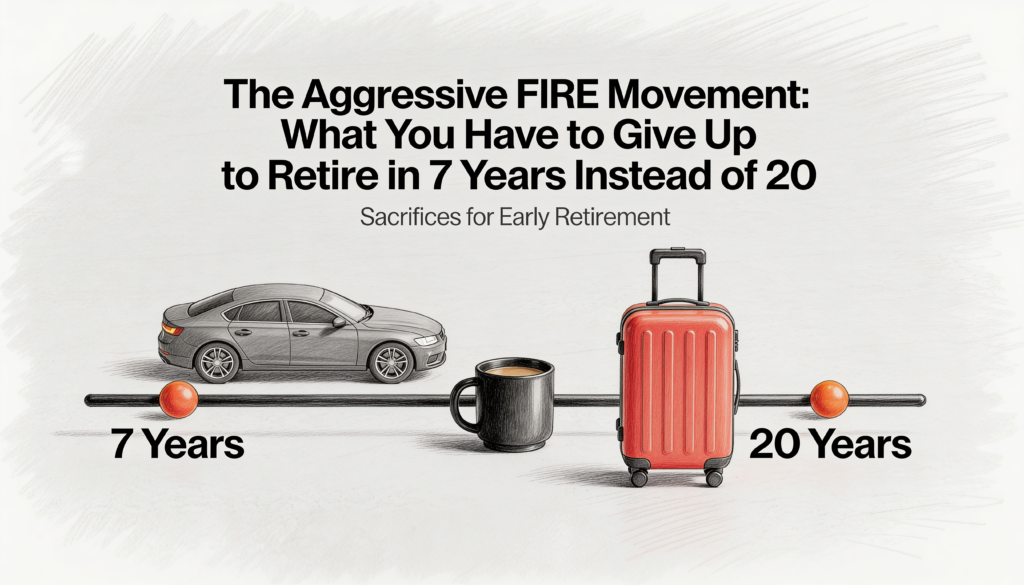
Retiring in seven years instead of twenty is not a financial trick. It is a series of painful sacrifices most people refuse to make, and pretending otherwise is dishonest. The aggressive FIRE movement demands that you give up things your peers consider essential to a normal life, and the only honest question worth asking is whether the freedom you buy justifies the price you pay along the way.
The FIRE movement promises something most financial advice does not dare to: actual freedom in exchange for actual sacrifice. Not the sanitized version where you clip coupons and feel virtuous, but the kind where you question every assumption about how life should be lived. It is less about retirement and more about buying back your time before you are too old to know what to do with it. Before you commit, you deserve to see the full bill.
What You Actually Have to Give Up to Retire in Seven Years
Let us begin with the sacrifices, because that is where the real story lives. When you compress forty years of conventional saving into seven, you are not trimming the fat from your budget. You are amputating limbs of your lifestyle that other people consider permanent fixtures. To hit a savings rate of fifty, sixty, or even seventy percent, the math leaves no room for comfortable illusions.
The Experiences You Will Miss While Your Peers Live
The destination wedding in Italy. The luxury vacation your coworkers post about. The house in the good school district that everyone assumes you should buy. The new car that signals you have arrived. These are not trivial sacrifices, and anyone who tells you they are is selling something. When you are saving seventy percent of your income, you are saying no to experiences your friends are having right now, in real time, while you watch from the sidelines and invest the difference.
The question is not whether these sacrifices exist. They clearly do. The question is what you are getting in exchange. Is seven years of aggressive saving worth twenty or thirty or forty years of freedom? Is missing some parties worth never having to sit in another meeting that could have been an email? Is driving an older car worth waking up when you want instead of when an alarm dictates your morning?
The Social Belonging You Will Trade for Numbers in a Spreadsheet
Humans are tribal creatures. We take cues from those around us about what is normal, what is acceptable, what is worth pursuing. When everyone you know is buying houses with thirty year mortgages and leasing cars they cannot afford, doing the opposite feels not just different but deviant. Aggressive FIRE requires comfort with being the weirdo.
You become the person who does not upgrade their phone every year. Who packs lunch instead of eating out. Who talks about index funds at dinner parties, which is definitely a way to ensure you are not invited to many dinner parties. This social cost is real, and pretending it does not exist is naive. You will feel the distance between yourself and people who once shared your habits, and that distance does not always close pleasantly.
The person who discovers they do not need most of what they thought they needed does not feel deprived. They feel liberated. Forced poverty feels like prison. Voluntary simplicity feels like clarity. The difference is not in the bank account. It is in the locus of control.
The Lifestyle Inflation You Must Permanently Refuse
Here is the counterintuitive part that trips up high earners. As you earn more, lifestyle inflation creeps in. The nicer apartment. The better restaurants. The premium gym membership. Before you know it, you are making twice as much and saving the same amount, or worse, saving a smaller percentage. The people who succeed at aggressive FIRE learn to decouple earnings from spending. When they get a raise, the money goes straight to investments, not lifestyle upgrades. This requires saying no to opportunities for immediate gratification over and over, for years on end.
The Problem Is Not Money, It Is Your Relationship With Time
Most people treat financial independence like a math problem. Save this much, invest that much, retire at this age. They are technically right but existentially wrong. The real revelation of FIRE is not compound interest or the four percent rule. It is recognizing that you have been trading the most valuable asset you have, your finite hours on Earth, for the least valuable asset there is, money that inflates away while sitting in your bank account.
The conventional path looks safe: spend forty years climbing, then relax when your body hurts and your sense of adventure has atrophied. The aggressive FIRE path flips this logic. It says the risk is not in leaving the corporate ladder early. The risk is staying on it so long you forget why you climbed it in the first place.
But here is where it gets interesting. FIRE is not really about retiring early. It is about optionality. When you achieve financial independence, you are not obligated to quit your job. You are free to choose whether to keep it. That subtle shift transforms everything. Your boss no longer holds leverage. The passive aggressive coworker becomes amusing rather than enraging. You are there by choice, not necessity, and that makes all the difference. This is precisely what you purchase with all those sacrifices: not idleness, but the power to decide.
The Mathematics of a Seven Year Timeline
You do not need complicated spreadsheets or financial wizardry. The core insight fits in a sentence: spend less than you earn, invest the difference in assets that generate returns, and repeat until your assets generate enough to cover your expenses. That is it. Everything else is commentary.
The real challenge is not understanding this formula. A child could grasp it. The challenge is emotional. It is watching friends take exotic vacations while you are investing. It is driving an old car when you could afford a new one. It is explaining to family why you are not buying the house they think you should buy. The math is easy. The social pressure is crushing.
Why Your Savings Rate Matters More Than Your Income
Yes, earning more makes the math easier. Obviously. If you make six figures, saving aggressively is more feasible than if you make thirty thousand. But aggressive FIRE is not primarily about the number you earn. It is about the gap between earning and spending.
Someone making eighty thousand who spends thirty thousand is in a better position than someone making one hundred fifty thousand who spends one hundred thirty thousand. The high earner has more comfort in the moment but less freedom in the future. The modest earner has less impressive consumption but more impressive optionality. In the FIRE framework, your savings rate is the only number that truly matters. A fifty percent savings rate beats a ten percent savings rate regardless of the absolute dollars involved.
Why Seven Years Specifically
Seven years is short enough to seem achievable but long enough to require genuine transformation. It is not a get rich quick scheme. It is a get intentional quick scheme. You are compressing what society says should take forty years into seven, and that compression creates heat. It burns away everything inessential.
What most people do not realize is that the person who achieves FIRE in seven years does not become a different person in year eight. The transformation happens during the journey. By the time you hit financial independence, you have already rewired your relationship with work, money, status, and meaning. The bank account is just evidence of deeper change.
The Three Psychological Barriers Nobody Talks About
The financial sacrifices are visible. The psychological ones are not, and they sabotage more aspiring early retirees than any market crash ever could.
Identity Confusion When the Work Disappears
Most people derive their sense of self from their work. Take that away, and who are they? The lawyer who retires at forty five is not a lawyer anymore. They are just someone with opinions about tort reform and no particular place to share them. This terrifies people more than they admit. FIRE forces a confrontation with meaning outside of career. What do you actually care about when no one is paying you to care about it? What gives your days structure when structure is no longer imposed externally? These questions are harder than asset allocation.
The Shifting Goalpost That Keeps You Imprisoned
You start pursuing FIRE with a target number. Let us say you need five hundred thousand to generate enough passive income to cover expenses. You grind for years, make sacrifices, invest consistently. Then you hit four hundred thousand and suddenly five hundred does not feel like enough. Maybe you need seven hundred fifty. Or a million. Just to be safe.
This moving target sabotages the entire project. The person who can never feel secure enough to pull the trigger has not actually achieved financial independence. They have achieved financial anxiety with a bigger bank account. The point is to buy freedom, not to accumulate a score you are too afraid to cash in.
The person who can never feel secure enough to pull the trigger has not actually achieved financial independence. They have achieved financial anxiety with a bigger bank account.
Security Through Apparent Insecurity
The traditional path promises security. Get the degree, get the job, climb the ladder, collect the pension. It feels safe because everyone does it and most people end up fine. But this safety is illusory. Your security depends entirely on factors outside your control: your employer’s solvency, the economy’s stability, your continued good health.
Aggressive FIRE inverts this. It feels risky because you are leaving the conventional path. But once achieved, it is actually more secure. Your income does not depend on one employer or one economy or one anything. It is diversified across investments, and those investments are yours. No one can fire you from your own portfolio. It takes real psychological work to overcome the bias that conflates familiar with safe.
Why the First Year Is Harder Than the Last
The beginning of the aggressive FIRE journey feels impossible. Your expenses seem reasonable and your income seems limited. Cutting back feels like deprivation. Investing feels like throwing money into a void. You cannot see the finish line and you are not even sure it exists.
Then something shifts. Usually around year two or three. You start seeing the numbers grow. Not from your contributions alone, but from returns on earlier contributions. The compound interest that sounded theoretical becomes visible. Your net worth starts moving faster than your salary would suggest.
By year five or six, momentum takes over. Your investments are generating serious returns. Your spending habits have normalized at a lower level and do not feel like sacrifice anymore. The finish line becomes visible, then imminent. The last year feels easier than the first year because you have changed. The journey has rewired you.
This progression explains why most people never try. They evaluate FIRE based on how year one feels and decide it is not worth it. They are right about year one. They are wrong about year seven. But you cannot experience year seven without surviving year one, and that creates a genuine catch twenty two.
The Evolution of Wants Versus Needs
One of the strangest discoveries on the path to aggressive FIRE is how flexible your needs turn out to be. Things that felt essential become optional. Luxuries you thought defined a good life reveal themselves as habit or status signaling or boredom.
This is not about becoming an ascetic. It is about becoming honest. Do you actually need the cable package or do you just watch three shows? Does the car need to be new or does it need to start reliably? Is the expensive gym membership making you healthier or making you feel like someone who has an expensive gym membership?
That restaurant meal did not cost forty dollars. It cost two hours of work. Or, once you achieve financial independence, it cost one day of freedom.
Most people live in a fog about their spending. They know generally what they earn and roughly what they spend, but the details blur together. FIRE practitioners live in crystalline clarity. They know what everything costs, not just in dollars but in time. This level of awareness changes behavior almost automatically. You do not need willpower to skip purchases that clearly do not provide enough value. You just need to see them clearly.
The Finish Line That Is Not Actually a Finish Line
What you are really buying with aggressive FIRE is not retirement. It is an education in what you actually value when the pressure is off. Most people never get this education because they are too busy working to think about whether the work is worth doing.
The moment of arrival often disappoints people. They expected euphoria and got ambiguity. The chase was clear. The capture is confusing. What do you actually want to do with unlimited time? The question sounds indulgent until you have to answer it every single morning.
Without the structure of employment, your actual priorities reveal themselves. Maybe you discover you love making furniture but hate doing it on a schedule. Maybe you realize teaching brings you joy but only when you choose your students. This period separates those who achieved FIRE because they hated their job from those who achieved it because they wanted to design their life. The former are running away from something. The latter are running toward something.
Here is the thing nobody mentions: some people achieve FIRE and realize they actually liked working. Not the commute, not the boss, not the bureaucracy, but the sense of contribution, the daily challenges, the social connection. These people often end up working again, but on their terms. They have bought the option to leave, which makes staying feel completely different.
So Is the Price Worth Paying
There is no objectively correct answer. For some people, the conventional path offers more satisfaction. They love their work, they value their current lifestyle, they are not particularly interested in radical freedom. That is fine. Aggressive FIRE is not a moral imperative. It is an option, and a demanding one.
But for those who feel the weight of golden handcuffs, who sense that trading decades for a pension might not be the best available bargain, who wonder if there is more to life than the cycle of work and weekend and work again, the seven year path offers a real alternative. The seven year timeline is not magic. You could do it in five or ten or fifteen depending on circumstances and commitment. But the specific duration matters less than the direction.
The unconventional roadmap is not about tactics or strategies or clever financial instruments. It is about deciding that the default path, comfortable as it may be, is not actually what you want. Everything else flows from that single decision. The math works itself out. The sacrifices stop feeling like sacrifices. The finish line arrives.
And then the real work begins: figuring out what to do with the freedom you paid so dearly to buy.