Table of Contents
The Index Fund vs. Stock Picking Debate That Splits the Investing World in Two
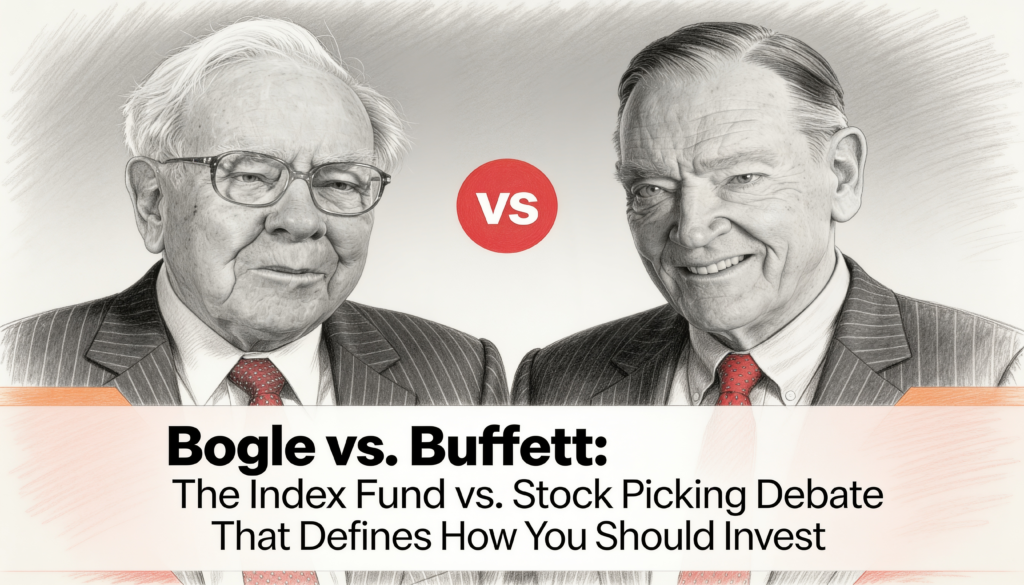
Jack Bogle and Warren Buffett agreed on almost everything that matters in money, and yet they built two of the most influential fortunes in financial history on opposite answers to a single question. That question still divides every serious investor alive today: can skill in picking stocks be identified before the fact, or only after it is too late to profit from it?
Both men thought Wall Street charged too much. Both believed that the overwhelming majority of professional money managers could not beat the market. Both told ordinary people, in plain language, to stop trying to be clever with their savings. And yet buried inside their nearly identical worldviews sits a disagreement so fundamental that it cleaves the entire investing universe into two camps. The index fund vs. stock picking debate is not a quarrel between a genius and a fool. It is a debate between two geniuses who reached different conclusions from the same evidence.
Bogle said: do not pick stocks. Buffett said: I will pick stocks, and I will be right. That is the whole disagreement. It sounds simple. It is not.
Two Philosophies Walk Into a Market
Bogle built Vanguard around one radical idea. The market, taken as a whole, is smarter than any individual trying to outsmart it. The logical response to that insight is to stop trying altogether. Buy everything. Pay almost nothing in fees. Wait. Let the economy do what economies do across decades. This approach is deliberately unexciting. It was never meant to thrill anyone.
Buffett built Berkshire Hathaway around a different radical idea. The market is mostly efficient, but it is not perfectly efficient. Gaps open up. When they do, a patient and disciplined mind can exploit them, not by trading frantically, but by studying businesses deeply and buying them when the price has detached from reality. Then holding. Possibly forever.
Here is the uncomfortable truth that makes this debate endure. Both men are correct, and that is precisely the problem.
If Bogle is right that almost nobody can beat the market consistently, then stock picking is a waste of time for nearly everyone. If Buffett is right that certain rare individuals can identify mispriced assets, then passive investing leaves real money on the table.
These two positions cannot both be universally true. But they can both be situationally true, and that is where the conversation becomes genuinely interesting rather than a tired argument between zealots.
The Church and the Cathedral: A Framework for the Debate
There is a useful way to think about this that has nothing to do with finance at all. Consider how religious traditions handle the question of who is permitted to interpret sacred texts. Some traditions say everyone can read the scripture and find meaning on their own. Others insist you need a trained priest, someone who has spent decades in study, to extract the real meaning from the material.
Bogle is the Protestant reformer. He argued that the wisdom of markets is available to everyone. You do not need a fund manager to intercede on your behalf. Buy the index. The returns of the entire market are your birthright as an investor, and nobody needs to stand between you and the S&P 500.
Buffett is the high priest. He does not disagree that most people should simply buy the index. He has said exactly that, publicly, dozens of times. But he also believes that someone who dedicates an entire life to understanding businesses, who reads annual reports the way a monk reads scripture, can perceive things the market overlooks. The text is available to everyone, yet the interpretation requires a rare kind of discipline that few possess.
This framing reveals something that gets lost in most versions of the Bogle vs. Buffett argument. The disagreement is not really about whether markets are efficient. It is about whether skill exists, and more pointedly, whether you can spot that skill before it has already proven itself.
The Skill Question Nobody Wants to Answer Honestly
This is where the debate becomes genuinely uncomfortable for both sides, because each camp owns a piece of the truth and neither likes the part the other owns.
The Statistical Case Against Stock Picking
The Bogleheads rest their entire philosophy on a single devastating statistical observation. Over any long stretch of time, roughly 85 to 90 percent of actively managed funds underperform their benchmark index after fees. That number does not whisper its conclusion. It screams it. The vast majority of people paid handsomely to pick stocks are not earning their keep. They are charging clients a premium to deliver below average results.
If you want the cleanest argument for passive investing ever constructed, that figure is it. Why pay someone to lose to a benchmark you could own for almost nothing?
Why Most Cannot Do Something Does Not Mean Nobody Can
But the passive investing community sometimes glosses over a crucial subtlety. The fact that most people cannot accomplish a thing does not prove that nobody can. Most people cannot run a four minute mile. That does not make Roger Bannister lucky. Most people cannot compose a symphony. That does not turn Mozart into a statistical anomaly who would have regressed to the mean given a few more years.
Buffett’s record is not a coin flip that happened to land heads for six straight decades. The nature of his outperformance, its consistency, the methodology behind it, the explainable reasoning attached to each position, all point toward something far closer to genuine skill than to luck. And he is not alone in this. Seth Klarman, Howard Marks, Peter Lynch. The roster is short, but it is real, and it has names on it.
The Boglehead response to this is perfectly reasonable, and it deserves respect. They concede that skill exists. Then they make the move that wins the argument for most people:
Fine, skill exists. But you cannot identify it in advance. You only learn who the great investors were after they have already been great, and by the time you know, it is far too late to benefit.
Better, they argue, to own the whole market and guarantee that you capture the average, which, thanks to compounding and rock bottom fees, turns out to be extraordinary across a lifetime. This is a strong argument. It is also, in a strange and overlooked way, a quiet concession that Buffett was right about something important.
The Paradox at the Heart of Passive Investing
Here is the part that should disturb anyone who thinks carefully about how markets actually function. Passive investing only works because active investing exists.
Prices in the stock market are not set by index funds. Index funds are price takers. Prices are set by active investors who are doing the laborious work of analyzing businesses, estimating future cash flows, and deciding what a company is genuinely worth. When you buy an S&P 500 index fund, you are free riding on the intellectual labor of every analyst and active manager who spent that day trying to determine whether a stock was overpriced or underpriced.
Bogle’s revolution depends entirely on the very people it claims are wasting their time. The free rider needs someone to do the driving.
This is not a theoretical concern dreamed up in a faculty lounge. As passive investing has swallowed an ever larger share of the market, academics and practitioners have begun asking what happens when the free ride becomes too crowded. If everyone indexes, who sets the prices? If nobody performs fundamental analysis, what exactly is the index tracking? The efficient market cannot remain efficient if nobody is doing the work that makes it efficient in the first place.
It resembles the claim that you do not need farmers because the grocery store shelves are always full. The shelves are full precisely because the farmers exist. Remove them, and the system that appeared self sustaining collapses within a season.
The Famous Bet That Proves Both Men Right
Buffett grasped this paradox intuitively. In his celebrated wager against hedge fund manager Ted Seides, he bet that a simple S&P 500 index fund would outperform a basket of carefully selected hedge funds over ten years. He won convincingly, and the proceeds went to charity.
But notice the move he made. The greatest active investor in history bet on passive investing to demonstrate that most active investors are not good enough. He never claimed that active investing fails as a discipline. He claimed that most people attempting it are not him. That is not humility. That is a remarkably precise statement about the distribution of talent across a population.
What Bogle Got Wrong
Bogle was a giant of finance. He probably did more for the ordinary investor than any single person in the history of the field, and the savings he generated for everyday people likely run into the hundreds of billions of dollars. But his philosophy carries a blind spot, and honesty requires naming it.
The Boglehead worldview quietly treats investing as a solved problem. Buy total market index funds, keep costs low, stay the course, and time will perform the heavy lifting. This is excellent advice for the overwhelming majority of people. It is also, when followed too rigidly, a way of outsourcing your financial thinking entirely.
There is a meaningful difference between saying most people should not pick stocks and saying that thinking about what you own does not matter. The first statement is backed by mountains of data. The second is a leap that Bogle himself would likely never have endorsed in such stark terms, yet his more devoted followers sometimes take it anyway.
When you buy a total market index fund, you are buying everything indiscriminately. The great companies and the doomed ones. The genuine innovators and the outright frauds. You are buying enterprises that will reshape civilization alongside enterprises that are actively destroying shareholder value as you read this. The index does not care. It weights holdings by market capitalization, which means the larger a company becomes, the more of it you own, regardless of whether that growth reflects durable strength or a bubble waiting to deflate.
This is not a fatal flaw. Over the long run, the index cleans itself. Bad companies shrink and drop out. Good companies grow and dominate. But the process is messy and slow, and the willingness to own everything without discrimination requires a form of intellectual surrender that is not always the wisest posture.
What Buffett Got Wrong
If Bogle’s weakness was the assumption that thinking does not matter, Buffett’s weakness is the assumption that his particular kind of thinking can be replicated.
Every Berkshire Hathaway annual letter reads as a masterclass in investment reasoning. They are clear, logical, and deeply persuasive. They make stock picking appear to be something any disciplined person could accomplish with sufficient effort. Read the financial statements. Understand the business. Wait patiently for the right price. Buy. Hold. The recipe seems almost embarrassingly straightforward.
The trouble is that millions of people have read those letters, absorbed the logic, and still failed to reproduce the results. Not because they were lazy or unintelligent, but because what Buffett does combines temperament, pattern recognition built over seventy years, and access that simply cannot be transmitted through text on a page.
Reading a book by a chess grandmaster explains every move and makes the reasoning transparent. Then you sit down at the board and lose to someone rated five hundred points above you, because understanding the logic and executing under pressure with real money on the line are entirely different skills.
Buffett’s philosophy has spawned an entire generation of self described value investors who believe they are doing exactly what he does. Most of them are not. They are buying cheap stocks and calling it value investing, which is rather like buying discount paint and calling yourself Michelangelo.
The deep irony is that Buffett knows all of this. He has repeated, again and again, that most people should simply buy index funds. Yet the sheer existence of his record, his letters, and his folksy wisdom at the annual meeting in Omaha creates a gravitational pull that draws ordinary people away from the very index fund they should probably be buying. His brilliance becomes an obstacle to the advice his brilliance produced.
The Real Lesson: A Debate About Human Nature, Not Money
The most important insight buried in the Bogle vs. Buffett showdown is that it is not really an argument about money at all. It is an argument about human nature, and about how confident any of us should be in our own abilities.
Bogle Believed in Systems
Bogle believed in structures. Design the right system, eliminate the middleman, minimize costs, and the system will produce good outcomes regardless of who happens to be using it. This is an engineering mindset applied to personal finance, and it is profoundly democratic. It assumes that ordinary people, handed the right tools, do not require extraordinary talent to build genuine wealth across a lifetime.
Buffett Believed in Mastery
Buffett believes in mastery. Study deeply, think independently, develop hard won conviction, and the rewards will be wildly disproportionate. This is a craftsman mindset. It is inherently elitist, not in any insulting sense, but in the literal sense that it assumes some people will always be better at this than others, and that the difference between them genuinely matters.
Both worldviews are incomplete on their own. A world of pure indexing is a world where nobody performs the analytical work that allows markets to function in the first place. A world of pure stock picking is a world where most participants pay high fees for the privilege of underperforming a simple benchmark. The tension between these two ideas is not a flaw waiting to be repaired. It is the engine that makes the entire market run.
How to Decide Which Investor You Actually Are
So how should you resolve this for your own portfolio? Start with brutal self assessment rather than aspiration. Ask yourself a few honest questions before you decide.
- Do you genuinely enjoy reading annual reports, or do you merely enjoy the idea of being someone who reads them?
- Can you hold a falling position for years when every instinct and headline screams at you to sell?
- Do you have an analytical edge that the thousands of full time professionals on the other side of your trade do not?
- Are you prepared to underperform the index for long stretches without abandoning your method?
If you hesitated on even one of these, the data has already answered the question for you. For the overwhelming majority of people, a low cost total market index fund held for decades is not a consolation prize. It is the genuinely optimal choice, the one that quietly beats most of the professionals who scorn it.
Maybe the wisest position is the one neither camp enjoys hearing. Bogle was right about you. Buffett was right about himself. The gap between those two truths is where most of the confusion in personal finance actually lives, and where most investors lose money trying to be someone they are not.
The next time someone asks whether you should buy index funds or pick stocks, the honest answer is that it depends entirely on whether you are Bogle or Buffett. And if you have to ask the question, you are almost certainly Bogle. There is no shame whatsoever in that. Bogle won too, and he won for tens of millions of ordinary people who never once had to outsmart anyone.