Table of Contents
Two Movements, One Enemy: The FIRE Movement vs. Bogleheads Debate Explained
There is something deeply entertaining about watching two groups of people who agree on almost everything argue as if they do not. The FIRE movement and the Bogleheads are, at their core, both rebelling against the same enemy: a financial industry that profits from complexity, hidden fees, and your confusion. When investors compare the FIRE movement vs. Bogleheads, they often expect a fierce ideological battle. What they find instead is two siblings who grew up in the same house and developed very different personalities.
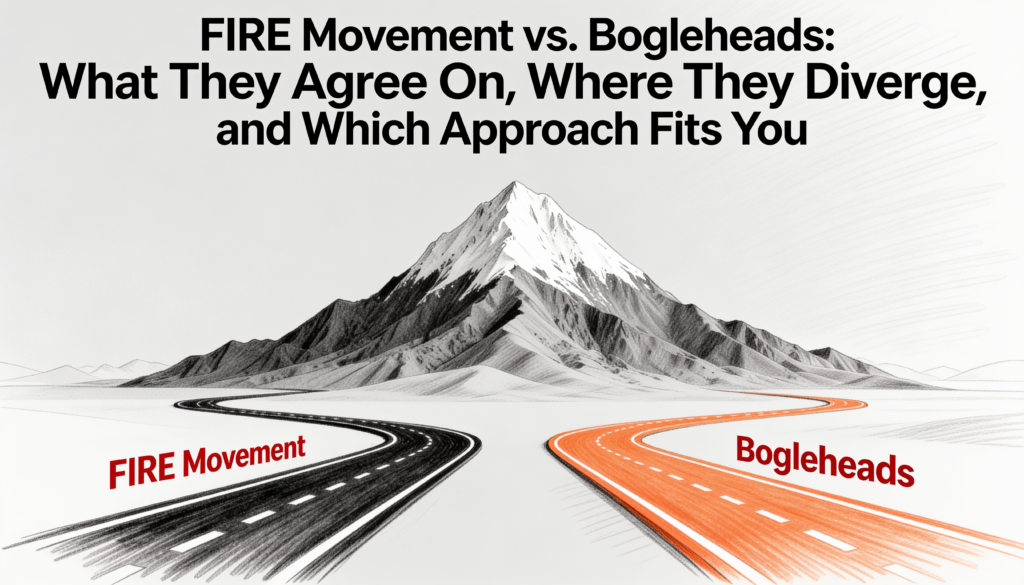
Both camps worship at the altar of low cost index funds. Both despise lifestyle inflation. Both believe Wall Street is, more often than not, playing a game rigged in its own favor. And yet, if you drop a FIRE enthusiast into a Bogleheads forum, or a Boglehead into a FIRE community, the tension is unmistakable. It is not hostile, exactly. It is more like two people who took the same road but disagree about how fast to walk it and what to do when they arrive.
This guide maps that tension precisely. It charts where these two frameworks genuinely overlap, where they truly diverge on withdrawal strategy and lifestyle frugality, and how to decide which approach actually fits your temperament. Because buried inside the disagreement is one of the most interesting questions in personal finance: is the point of money to escape the system, or to master it from within?
The Origin Stories That Shaped Each Philosophy
Every movement has a founding myth, and understanding those origins explains almost everything about how each group behaves today.
The Bogleheads: Patience as a Strategy
For the Bogleheads, the founding figure is John Bogle, the man who created the first index fund for individual investors and spent the rest of his life telling people to stop trying to beat the market. Bogle was not flashy. He did not promise early retirement or radical freedom. He promised something quieter but arguably more radical: that ordinary people could build real wealth by doing almost nothing.
His instructions were nearly monastic in their simplicity. Buy index funds. Keep your costs low. Stay the course. Do not panic during downturns. Do not get clever with market timing. The Boglehead philosophy is fundamentally about how you invest, not how you live. It is an investment discipline designed to outlast emotion.
The FIRE Movement: Impatience With Purpose
The FIRE movement, by contrast, was born from restlessness. Its intellectual roots trace back to Vicki Robin and Joe Dominguez and their book “Your Money or Your Life,” and the philosophy later crystallized through writers like Mr. Money Mustache, who turned aggressive saving and early retirement into something between a lifestyle and a religion.
FIRE is louder than anything Bogle ever championed. It carries an urgency that he never quite channeled. Where Bogle counseled people to be patient, FIRE tells people to be impatient with the right things. This is the first meaningful distinction between the two. The Bogleheads are primarily concerned with how you invest your money. The FIRE movement is primarily concerned with how you live your life. One is an investment philosophy. The other is an existential project wearing financial clothing.
The Philosophy of Enough and the Race to Reach It
The Bogleheads have a concept they return to constantly: the idea of enough. Bogle himself wrote an entire book on the subject. The principle is deceptively simple. At some point, you have enough money, and the pursuit of more becomes not just unnecessary but actively destructive. It leads to overwork, chronic stress, greed, and the slow erosion of everything money was supposed to provide in the first place.
FIRE agrees with this completely, but it adds a sharp twist. It does not just want you to recognize enough as a philosophical concept. It wants you to reach that number as fast as humanly possible and then walk away from paid work entirely.
The Bogleheads treat enough as a principle to carry across a full career. The FIRE movement treats enough as a finish line to sprint toward. That single difference in posture explains nearly everything else about how the two groups behave.
This creates a subtle but very real difference in how both groups think about sacrifice. For a Boglehead, saving is a lifelong habit. It is steady, moderate, and sustainable. It is the tortoise. For a FIRE adherent, saving is an intense, compressed campaign. It is the sprint that makes the marathon unnecessary.
There is something almost athletic about the FIRE approach. It resembles an endurance event more than a financial plan. You push hard, you track every dollar obsessively, you tolerate genuine discomfort, and then one day you cross a threshold and the game changes permanently. Bogleheads, by comparison, behave more like gardeners. They plant, they water, they wait. The harvest comes when it comes. Neither approach is wrong, but they attract very different temperaments, and that matters far more than most people are willing to admit.
The Savings Rate: Religion Versus Routine
If there is a single number that defines the FIRE movement, it is the savings rate. Not the rate of return on investments. Not stock market performance. The savings rate. FIRE practitioners obsess over it the way endurance athletes obsess over body fat percentage.
Why FIRE Treats Saving as a Mathematical Mission
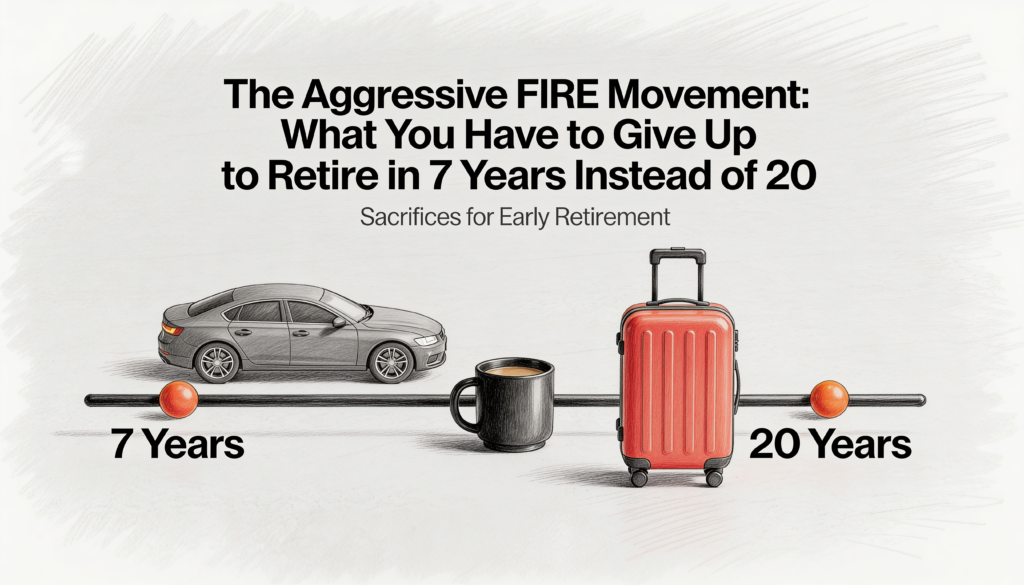
Sixty percent. Seventy percent. Some aim for eighty. The logic is mathematical and difficult to argue with: the higher your savings rate, the fewer years you need to work. Save roughly half your income and you can reach financial independence in approximately seventeen years. Save seventy five percent and you are looking at closer to seven years. This is the engine that powers the entire movement.
This is also why FIRE does not trust time. Or, more precisely, FIRE does not want to give time the opportunity to take things away before freedom arrives. The conventional career arc, in this worldview, is a form of slow surrender, a trade so lopsided that only cultural conditioning makes it appear reasonable.
Why Bogleheads Trust Time Instead
Bogleheads care about saving too, of course. But they are far less interested in intensity and far more interested in consistency. A Boglehead is perfectly content saving fifteen or twenty percent of income across a full career, letting compound growth perform the heavy lifting. They have made peace with the conventional timeline of life: work for decades, retire comfortably, enjoy the final act.
There is a counterargument worth taking seriously here. Some Bogleheads view the extreme FIRE savings rate as its own form of captivity. If you are earning a strong salary but living on a small fraction of it, constantly denying yourself experiences that would bring genuine joy, are you actually free? Or have you simply traded one prison for another, swapping the cubicle for a spreadsheet that governs every single purchase? It is a fair point, and it reveals something essential. Bogleheads optimize for sustainability. FIRE optimizes for escape velocity.
Where Withdrawal Strategy Reveals the Deepest Divide
Accumulation is where these two movements look almost identical. Decumulation is where they finally separate, and the difference is enormous.
The Boglehead Approach to Withdrawals
A traditional Boglehead typically plans to stop working in their sixties. This gives them several powerful advantages when it comes to spending down a portfolio. Their retirement horizon is shorter, perhaps twenty five to thirty years, which makes the classic four percent withdrawal guideline comfortably conservative. They will likely have Social Security or a pension cushioning their income. They have a smaller window in which a major market crash could permanently damage their plan.
Because of this, the Boglehead conversation about withdrawals tends to be relatively relaxed. They favor a moderate, diversified withdrawal rate, often built around a three fund portfolio, and they generally trust that a full career of accumulation has given them a wide margin of safety.
The FIRE Approach to Withdrawals
FIRE retirees face a fundamentally harder problem. A person who leaves work at forty might need their portfolio to last fifty years or longer. This single fact reshapes the entire withdrawal conversation.
A thirty year retirement and a fifty year retirement are not the same problem with different numbers. They are genuinely different challenges, and that is the real reason the FIRE movement and the Bogleheads diverge on withdrawal strategy.
As a result, the FIRE community has developed far more elaborate decumulation tools. Many adherents use lower withdrawal rates, somewhere between three and three and a half percent, to account for the extended horizon. They obsess over sequence of returns risk, the danger that a market crash early in retirement can ruin a plan that would otherwise have succeeded. They build cash buffers and bond tents to survive the first vulnerable years. They study Roth conversion ladders to access retirement accounts before the standard age without penalty. They embrace flexible spending rules that cut expenses during bad market years.
In short, the Boglehead treats withdrawal as the simple final chapter of a long book. The FIRE adherent treats withdrawal as an engineering challenge that demands its own dedicated strategy. Anyone genuinely choosing between these frameworks should understand that the early retirement promise of FIRE comes attached to a more complex and less forgiving withdrawal phase.
The Role of Identity and Lifestyle Frugality
Here is where the comparison becomes philosophically rich. For many Bogleheads, the philosophy is simply a tool. It serves their life but does not define it. A Boglehead might be a doctor, a teacher, or an engineer. Their investment approach is sensible, but it is not who they are. They discuss it on forums, they follow the principles, and then they go and live the rest of their lives.
FIRE is different. For a significant portion of its adherents, it becomes an identity. They are not merely people who save aggressively. They are FIRE people. Their social circles shift. Their spending choices begin to carry moral weight. The movement has its own vocabulary, its own heroes, and its own heresies. Spending money on something a strict FIRE purist would consider wasteful can feel like a betrayal, not just of a budget but of an entire belief system.
This pattern is not unique to finance. It mirrors what happens in fitness culture, where someone starts going to the gym for health reasons and ends up identifying entirely as a CrossFitter or a marathon runner. The practice becomes the personality. The tool becomes the temple.
There is nothing inherently wrong with this. Identity can be a powerful source of motivation and community. But it carries a risk that Bogleheads largely avoid: the risk of rigidity. When your financial strategy becomes who you are, changing course feels like losing yourself. A Boglehead who decides to spend more in retirement simply adjusts a number. A FIRE adherent who decides to return to work can face something closer to an identity crisis. This is the hidden cost of intense lifestyle frugality, and it deserves honest reflection before you commit to either path.
Where They Actually Agree, Which Is Almost Everywhere
Strip away the cultural packaging and these two movements share an enormous amount of intellectual real estate. It is worth listing exactly where the FIRE movement and the Bogleheads stand shoulder to shoulder:
- Both believe low cost index funds are the primary vehicle for building wealth.
- Both reject market timing and individual stock picking as losing strategies for ordinary investors.
- Both understand that fees are the silent killer of long term returns.
- Both value simplicity over complexity in portfolio design.
- Both reject the financial industry’s attempts to make you dependent on expensive advice.
- Both embrace the principle that controlling spending matters more than chasing returns.
In practice, most FIRE portfolios look almost identical to a standard Boglehead three fund portfolio. The vehicle is the same. The destination of financial security is the same. The disagreement is entirely about speed, intensity, and what you do once you arrive.
The comparison resembles distance running. Ultramarathon runners and casual joggers both put one foot in front of the other. They both benefit from good shoes, proper hydration, and not doing anything reckless with their knees. But one is training for a hundred mile race and the other is enjoying a Sunday morning routine. Same mechanics, wildly different relationship to suffering.
The Question Neither Group Fully Answers
Both the FIRE movement and the Bogleheads are excellent at the accumulation phase. They know how to build wealth efficiently. What neither addresses quite as well is the deeper question of what wealth is actually for.
Bogleheads tend to assume a conventional life structure. You work, you save, you retire, you spend carefully, and you leave something for the next generation. It is a good life. But it does not interrogate the structure itself. It accepts the timeline and optimizes within it.
FIRE interrogates that structure aggressively but sometimes struggles with what comes after. The blogs and forums are full of people who reached financial independence and then felt strangely lost. The identity that drove them to save so fiercely offered no guidance for what to do once the saving was finished. Some returned to work. Some started businesses. Some traveled. Some simply felt empty for a while before discovering new purpose.
This is not a failure of either philosophy. It is a limitation of any financial framework when it collides with the question of meaning. Money can purchase freedom, but freedom is not the same thing as fulfillment. Both movements understand this intellectually. Neither has fully solved it in practice.
Which Path Is Right for You?
The honest answer is that the right path depends on who you are, not on what the math alone says. Both routes lead to financial security. Both are grounded in solid evidence. Both refuse to make you a permanent customer of the wealth management industry.
Consider leaning toward FIRE if you genuinely thrive on intensity, if you would rather sprint hard and then rest than jog forever, if you find tracking and optimizing energizing rather than exhausting, and if escaping conventional work is a goal you feel in your bones. The tradeoff is a longer and more demanding withdrawal phase and a deeper psychological entanglement with the movement itself.
Consider leaning toward the Boglehead approach if you value balance above all, if you do not want your financial strategy to dominate every other part of your life, if you enjoy your work enough that escaping it is not urgent, and if you prefer a simpler, more forgiving path to a conventional retirement. The tradeoff is a longer working life and the discipline to let time do the work.
The genuine mistake is treating this as a debate with a single winner. It is not. It is a personality test disguised as a financial argument. The numbers work either way. What differs is the emotional experience of the journey, and that is something no spreadsheet can fully optimize for you. The mountain does not care which trail you took. It only cares that you kept climbing.