Table of Contents
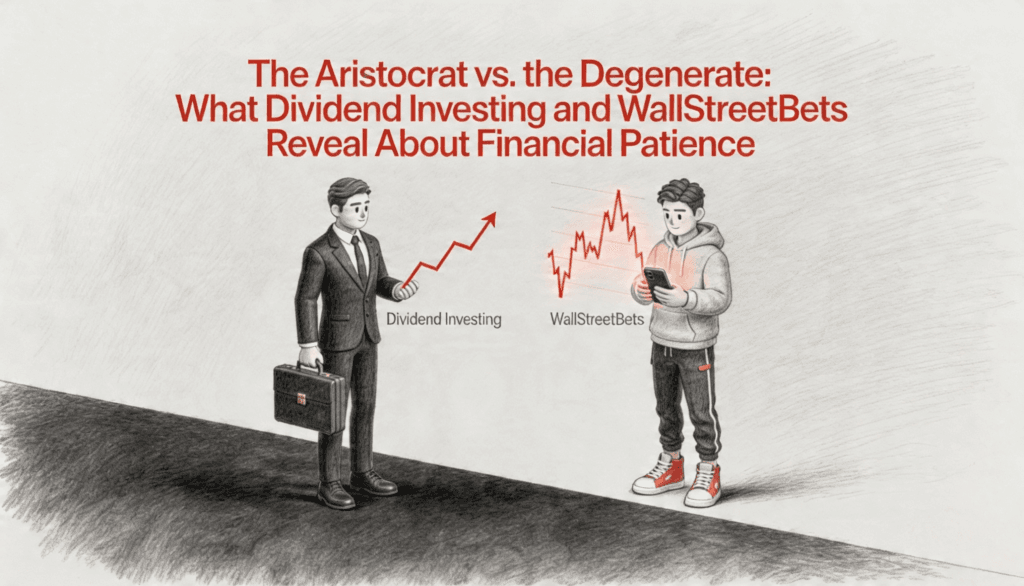
There is a corner of the internet where people celebrate receiving $47 in quarterly dividends from Coca Cola like they just inherited a country estate. There is another corner where people post screenshots of losing $80,000 on weekly options and receive thousands of upvotes accompanied by a single word: legend.
These two communities could not be more different. And yet they are both doing the same thing. They are both trying to make money work for them. They just disagree, violently, on what that process should look like and how long it should take.
The dividend investor is playing a game measured in decades. The WallStreetBets trader is playing a game measured in days. One sees patience as the ultimate edge. The other sees patience as the thing you practice while waiting for a better opportunity to gamble. Somewhere between these two extremes lies a truth about human nature, money, and what we actually mean when we say we want financial freedom.
The Church of Compound Interest
Dividend investing has the energy of a retirement dinner. Respectable. Predictable. The kind of strategy that would wear a blazer to a backyard barbecue. Its disciples revere something called a Dividend Aristocrat, which is a company that has increased its dividend payment every year for at least 25 consecutive years. The word “aristocrat” is not an accident. It signals lineage, stability, the quiet confidence of old money that does not need to prove anything.
The philosophy is beautifully simple. Buy shares in companies that pay regular dividends. Reinvest those dividends to buy more shares. Those shares pay more dividends. Repeat until you die or retire, whichever comes first. The appeal is not excitement. The appeal is inevitability. Given enough time, the math works. It always has.
There is something almost religious about it. The dividend growth community talks about their portfolios the way monks talk about their gardens. With reverence, patience, and an unshakable belief that tending something small and steady will produce abundance eventually. The key word is eventually. Nobody gets rich quick from a three percent yield. You get rich slow. And that slowness is, paradoxically, the entire point.
The Casino With a Comment Section
WallStreetBets is something else entirely. Born on Reddit, it operates as part trading forum, part comedy club, part group therapy session. Its members call themselves degenerates. This is not self deprecation. It is a badge of honor. Where dividend investors worship consistency, WallStreetBets worships chaos. Where dividend investors share spreadsheets showing projected income in 2045, WallStreetBets shares screenshots of positions that will either triple by Friday or go to zero.
The community runs on options trading, which is the financial equivalent of ordering the spiciest item on the menu just to see what happens. Options allow you to control large amounts of stock with small amounts of money. When you are right, the returns are absurd. When you are wrong, and you will be wrong often, the losses are equally absurd. This asymmetry is not a bug. It is the feature that keeps people coming back.
What makes WallStreetBets genuinely interesting is not the gambling. It is the self awareness. These are not people who think they have figured out the market. They know the odds are against them. They post their losses with the same enthusiasm as their wins. They have turned financial risk into entertainment, and in doing so, they have accidentally revealed something that traditional finance has always tried to hide: most people do not find investing interesting. The dividend community solved this by turning investing into a moral practice. WallStreetBets solved it by turning investing into a sport.
Patience as Identity
Here is where it gets psychologically fascinating. Dividend investing is not really a financial strategy. It is a personality test disguised as one. The kind of person who can watch their portfolio grow by two percent a year while the market swings wildly around them is the kind of person who finishes books, runs marathons, and probably flosses daily. Dividend investing selects for people who are already patient. It does not teach patience. It requires it as the price of admission.
This creates a survivorship problem that nobody in the community talks about. The people who succeed at dividend investing were going to succeed at almost any long term strategy because they possess the temperament for it. The strategy gets credit that should probably go to the person executing it. It is like saying a treadmill is the best exercise equipment because fit people use it.
WallStreetBets, on the other hand, selects for a completely different trait. Risk tolerance. Or more accurately, the willingness to detach money from its emotional weight. The traders who thrive there, and some genuinely do, have developed the ability to see money as points in a game rather than months of rent. This is either liberation or delusion depending on your perspective and their account balance.
What They Get Right About Each Other
The dividend community thinks WallStreetBets is reckless. They are not entirely wrong. When someone puts their entire savings into short dated call options on a meme stock, that is not a strategy. That is an expensive prayer. The statistics on options trading are grim. Most retail options traders lose money. The ones who win big tend to give it back eventually. The house edge is real, and no amount of rocket ship emojis changes the math.
But WallStreetBets has a legitimate critique of dividend investing that the dividend community would rather not address. The opportunity cost argument is real. A young person putting their money into stable dividend payers yielding three percent when they could be investing in growth companies, or even broad index funds, is potentially sacrificing enormous long term returns for the psychological comfort of seeing small deposits hit their account every quarter. The dividend feels productive. But feeling productive and being productive are not always the same thing.
There is a parallel in fitness culture that illuminates this. Some people go to the gym and spend an hour doing comfortable exercises they already know. They leave feeling great. Others push into discomfort, try new movements, and leave feeling uncertain about whether they did it right. The first group is more consistent. The second group often makes faster progress. Comfort and results do not always travel together.
The Illusion of Control
Both communities share a deeper psychological need that neither would admit to. They both want to feel like they have control over their financial future. The dividend investor achieves this feeling through predictability. If Johnson and Johnson has paid a dividend for 60 years, it will probably pay one next year too. That continuity creates a sense of safety that is, honestly, partially illusory. Companies cut dividends. It happens. When it does, the emotional damage is disproportionate to the financial damage because the entire strategy was built on the assumption that the payments would never stop.
The WallStreetBets trader achieves the feeling of control through action. Every trade is a decision. Every position is a statement about the future. The fact that these decisions are frequently wrong does not diminish the psychological satisfaction of making them.
This is why both communities are so resistant to criticism. You are not attacking their portfolio. You are attacking their coping mechanism.
The Generational Divide Nobody Mentions
There is also a generational layer to this clash that deserves attention. Dividend investing makes intuitive sense to people who grew up watching their parents build wealth slowly through homeownership and steady jobs. The model maps onto an economic reality where patience was reliably rewarded. You stayed at the company, you got the pension. You held the house, it went up in value. Time was your ally.
WallStreetBets makes intuitive sense to people who grew up watching that model collapse. If you graduated into the 2008 financial crisis, or into a job market where salaries did not keep pace with housing costs, the idea of patiently saving three percent at a time feels like trying to fill a swimming pool with an eyedropper. The urgency behind WallStreetBets is not purely about greed. Some of it is about math. When the gap between where you are and where you need to be feels insurmountable through conventional means, unconventional bets start to look rational.
This does not make them wise. But it does make them understandable.
The Middle
The honest answer, the one that neither community wants to hear, is that both approaches contain a kernel of truth wrapped in a layer of identity. Dividend investing works, but it works best for people who already have significant capital. A three percent yield on a million dollars is $30,000 a year. A three percent yield on $10,000 is a nice dinner. The strategy scales beautifully in theory but requires a starting point that many people simply do not have.
WallStreetBets style speculation can work too, but only as a small allocation within a broader plan. The problem is that small allocations do not generate the kind of stories that go viral. Nobody posts a screenshot of a responsible five percent speculative position. The culture rewards extremes because extremes are entertaining. And when entertainment drives decision making, the house always wins.
The real wisdom might be something neither tribe would endorse. Be boring with most of your money and a little bit reckless with a small piece of it. Own your aristocrats. Let them drip their dividends into your account while you sleep. But keep a small, defined amount set aside for the bets that make your heart rate increase. Not because the bets are smart. But because the person who never scratches the itch tends to scratch it at the worst possible time with the worst possible amount.
Discipline without release becomes fragile. Risk without structure becomes ruin. The aristocrat and the degenerate are not opposites. They are two halves of the same financial brain, each handling a different part of what it means to be human and uncertain about the future.
The question was never which approach is right. The question is whether you understand which one you are using and why.