Table of Contents
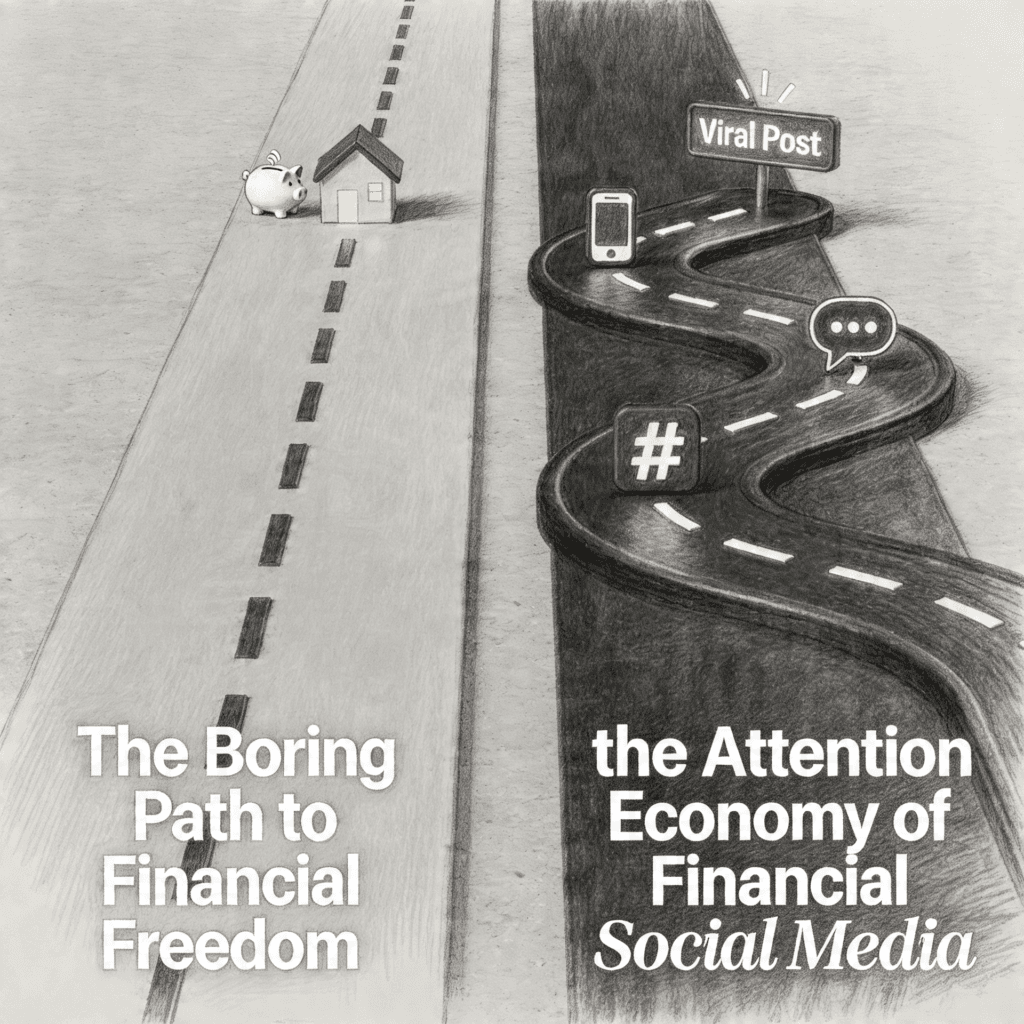
Nobody has ever gone viral for buying an index fund and waiting thirty years. There is no comment section war over the merits of a consistent savings rate. No one has built a million followers by telling you to automate your investments and then go live your life. And this is precisely the problem.
The most effective path to financial freedom is, by almost every credible measure, extraordinarily boring. Save a meaningful percentage of your income. Invest in diversified, low cost funds. Do this for a long time. Do not check your portfolio every day. Do not panic. Do not get clever. Repeat until the math works.
That is the entire strategy. You could fit it on a napkin. And napkins do not generate ad revenue.
The Algorithm Does Not Reward Patience
Financial social media exists inside a machine that was designed to reward the exact opposite of sound financial behavior. The attention economy runs on novelty, urgency, and emotional reaction. It needs you to feel something every few seconds. Fear. Excitement. Outrage. The dopamine cycle that keeps you scrolling is structurally identical to the emotional cycle that makes people terrible investors.
This is not a coincidence. It is a design feature.
The creator who tells you to buy index funds and wait has one piece of content. Maybe two. The creator who tells you about the next big opportunity, the hidden crash signal, the secret strategy that institutions do not want you to know, has unlimited content. Every day brings a new reason to be afraid, a new reason to act, a new reason to watch the next video. Fear is renewable energy in the attention economy. Patience is not.
So the incentive structure of financial social media selects for the loudest, most dramatic, most action oriented voices. Not because they are right, but because they are interesting. And in a world where interesting beats accurate, the boring path to wealth never stood a chance on your feed.
The Paradox of Financial Education as Entertainment
Here is where it gets strange. Most people who consume financial content on social media genuinely believe they are educating themselves. They are not scrolling for entertainment. They are investing in their financial future. They are learning.
Except learning about money and being entertained about money feel almost identical from the inside. You absorb information. You feel smarter. You nod along. You share the clip. But the question nobody asks is whether the information you just consumed actually changed your behavior in a way that made you wealthier. Or whether it simply made you feel like it did.
This is the same distinction that separates reading about exercise from actually going to the gym. The feeling of progress without the substance of it. Financial content consumption has become its own form of productive procrastination. You are doing something that feels like financial planning but functions more like scrolling through a catalog of anxiety.
The behavioral science research on this is fairly clear. People who check their portfolios more frequently tend to make worse decisions. They trade more. They react to noise. They buy high and sell low because that is what emotions tell you to do when you are watching the market in real time. Financial social media does not just encourage portfolio checking. It is portfolio checking dressed up as education, served to you between ads for trading apps that make it dangerously easy to act on whatever you just felt.
The Creator Economy Has Its Own Version of Inflation
There is an economic concept worth borrowing here that has nothing to do with the CPI. In the attention economy, content inflation is real. What shocked the audience last year barely registers this year. The financial creator who once gained followers by explaining compound interest now needs to explain why the entire banking system might collapse next Tuesday. The bar for attention keeps rising, which means the claims keep getting more dramatic, the predictions more extreme, the urgency more manufactured.
This is the same dynamic that drives tabloid journalism, political media, and reality television. The product is not information. The product is arousal. Financial social media has simply applied the same playbook to your retirement savings.
The irony is beautiful if you think about it. The financial freedom community talks endlessly about escaping the rat race, about not trading your time for money, about building a life of independence. And then it builds that community inside platforms specifically designed to monetize your time and attention. The medium contradicts the message. You are consuming content about freedom on a platform engineered to make you dependent on content.
Why the Boring Path Actually Works (and Why That Does Not Matter on the Internet)
The evidence behind slow, boring, systematic investing is not ambiguous. It is one of the most well documented findings in the history of finance. Most active managers underperform index funds over long periods. Most retail traders lose money. Most market timing strategies fail. Most people who try to get rich quickly end up poorer than people who got rich slowly.
But evidence has never been particularly viral. The truth about building wealth is closer to the truth about getting healthy. Eat well. Move your body. Sleep enough. Do this for years. There is no secret. There is no hack. The people selling you shortcuts are making their money from selling you shortcuts, not from using them.
The boring path works because it removes the human element from a process that humans are remarkably bad at. Automated investing takes your emotions out of the equation. Long time horizons let compound growth do its work. Diversification protects you from the concentrated bets that make great stories on social media and terrible outcomes in real portfolios. The strategy is not exciting because it was never designed to be exciting. It was designed to work.
And yet, “it works” is the worst possible pitch in the attention economy. Nobody shares a video titled “I did nothing interesting with my money for twenty years and now I am financially independent.” The story has no conflict. No villain. No twist. It is the equivalent of a movie where the protagonist makes a good decision in the first act and then sits quietly until the credits roll.
Most financial creators are not scammers. This is worth saying clearly because the conversation too often collapses into “influencers bad, index funds good.” The reality is more interesting and more uncomfortable than that.
Most financial creators start out with genuine intentions. They learned something about money. It changed their life. They want to share it. The problem is not their character. The problem is the environment they operate in. The attention economy slowly reshapes what they talk about, how they talk about it, and how often. The algorithm trains them the way it trains everyone. Post what gets engagement. Abandon what does not. Over time, the content drifts from what is useful toward what is clickable. It happens gradually enough that many creators do not even notice.
What Actually Changes Behavior
If the boring path is so effective and financial social media is so misleading, why do people keep scrolling instead of automating? The answer is almost comically simple. The boring path does not give you anything to do.
Humans are wired for action. We feel safer when we are doing something, even when doing nothing is the optimal strategy. Financial social media exploits this bias perfectly. It gives you constant things to do. Watch this. Learn this. Consider this. Rebalance. Rotate. Hedge. React. The activity feels productive even when it is destructive.
The boring path asks you to do something much harder than being active. It asks you to be still. To trust a process you cannot see working in real time. To sit with the discomfort of not knowing exactly what will happen. This is, psychologically speaking, much closer to meditation than to a strategy. And meditation has never been a great business model either.
The people who actually build wealth slowly almost never talk about it publicly. They are not on social media debating portfolio allocations. They are living their lives, checking their accounts once a quarter, and spending their energy on things that actually make them happy. They are invisible on the internet because the internet was not built for people who have figured things out and moved on.
The Real Divide
This is not really a debate between two investment strategies. It is a clash between two models of how knowledge should work. The boring path treats financial knowledge as a small set of principles you learn once and apply forever. Financial social media treats financial knowledge as an endless stream of new information that requires constant consumption.
One model says: you already know enough. The other says: you will never know enough.
The first model builds wealth. The second model builds audiences. And the tragedy is that the people who need the first model the most are the ones most likely to be captured by the second.