Table of Contents
The carry trade is one of those strategies that sounds embarrassingly simple when you first hear it. Borrow money where it is cheap. Park it where it pays more. Pocket the difference. A child could explain it at the dinner table, and yet entire careers have been quietly buried by it. Currencies have collapsed because of it. Hedge funds have unwound positions so violently that central banks needed to step in like parents at a kindergarten brawl.
The reason this gap exists between the idea and the execution is not intelligence. It is humility. Amateurs treat the carry trade as a yield play. Professionals treat it as an insurance contract they happen to be on the wrong side of. Same instrument. Two completely different mental models.
What follows are the seven factors that separate the people who collect carry quietly for years from the ones who blow up spectacularly in a single afternoon.
1. The Interest Rate Differential Is the Bait, Not the Meal
Newcomers fixate on the spread. If Japanese yen funding costs almost nothing and the Mexican peso pays handsomely, that gap looks like free money sitting on a sidewalk. Pick it up. Repeat.
The professional sees something different. That spread is not a gift from the financial gods. It is compensation for risk that has not shown up yet. Markets are not charities. If a currency pays you eight percent more than another, the collective wisdom of traders is essentially whispering that something unpleasant is statistically expected to happen to it. Maybe inflation. Maybe political turmoil. Maybe a quiet capital flight that turns loud.
Think of it like a job posting that offers triple the going salary for what looks like ordinary work. You do not assume your future employer is generous. You assume there is a reason nobody else took the job. The carry trade rewards the same suspicion. The differential is the headline. The story is buried somewhere on page twelve.
2. Volatility Eats Carry for Breakfast
There is a phrase that floats around trading floors. Carry trades go up by the stairs and down by the elevator. It is one of those market sayings that sounds folksy until you live through it. A position can accumulate gains slowly and tidily for eighteen months, and then in three trading sessions, give back everything and then some.
Volatility is not just a risk metric. It is the entire game. When global markets are calm, capital flows comfortably toward higher yields. The moment fear arrives, that capital does not walk back. It sprints. And when everyone sprints through the same doorway at once, the door becomes the problem.
Amateurs look at carry returns and compute an annualized yield. Professionals look at the same returns and divide them by the volatility. Suddenly the trade does not look quite so attractive. A modest return earned smoothly is a serious thing. A high return earned through white knuckle drawdowns is a lottery ticket with extra steps.
3. Liquidity Is a Fair Weather Friend
There is a peculiar property of currency markets that everyone acknowledges and almost nobody internalizes until it bites them. Liquidity is generous precisely when you do not need it, and stingy precisely when you do.
During calm periods, you can move millions of dollars in and out of emerging market currencies with barely a ripple. Bid ask spreads are tight. Brokers smile. Everything works. Then a regional bank somewhere wobbles, or a central banker says something ambiguous on a Thursday afternoon, and suddenly the same trade that filled in seconds takes hours and costs a fortune to exit. Or it cannot be exited at all without taking a haircut that erases years of accumulated carry.
The professional treats liquidity not as an assumption but as a question. Who else holds this trade? How crowded is the exit? If the music stops, am I closer to the door or closer to the back wall? These are not paranoid questions. They are the only questions that matter when the trade goes wrong, and by definition you will not have time to ask them at that moment.
4. The Funding Currency Has Its Own Personality
Most retail traders pick the high yielding currency carefully. They research the country. They check inflation. They look at the central bank. Then they grab whatever low yielding currency they can borrow in, almost as an afterthought, as if it were a neutral vehicle.
This is backwards. The funding currency is not neutral. It has moods. It has triggers. It has a habit of appreciating violently at exactly the wrong moment.
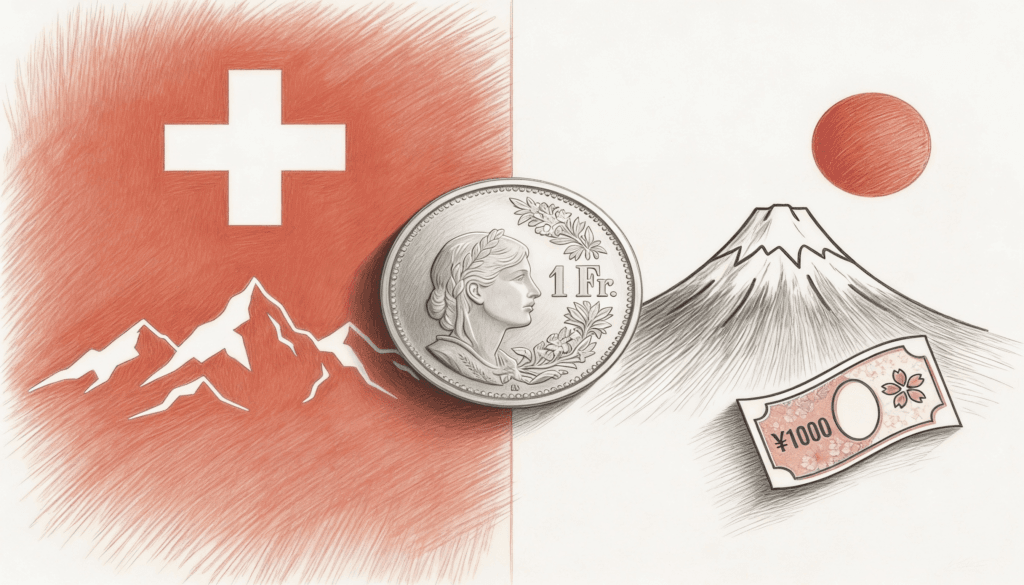
The Japanese yen and the Swiss franc earned their reputation as funding currencies for good reasons, but the same features that make them cheap to borrow also make them safe havens during stress. When global investors get scared, they rush back into these currencies. Your funding leg appreciates. Your asset leg depreciates. You are getting squeezed from both ends like a tube of toothpaste. The very stability that made the funding currency attractive is what destroys you when conditions change.
A serious trader spends as much time studying the funding currency as the target. Maybe more. The thing you are short can hurt you in ways the thing you are long cannot.
5. Central Banks Are Not Your Counterparties. They Are the Weather.
There is a fantasy that floats around in financial commentary that central bankers are predictable. They have dual mandates. They publish forecasts. They speak in measured tones. Surely a careful reader can anticipate their moves.
In reality, central banks operate under constraints that have nothing to do with what makes carry traders comfortable. A central bank in a small open economy might cut rates to protect employment even when capital is fleeing. Or it might hike rates aggressively to defend the currency, crushing the local economy in the process. Neither outcome is good for a carry trader who assumed yields would stay where they were.
The professional accepts a humbling truth. You are not in a relationship with the central bank. You are exposed to its decisions the same way a farmer is exposed to rainfall. You can study patterns. You can prepare. You cannot negotiate. The amateur reads policy statements looking for confirmation. The professional reads them looking for surprises and then asks what would happen to the position if the surprise went the other way.
6. Correlation Is Not a Number. It Is a Behavior.
This is perhaps the most overlooked factor, and the one that turns sophisticated portfolios into smoking craters. Traders often hold multiple carry positions across different currency pairs to diversify. The reasoning seems sound. Different countries. Different economies. Different stories. If one trade goes wrong, the others should hold up.
Then the morning arrives when every single one of them moves against you at the same time, and you realize that diversification was a costume the trades were wearing, not a property they actually had.
Carry trades share a hidden common factor. They all depend on global risk appetite. When investors are optimistic, capital seeks yield, and every carry trade in the world tends to make money. When fear returns, capital flees yield, and every carry trade in the world tends to lose money. The correlations that looked low in normal times reveal themselves to be deeply linked under stress.
Think of it as a dinner party where every guest seems independent until the lights go out. Then you realize they were all sitting on the same fragile bench. The pro builds portfolios assuming that during a crisis, correlations rise toward one. The amateur builds portfolios assuming the historical correlations will hold. The market does not care which approach you took until it is too late to change your mind.
7. Time Horizon Decides Whether You Are an Investor or a Tourist
The final factor is the one that determines whether carry trading is even appropriate for you, and it has nothing to do with the trade itself. It has to do with how long you can sit still.
Carry trades generate returns slowly. The interest differential drips in over months and years. Meanwhile, the risk of a sharp adverse move is concentrated in rare but devastating episodes. This asymmetry has a brutal implication. To earn the long term return, you must survive every short term storm. You cannot tap out during the storm and tap back in once it passes, because by then the prices have already moved and the carry has already been collected by the people who held on.
This requires a time horizon that most retail traders simply do not have, either psychologically or financially. If you need the money in two years, you cannot afford a five year drawdown, even if the strategy has positive expected returns over a decade. The strategy and the holder must be compatible.
The professional builds carry positions with capital that has nowhere else it urgently needs to be. The amateur builds carry positions with money earmarked for life events and then has to liquidate at the worst possible moment because rent is due or the kids need braces. The arithmetic of the trade is identical. The outcome is opposite.
A Closing Thought
The carry trade is sometimes described as picking up pennies in front of a steamroller. The metaphor is famous because it is accurate, but it misses something important. It is not the steamroller that ruins most traders. It is the assumption that they can step off the road quickly enough when they see it coming.
What separates professionals from amateurs is not better forecasts. It is not access to fancier tools. It is a fundamentally different relationship with uncertainty. The pro assumes the steamroller will arrive at an unknown time and builds the position around that assumption from day one. The amateur assumes the steamroller is somebody else’s problem until it is not.
Every one of the seven factors above is really a variation of the same underlying discipline. Pay attention to what could go wrong, not just what could go right. Size positions for the worst plausible outcome, not the average one. Treat liquidity, volatility, correlation, and time horizon as living things that change behavior under stress, not as static numbers in a spreadsheet.
The carry trade is not unprofitable. It has produced real wealth for patient and careful operators across generations. But it does not give that wealth away cheaply. It charges a kind of intellectual tax, paid in vigilance and humility. The traders who refuse to pay that tax end up paying a much larger one to the market instead. And the market, unlike the central bank, does not publish a schedule.