Table of Contents
Every company has a leader who stands on stage with a microphone, talking about vision, culture, and synergy. The slides are clean. The charts go up and to the right. The audience nods. Somewhere in the back, a junior analyst is taking notes and wondering if any of this is actually true.
There is one number that cuts through the theater. It does not care about charisma. It does not care about the founder myth. It does not care whether the CEO wears a hoodie or a suit. It simply asks a brutally honest question. For every dollar that shareholders have parked inside this business, how many cents of profit are coming back each year?
That number is Return on Equity. And once you learn to read it properly, you start to see the world of business in a completely different way. You stop watching the magician and start watching the hands.
The Question Nobody Wants to Ask
Most people evaluating a company look at profit. The company made a billion dollars last year. Impressive, right?
Not really. A billion dollars of profit on ten billion of shareholder capital is a ten percent return. A billion dollars of profit on fifty billion of shareholder capital is a sad two percent. The first business is healthy. The second is essentially a savings account with a corporate logo.
Profit on its own is a vanity metric. It tells you the size of the harvest but says nothing about the size of the field. Return on Equity is what happens when you finally ask how big the field was. It compares the harvest to the land used to grow it. And suddenly, half the companies you thought were impressive start to look like overgrown gardens producing very few tomatoes.
This is why the metric matters. A CEO can spin a quarterly call for ninety minutes, but if the return on equity has been drifting down for five years, the spin does not change the reality. The capital is not working as hard as it used to.
Magicians Versus Managers
Here is the mental model worth keeping. There are two kinds of CEOs in the world.
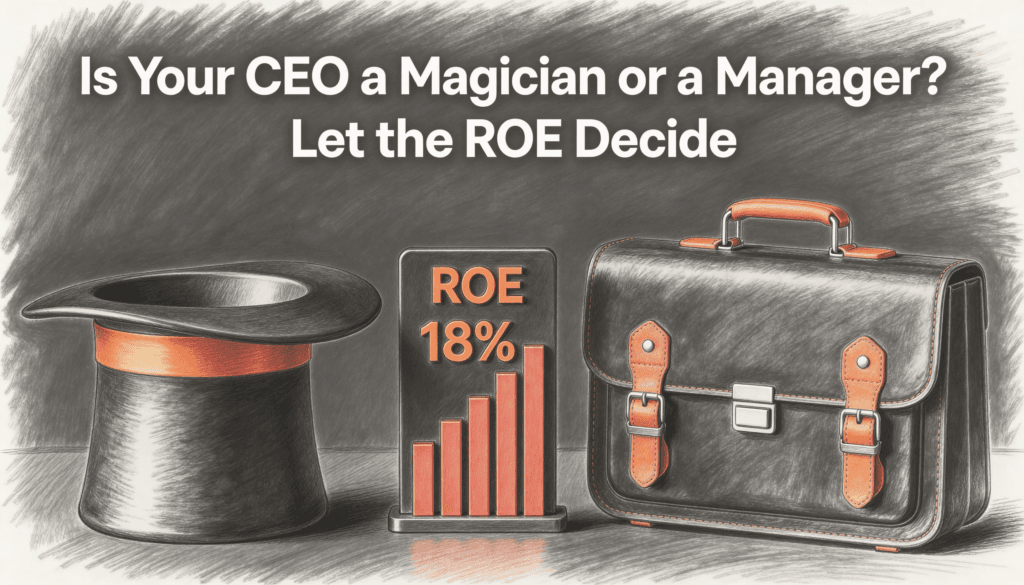
The Manager runs the business. He or she shows up, makes decisions, allocates capital, hires people, fires people, and tries to make sure that every dollar invested in the company earns a respectable return. The Manager is often boring. The Manager does not trend on social media. The Manager rarely writes a book. But the Manager grows your money.
The Magician runs the narrative. He or she shows up, makes announcements, allocates attention, hires consultants, fires departments, and tries to make sure that every quarter has a fresh story to tell. The Magician is exciting. The Magician trends. The Magician sometimes grows your money and sometimes evaporates it, and you only find out which after a few years.
Return on Equity is how you tell them apart before the trick is revealed. Because magic works on the audience. Math works on the books. And the books do not clap.
What ROE Is Really Telling You
When you see a company with a consistently high return on equity, year after year, something interesting is happening underneath. The business is generating profits without having to keep stuffing more capital into the machine. That is the dream. You put a dollar in once, and the dollar keeps producing baby dollars without you having to feed it constantly.
A consistently high return on equity is the financial fingerprint of a business that has something valuable. Maybe it is a brand people love. Maybe it is a technology no one else can copy easily. Maybe it is a network effect, where the product gets better as more people use it. Maybe it is just a wonderful boring monopoly on selling soap in a country where everyone needs soap.
Whatever the cause, the effect is the same. The company does not need to keep raising money or borrowing heavily to grow. It generates its own fuel. And a business that generates its own fuel is the kind of business that compounds for decades.
When you see a company with a low or declining return on equity, something else is happening. The business is having to work harder and harder to produce the same result. It is the corporate version of needing more coffee each year to feel awake. At some point, the coffee stops working, and you are just tired and broke.
The Trap of the Borrowed Halo
Now here is where it gets interesting. And a little dangerous.
A clever CEO who knows you are watching return on equity can do something tricky. They can borrow money. A lot of it. Debt does not show up as equity. So if the company funds its growth with loans instead of using shareholder capital, the equity stays small while the profit grows. The ratio shoots up. The slide looks beautiful. The CEO gets a standing ovation.
But the business is now sitting on a mountain of debt. The return on equity looks magnificent, but it has been borrowed in a very literal sense. The day interest rates rise, or revenue dips, or a recession hits, the whole structure starts to wobble. And the same number that looked like a sign of brilliance starts to look like a sign of fragility.
This is the part where the metric can betray you if you take it at face value. A high return on equity is wonderful when it is earned through real business quality. The same high return on equity is terrifying when it is engineered through leverage. You have to look at both numbers together. The return, and the debt that helped produce it. Otherwise you are just admiring the magician for the speed of the hand without checking whether the rabbit was in the hat the whole time.
Why Smart Investors Whisper About It
If you have ever read the letters that the great long term investors write to their shareholders, you notice something. They rarely talk about quarterly earnings. They almost never talk about the stock price. They talk about return on equity, return on capital, and the durability of those returns over time.
This is not because they are old fashioned. It is because they have figured out a quiet secret. The single biggest determinant of how much money you make as a long term owner of a business is how well that business reinvests its profits. And the cleanest way to measure that is to see what kind of return the business is currently earning on the capital already inside it.
This is why the metric is whispered about by the patient. It is the closest thing to a crystal ball that public information provides.
The Counterintuitive Twist
Now for something that might surprise you.
A very high return on equity, sustained for too long, can be a warning sign. Not because the company is doing something wrong, but because nature does not allow excellent returns to last forever in a free market. If a company is earning thirty percent on its equity, every smart competitor in the world is looking at that business and trying to copy it. Capital flows toward high returns the way water flows toward low ground. Over time, competition tends to grind down the returns of even the best businesses.
So when you see a company with a return on equity that has stayed unusually high for a very long time, the right question is not how clever the CEO is. The right question is what is protecting this business from the competition that should have arrived by now.
This is the kind of thinking that separates investors from spectators. Spectators see the number and feel impressed. Investors see the number and ask why it has not been competed away.
How to Use It Without Becoming a Spreadsheet Bore
You do not need to memorize formulas to use this idea. You just need to develop a habit. Whenever you hear about a company, before you get swept up in the story, ask one simple question. How much profit does this business generate compared to the money shareholders have put into it?
If the answer is high and consistent, lean in. Find out why. Figure out what is protecting that return. If the protection looks real, you may have found something worth owning. If the answer is low or volatile, lean back. Maybe the business is genuinely struggling. Maybe it is in a tough industry. Maybe the CEO is a Magician whose tricks are starting to fail. Either way, you have learned something useful before being charmed.
This habit will save you from a lot of expensive mistakes. It will also help you appreciate businesses that are quietly excellent but never get magazine covers. Some of the best businesses in the world are run by people you have never heard of, in industries you find unglamorous, producing returns on equity that would make a hedge fund weep. They do not need a story because they have a number.
The Final Trick
In the end, the difference between a magician and a manager is simple. A magician needs you to keep watching. A manager just needs you to keep counting.
Return on Equity is how you count. It is a small number with a long memory. It quietly records, year after year, whether the people running a business are creating wealth or just creating an impression of wealth. It does not care about your feelings, the CEO’s feelings, or the consultant’s slide deck. It just sits there on the financial statement, doing the only thing numbers know how to do. Telling the truth.
The next time you hear a company being praised, do not ask whether the CEO is brilliant. Ask what the return on equity has done over the last decade. The answer will tell you everything the standing ovation tried to hide.
Magicians get applause. Managers get returns. And over time, only one of them makes you richer.