Table of Contents
There is a moment that happens in almost every crypto conversation where the topic stops being money and starts being philosophy. Someone mentions Bitcoin, and within about ninety seconds you are hearing about central banks, monetary policy, the 2008 financial crisis, and the idea that money itself is a kind of illusion agreed upon by people who have not thought about it hard enough. The person talking is usually not a banker. They are usually someone who discovered all of this in their twenties and has not recovered.
Now picture a different conversation. Someone on WallStreetBets has just bought weekly call options on a company whose earnings report drops in two days. They are not thinking about the nature of money. They are not thinking about central banks. They are thinking about whether the line goes up or down before Friday. If it goes up, they post a screenshot. If it goes down, they also post a screenshot. The screenshot is the point.
These two communities share a platform, a generation, and a deep suspicion that the normal path to wealth is broken. And yet they have arrived at completely opposite responses to that suspicion. One built a religion. The other built a casino. Both are surprisingly serious about what they are doing, even when they pretend not to be.
Two Different Escape Plans From the Same Building
If you squint, crypto and WSB look like rival escape plans drawn up by prisoners in the same cell.
Both groups looked at the traditional financial system and concluded that it was not designed for them. Both noticed that the people who already had money were the ones the rules seemed to protect. Both decided that patience was a trap set by people who could afford to be patient. The difference is what they did next.
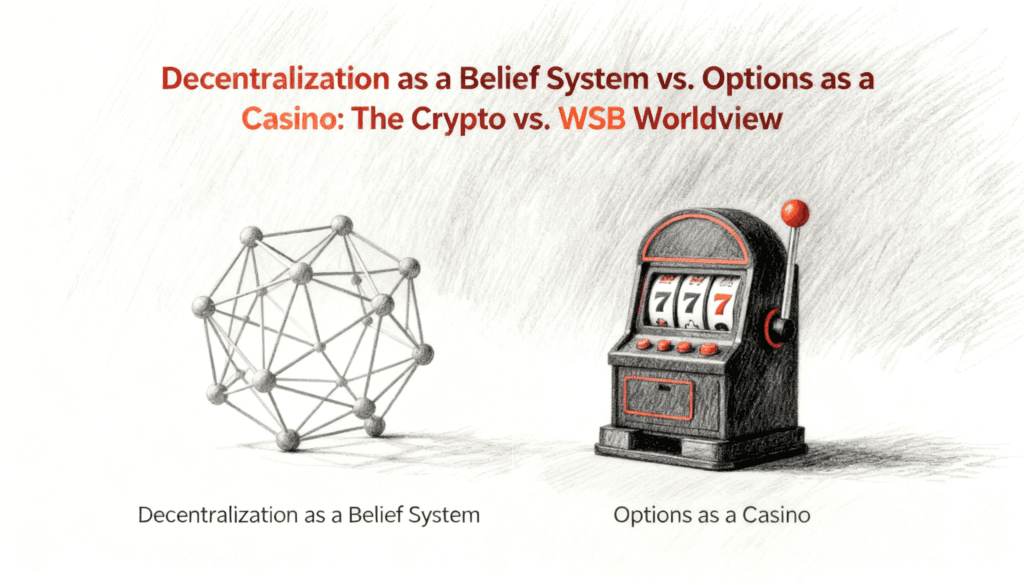
The crypto person said, let us build a new system. A system where no bank can freeze your account, no government can print away your savings, and no middleman can take a cut. This is a serious ambition. It is also, whether the believers admit it or not, a kind of theology. You have to have faith that the new thing will work, that the code is trustworthy, that the community will not fall apart, and that the price will eventually reflect the vision. Faith is a strong word, but it is the right one. Nobody buys a decentralized protocol expecting nothing. They buy it expecting a future that does not exist yet.
The WSB person looked at the same building and said, forget building a new one. Let us just rob this one really fast and get out. Options are a tool that lets you turn a small amount of money into a large amount of money very quickly, and also into zero dollars even more quickly. WSB figured out that if the system is rigged anyway, you might as well take the asymmetric bet. You are not trying to change finance. You are trying to exploit it for long enough to stop caring about it.
One group wants to rewrite the rules. The other group wants to ignore the rules for thirty minutes and see what happens.
The Belief System Nobody Calls a Belief System
The strangest part of crypto culture is how much it resembles religion while insisting that it is purely technical. There are founding texts. There are prophets. There are schisms. There are conversion stories, complete with the part where the person remembers the exact moment they finally understood. There are heretics, usually people who support the wrong chain or the wrong consensus method. And there is a promised land, which is always just a little further away than it was last year.
This is not a criticism. Belief systems are how humans organize themselves around ideas that cannot be proven yet. The American founders had a belief system. Scientists have a belief system about the value of experiments. The crypto community has a belief system about decentralization, and it happens to be one of the more internally consistent ones produced in the last twenty years. It says that concentrated power corrupts, that transparency is better than trust, and that money controlled by nobody is safer than money controlled by someone.
You do not have to agree with any of this to notice that it gives people something the stock market cannot give them. It gives them a cause. When a crypto holder watches their portfolio drop, they can tell themselves a story about short term volatility within a long term revolution. That story is emotionally very useful. It turns a loss into a test of faith instead of a mistake.
Compare that with WSB, which offers no comfort of that kind at all.
The Casino That Refuses to Pretend
WSB is philosophically honest in a way that crypto sometimes is not. Nobody on WSB claims that buying weekly call options on a retailer is going to liberate humanity from central bank tyranny. They know what they are doing. They are gambling, and they use the word gambling, and they post the losses next to the wins, and the whole culture is built around accepting the absurdity of the exercise.
There is something almost clean about this. When you remove the pretense that finance is about building the future, you are left with the raw activity of trying to guess which way a number will move. WSB treats this as a form of entertainment with the possibility of a payout, which is more or less the definition of a casino. The rocket emojis are not decoration. They are a signal that the user understands the terms. No promises of revolution. No talk of changing the system. Just a trade, a screenshot, and whatever feelings come after.
This honesty has a cost. Without a belief system to absorb losses, WSB has to absorb them with humor. This is why the culture leans so hard on jokes, memes, and a very specific form of self-mockery. The jokes are not just jokes. They are load bearing. They are the emotional infrastructure that lets people take wild risks without needing a philosophy to justify them.
Crypto says the loss is a step on the journey. WSB says the loss is the joke. Both are coping mechanisms. One just has better marketing.
The Deeper Thing Going On
If you zoom all the way out, what crypto and WSB have in common is that they are both responses to a crisis of meaning in how young people relate to money. The old script said work hard, save steadily, invest patiently, and retire comfortably. That script assumed a world where wages kept up with prices, where housing was affordable, and where institutions could be trusted to keep their promises. A lot of people under forty looked at that script, looked at reality, and concluded that the script was written for a different movie.
When people lose faith in the default story, they do not stop telling themselves stories. They just start telling different ones. Some of those stories are about building a better system. Some are about outsmarting the existing one. Very few are about quietly accepting that the original plan might still work if you give it enough time. That option feels like surrender, even when it is mathematically the most reliable path for most people.
This is where the real insight lives. Crypto and WSB are not competing theories of how to make money. They are competing theories of how to feel okay about money in a world where the old answers stopped feeling trustworthy. One theory says, join something bigger than yourself and wait for the revolution. The other says, make a joke, take the shot, and do not pretend it is anything more than that.
Somewhere, quietly, in a different corner of the internet, somebody is putting a few hundred dollars a month into a basic index fund and will almost certainly end up wealthier than the average participant in either camp. They do not have a cause. They do not have a meme. They do not have a screenshot to post. They are probably bored. And boredom, in finance, is one of the most underrated forms of wealth there is.