Table of Contents
There is a quiet assumption in finance that the people who take things seriously will beat the people who do not. It sounds obvious. It sounds like the kind of thing a parent would say. Work hard, study the craft, respect the process, and you will end up ahead of the person who treats the whole thing like a joke.
Then you look at the actual scoreboard between day traders and WallStreetBets, and the story gets strange.
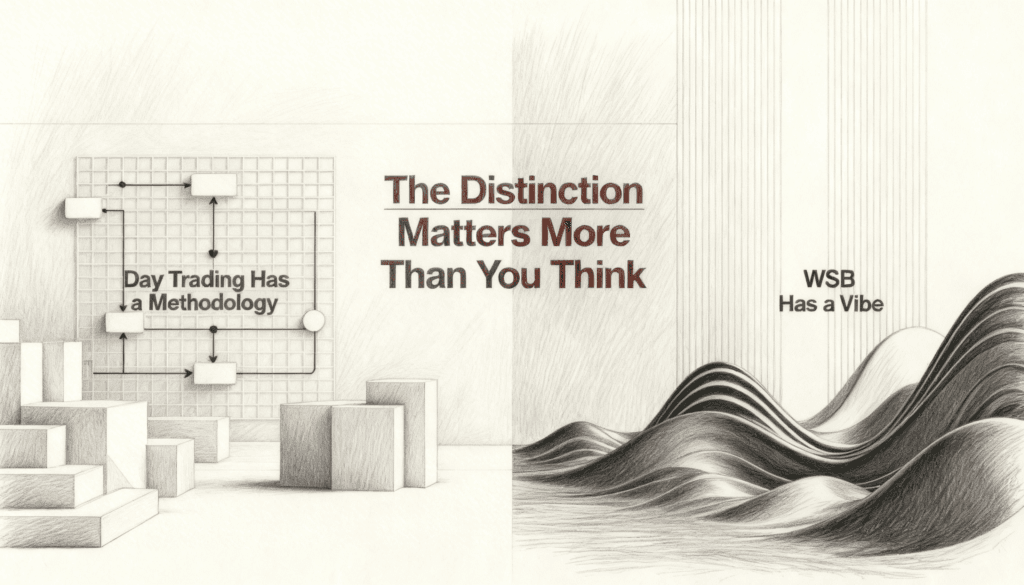
Day trading is a methodology. It has rules, setups, entry criteria, exit criteria, risk limits, and a whole vocabulary that sounds borrowed from a pilot checklist. There are books about it. There are courses. There are mentors who will sell you their system for a suspicious amount of money. The whole thing is dressed up in the language of professionalism, and that is not an accident. The day trader wants you to know, and wants to know themselves, that what they are doing is a discipline.
WallStreetBets is a vibe. It has no rules, no required reading, no entry criteria beyond owning a brokerage account and a sense of humor about losing money. It has memes, inside jokes, screenshots of enormous gains, and screenshots of enormous losses treated with exactly the same energy. The whole thing is dressed up in the language of not caring, and that is also not an accident.
Here is the thing nobody says out loud. A methodology and a vibe are not opposites. They are two different technologies for solving the same problem. And the problem is not what you think it is.
The problem both groups are actually solving
Markets are uncertain. That is the whole game. If you knew what was going to happen, you would not need a methodology or a vibe. You would just buy the thing that goes up and sell the thing that goes down and become unbearable at parties.
But you do not know. Nobody does. The professionals do not, the amateurs do not, the hedge funds with satellites watching parking lots do not, and the guy on a Discord server with a webcam and a neon sign does not. Everyone is guessing with different levels of information and different levels of confidence.
So the question becomes how do you keep playing a game where the outcome is partly random and partly skill, without losing your mind?
Day trading answers this with structure. You build a process. You follow the process. When a trade works, the process gets credit. When a trade fails, the process gets adjusted. The process becomes a kind of emotional armor. It lets you sit through losses without feeling like the universe is personally attacking you, because the loss was “part of the system.” The methodology is not really there to make you money. It is there to let you keep trading tomorrow.
WSB answers the same problem with humor. You make a joke. You post the joke. When a trade works, you are a genius. When a trade fails, you are a loss porn celebrity. Both outcomes are content. The loss is not a failure, it is material. The vibe is not really there to make you money either. It is there to let you keep trading tomorrow.
Both groups have invented a way to absorb loss without quitting. One calls it risk management. The other calls it being a regard. They are doing the same job.
Why the methodology feels safer and might not be
There is a very seductive idea in trading that if you just find the right system, the randomness stops mattering. You will have figured it out. You will have a map. The market becomes readable.
This is where day trading gets interesting as a subculture, because the methodology is often more valuable as a comfort object than as an edge. A lot of day trading systems are not particularly predictive. They are particularly soothing. They give you something to do with your hands while the chart moves. They let you point at a candle and say a word and feel like you understand something other people do not.
Compare this to WSB, which has no illusions about predictive power. The vibe is loud about this. The whole culture is built around the admission that this is a gamble, that the gamble is entertaining, and that pretending otherwise is what losers do. There is a strange honesty in it. A WSB trader who loses twenty thousand dollars on a weekly call option does not sit down and journal about their mistakes. They post the screenshot. They move on.
The day trader who loses twenty thousand dollars has to reconcile it with the methodology. The methodology said this setup had an edge. The edge did not show up. Now what? Either the methodology is wrong, or you executed it wrong, or variance is just happening. Each of these answers is psychologically expensive. The methodology that was supposed to protect you from chaos has now become a source of it.
The costume problem
Every subculture gives you a costume. A way to present yourself to yourself. The day trader costume is “focused professional.” The WSB costume is “self aware clown.” And here is the sneaky part. The costume is usually more durable than the returns.
You can keep wearing the focused professional costume for years while losing money, because the costume does not depend on the outcome. It depends on the ritual. Multiple monitors, coffee, early mornings, a notebook, the little exhale after closing a position. The costume works even when the account does not.
You can also keep wearing the self aware clown costume for years while losing money, because the costume also does not depend on the outcome. It depends on the tone. The rocket emojis, the willingness to post the loss, the refusal to pretend. The costume works even when the account does not.
This is why both communities are sticky in a way that more successful strategies are not. Index fund investing is probably better for most people, and almost nobody builds an identity around it. There is no costume. There is no ritual. There is just a monthly transfer and a long wait. The costume matters because the costume is what makes the activity feel like yours. A strategy without a costume is just a chore.
You can see this same pattern in completely unrelated places. Think about people who run. Some runners have elaborate gear, watches, training plans, splits, nutrition routines. Other runners just put on shoes and go outside. Both might run the same distance at the same pace. The first group is the day trader. The second group is WSB. The costumes are different. The miles are the same.
The distinction that matters
So if both groups are solving the same problem, and both costumes are equally sticky, why does the distinction between methodology and vibe matter at all?
Because of what happens when things go wrong.
A methodology can be falsified. If the setup fails enough times, the day trader has to either abandon the setup, abandon the methodology, or abandon the idea that methodologies work. All three of these are painful, and the last one is the most painful, because it takes away the identity the whole thing was built on. Some day traders never recover from this. They keep grinding a broken system because the alternative is admitting that the costume was the point.
A vibe cannot be falsified, because it was never making a claim in the first place. WSB never said the trade would work. It said the trade would be funny. If the trade loses, the trade was funny. If the trade wins, the trade was funny and also profitable. The vibe is unkillable because it is not making testable promises. This sounds like a weakness. It might actually be a strength. It is very hard to blow up your identity when your identity was always the joke.
The counterintuitive lesson, and this is the part I suspect people will not like, is that the vibe is in some ways the more emotionally mature response to uncertainty. Not because it is smarter, and not because it makes more money, but because it does not require the user to lie to themselves about what they are doing. The methodology user often has to pretend they have found an edge that the rest of the world missed. The vibe user only has to admit they are gambling for fun.
Somewhere between them sits a third kind of person. The one who has decided they are not going to treat markets as a personality. They are going to buy a broad index, stop looking, and spend the saved mental energy on literally anything else. This person will likely outperform both the methodology people and the vibe people over a long enough period, and they will do it wearing no costume at all.
That might be the real distinction worth thinking about. Not methodology versus vibe. But whether you need a costume in the first place.