Table of Contents
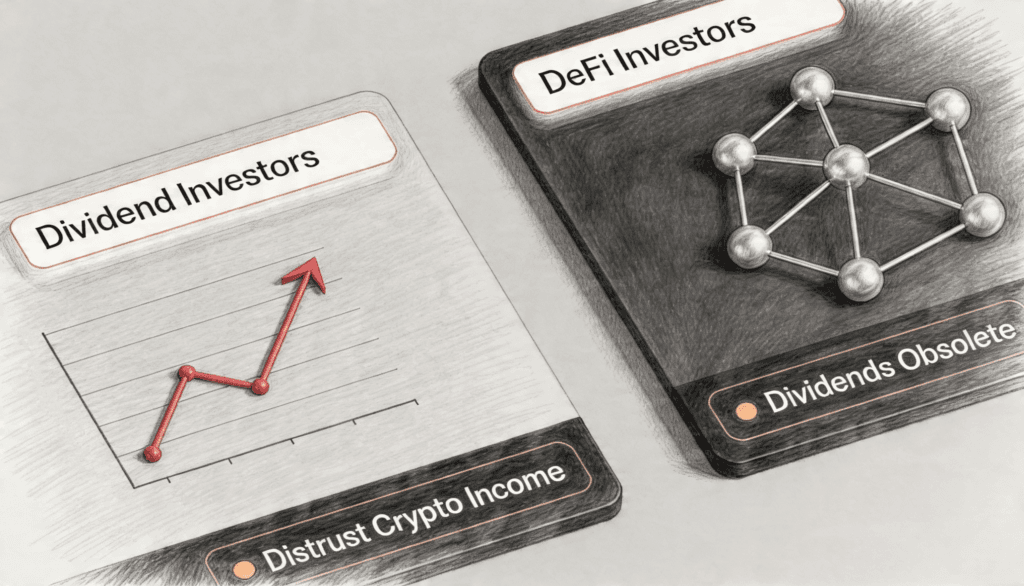
There is a quiet contempt between two groups of income investors that rarely gets talked about directly. On one side, dividend investors. They buy shares in companies that have paid cash to shareholders for decades, sometimes centuries. On the other side, DeFi investors. They lock tokens into protocols and earn yield that can make a dividend portfolio look like a savings account from 1998.
Both groups want the same thing. They want their money to make more money while they sleep. They want income without a boss. They want cash flow without clocking in. And yet, if you put them in the same room, they would argue until the sun came up about whether the other side is even investing at all.
This is not a disagreement about math. It is a disagreement about what money is allowed to be.
The Church of the Quarterly Check
Dividend investors have a belief system that runs deep, deeper than most of them realize. When a company like Johnson and Johnson or Coca Cola sends you a payment every quarter, it feels like something earned. Not by you, necessarily, but by the business. Real products were sold. Real revenue came in. A real board of directors sat in a real room and decided to share some of those profits with you. There is a chain of cause and effect that a five year old could follow.
This tangibility is the foundation of the entire dividend investing philosophy. The income is not a projection or a simulation. It is a portion of actual economic activity flowing into your brokerage account. For dividend investors, this is not just a preference. It is a moral position. You are a part owner of a business, and the business is paying you for that ownership.
Now tell this person that someone on the internet is earning higher yields by lending made up tokens to a protocol that did not exist not so long ago. Watch what happens to their face.
The Temple of Programmable Money
DeFi investors see the financial world through a completely different window. To them, the dividend system is not sacred. It is slow. It is gated. It is permission based. You need a brokerage account. You need to meet regulations. You need to wait for a board to decide how much you deserve. And the yields? After decades of compounding, a good dividend portfolio might pay you three or four percent annually. In DeFi, that can be a slow afternoon.
The DeFi worldview starts with a premise that sounds radical until you think about it for more than thirty seconds: if income is just a function of capital allocation, then why does it need a corporation to exist? Why does it need a CEO, a supply chain, or a factory in Ohio? If a protocol can match lenders with borrowers, facilitate trades, or provide insurance, and it can distribute the fees from those activities to participants, then is that not income? Is that not yield?
For the DeFi crowd, the answer is obvious. They have stripped the concept of investment income down to its mechanical core. Capital goes in. Yield comes out. The wrapper around it, whether that is a Fortune 500 company or a smart contract, is just packaging.
Trust and Its Discontents
Here is where the divide becomes genuinely interesting. Both sides are making a bet on trust, but they are placing that bet in opposite directions.
Dividend investors trust institutions. They trust that companies will continue to operate, that boards will continue to authorize payments, that regulators will continue to enforce rules. Their entire strategy depends on continuity. The best dividend stocks are boring precisely because they are predictable. The system works because it has worked. History is the evidence.
DeFi investors trust code. They trust that a smart contract will execute exactly as written, that mathematics does not lie, that removing the human element removes the possibility of corruption. Their strategy depends on transparency. Anyone can read the code. Anyone can verify the transaction. The system works because it cannot do anything other than what it was programmed to do.
The irony is thick. Dividend investors, who pride themselves on rationality, are making an essentially emotional argument: we trust these people because they have been trustworthy. DeFi investors, who operate in a space famous for emotional speculation, are making an essentially rational argument: we trust this system because trust is not required.
Both positions have a blind spot big enough to drive a truck through.
The Blind Spots
Dividend investors tend to forget that institutional trust is not permanent. Companies cut dividends. It happens more often than the community likes to discuss. General Electric was once considered a dividend aristocrat. So was AT&T in its earlier form. The assumption that a company will keep paying you simply because it always has is a version of the same logical error that says the sun will rise tomorrow because it rose today. It probably will. But “probably” is doing a lot of heavy lifting in that sentence.
There is also something dividend investors rarely confront: the income they receive is entirely at the discretion of other people. A board can vote to slash the dividend at any time. Your yield is, in a very real sense, a gift. You have no contractual right to it. You have precedent, expectation, and hope. These are fine tools for planning a retirement. They are terrible tools for guaranteeing one.
DeFi investors, meanwhile, tend to forget that code is written by people. And people make mistakes. Smart contracts have been exploited, drained, and manipulated in ways that would make a dividend investor physically ill. The argument that “the code is the law” sounds powerful until the code has a bug that lets someone walk away with a few million dollars of other people is money. When that happens, and it has happened repeatedly, the DeFi community suddenly discovers a newfound appreciation for governance, courts, and all the institutional infrastructure they claimed to have transcended.
There is a parallel here to something outside finance entirely. In political philosophy, there is an old tension between those who trust traditions and those who trust systems designed from scratch. Edmund Burke argued that institutions carry accumulated wisdom that no single generation can replicate. Rationalist thinkers argued that starting from first principles produces better outcomes. Both were right about the other side is weaknesses and blind about their own. Dividend and DeFi investors are replaying this exact debate, just with yield percentages instead of constitutions.
The Yield Question Nobody Wants to Answer
Here is the uncomfortable part. In both worlds, yield has to come from somewhere. It is not magic. It is not free. And in both worlds, there are moments when the source of that yield gets uncomfortably murky.
Dividend income comes from corporate profits. But corporate profits sometimes come from cost cutting that hollows out the business. A company can maintain its dividend for years while slowly consuming itself. The check keeps arriving, but the machine producing it is getting smaller. By the time the dividend gets cut, the stock price has often already collapsed. The income was real right up until the moment it was not.
DeFi yield often comes from token emissions, which is a polite way of saying the protocol prints new tokens and gives them to you as a reward. This can look like income. It feels like income. But if the value of those tokens is declining at the same rate they are being distributed, you are running on a treadmill. You are earning yield in name only. Some DeFi protocols have offered yields that, upon closer inspection, were just elaborate mechanisms for redistributing value from late participants to early ones. There is a word for that structure, and it is not a flattering one.
Both communities could benefit from asking themselves a question that neither seems eager to engage with: is my income sustainable, or am I just being paid with someone else’s optimism?
The Generational Fracture
There is a demographic layer to this clash that explains a lot. Dividend investing skews older. Not because older people are smarter, but because the strategy requires patience measured in decades and a fundamental belief that the existing financial system will be around long enough to reward that patience. If you came of age in the 1970s through 1990s, this belief is almost automatic. Institutions worked. Markets recovered. Compounding did its thing.
DeFi skews younger. Not because younger people are reckless, but because many of them watched the 2008 financial crisis from a formative vantage point. They saw institutions fail. They saw bailouts go to the people who caused the problems. They saw their parents lose homes while banks posted record profits a few years later. For this generation, “trust the system” is not investment advice. It is a punchline.
So when a dividend investor says DeFi yields are not real, a younger investor hears something very specific: trust the same institutions that let my family down. And when a DeFi investor says dividends are obsolete, an older investor hears something equally loaded: throw away everything that has worked for fifty years because a twenty six year old wrote some code.
Neither translation is fair. Both are understandable.
The Convergence Nobody Is Expecting
Here is the part that will annoy both sides. They are converging. Slowly, reluctantly, and without admitting it.
Tokenized securities are already blurring the line between traditional dividends and DeFi yield. Real companies are beginning to explore distributing profits through blockchain infrastructure. Meanwhile, DeFi protocols are maturing, adding governance structures, compliance layers, and risk management frameworks that look suspiciously like the traditional finance they claimed to replace.
The dividend investor of 2035 might receive quarterly payments through a smart contract. The DeFi investor of 2035 might earn yield from protocols backed by real world revenue. At that point, the argument about which form of income is more “real” will seem as quaint as the debate about whether email or fax was the proper way to send a document.
But for now, the two tribes sit on opposite sides of the internet, each convinced the other is living in a fantasy. The dividend investor thinks DeFi is a casino pretending to be a bank. The DeFi investor thinks dividends are a horse pretending to be a Tesla.
They are both half right. Which, in investing, is usually the most expensive place to be.