Table of Contents
There is a quiet madness that lives inside every trading floor, every retail brokerage app, and every financial news segment. It does not show up in the spreadsheets or the earnings calls. It hides in the language. Watch any market commentator for ten minutes and you will hear it. The market is nervous today. Tesla is throwing a tantrum. Bitcoin is finally waking up. Gold is sleeping. The Nasdaq is in a bad mood. Apple wants to test new highs.
Wants to. That is the phrase that should stop you cold.
A stock does not want anything. A ticker is a string of letters that represents fractional ownership of a legal entity. It has no desires, no preferences, no moods, no ambitions, no fears. And yet we talk about it the same way our ancestors talked about thunder gods and forest spirits. We have built the most sophisticated capital allocation system in human history, and we describe it using the vocabulary of a medieval peasant explaining why the harvest failed.
This is not a small thing. The way we talk about markets shapes the way we act in them. And the way we act in them determines whether we keep our money or hand it to someone who talks about markets a little less mystically.
The Oldest Software in the Human Brain
There is a reason we do this, and the reason is not stupidity. It is older than stupidity. It is older than money itself.
The human brain evolved to detect agents. Anything that moves with apparent purpose, anything unpredictable, anything that affects our survival, gets sorted into a mental category that assumes intention behind it. This was useful when the rustling in the grass might be a lion. The cost of assuming a lion when there was none was a wasted sprint. The cost of assuming wind when there was a lion was your entire genetic future. Evolution settled the debate quickly. We are descended from the paranoid ones.
This same machinery now stares at a candlestick chart on a Tuesday afternoon and decides that the market is angry about the jobs report. The price went down, something moved, and the brain demands to know who did it and why. The honest answer is that millions of unrelated people made millions of unrelated decisions for millions of unrelated reasons, and the net effect happened to be negative. But that answer offers no story, no villain, no lesson. So we invent one.
We give the market a face because a face is something we can negotiate with. We can study it. We can learn its moods. We can feel like we understand it. The alternative is admitting that we are riding on the back of a statistical creature with no head, no tail, and no particular interest in whether we live or die.
That is uncomfortable. So we name it. We say the bears are in control. We say the bulls are tired. We say sentiment has turned. And we feel better, even though nothing we said meant anything in particular.
When Personification Becomes Strategy
The strange part is that this is not just casual language. It leaks into actual decisions. People sell because the stock seems to be punishing them. They hold because they believe the stock will reward their loyalty. They buy more because the stock is being unfairly attacked. Every one of these sentences treats a security as a being with memory, intent, and a sense of justice.
I once watched a friend refuse to sell a position that had collapsed by sixty percent. His reasoning was not financial. He said he could not betray the stock now, after everything they had been through together. He used the word together. He had a relationship with three letters on a screen.
This is not unusual. This is the default. Most investors, especially retail investors, build emotional contracts with the things they own. The contract is one sided. The stock has not signed anything. The stock does not know you exist. But the relationship feels real, and the feeling produces behavior, and the behavior produces losses.
There is a name for the tendency to assign human qualities to things that do not have them. Psychologists call it anthropomorphism. In finance it has no formal name, because admitting it exists would require admitting that a large fraction of market activity is essentially a folk religion practiced by people in suits.
The Patron Saints of the Ticker
Every personification needs a personality, and the market has assembled a full pantheon. Tesla is the temperamental genius, brilliant and unstable, capable of miracles and meltdowns. Apple is the responsible older sibling, dependable, slightly boring, quietly compounding. Bitcoin is the rebellious teenager, defiant, prone to disappearing for months and returning with a new haircut. Gold is the wise grandparent, slow to speak, suspicious of everything modern. Bonds are the accountant nobody invites to parties. Oil is the unpredictable uncle who shows up drunk to weddings.
These caricatures are not entirely useless. They compress real differences in volatility, sector behavior, and investor base into shorthand a beginner can grasp. The problem is that the shorthand starts feeling like the reality. Once you have decided that Tesla is a temperamental genius, you start interpreting every move through that frame. A crash becomes a tantrum. A rally becomes a flash of brilliance. The underlying business, the actual cash flows, the actual competition, the actual margins, all of this fades into the background. You are no longer analyzing a company. You are interpreting the mood swings of a character you invented.
This is how investment theses become fan fiction. And fan fiction is a wonderful thing to write, but a terrible thing to fund.
The Chart as Tarot Card
The technical analysis community has industrialized this superstition into something that almost looks like a discipline. A chart, which is a record of past prices, gets read like the bones of a sacrificed animal. There are head and shoulders patterns, double tops, cup and handles, golden crosses, death crosses, hammers, dojis, hanging men. Each pattern comes with a prophecy. Each prophecy comes with the implication that the market has just signaled its intentions to those wise enough to read the signs.
I am not here to argue that all technical analysis is useless. Some of it captures real behavioral patterns. Support and resistance can become self fulfilling because enough people watch them. Momentum exists because flows take time to unwind. There is signal in there somewhere. But the vocabulary around it has drifted into something that resembles divination more than analysis.
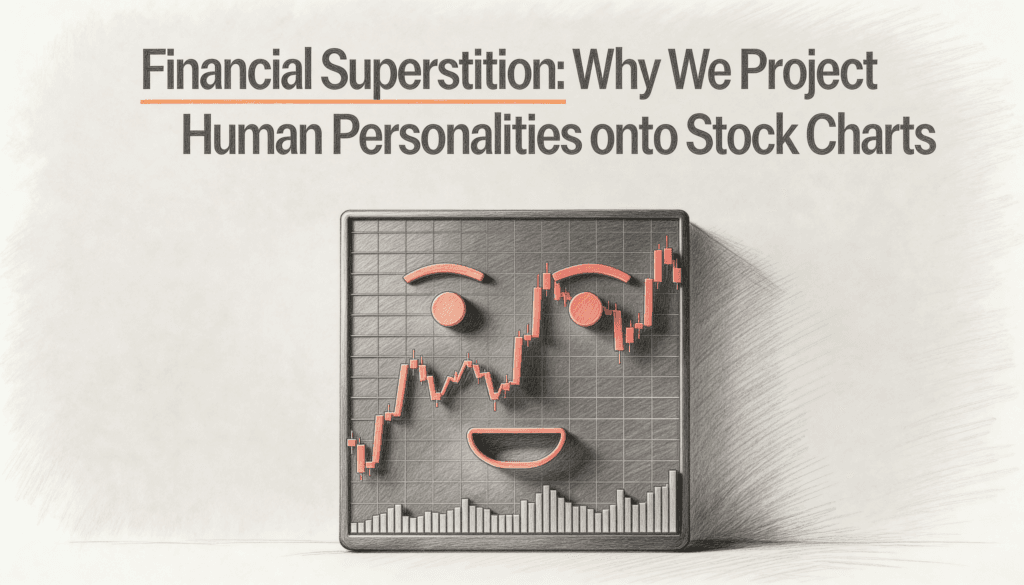
When a chartist says the market is telling us something, the unspoken assumption is that there is something doing the telling. There is not. There is only the aggregated noise of human decisions, some informed, most not, and the patterns we find in that noise often have more to do with how our visual cortex hates randomness than with anything the market is trying to say.
Our brains are pattern detection machines. Show us a stock chart and we will find narratives in it. The chart did not put them there. We did.
The Comfort of the Story
Here is the deepest reason we cannot stop doing this. Stories make uncertainty bearable. The world without a narrative is unbearable. A market that simply does what it does, for reasons we cannot fully reconstruct, feels like swimming in dark water. A market with a personality, with motives, with moods, feels like dealing with a difficult but knowable person. We would rather argue with a stubborn friend than stare into a void.
This is why financial media is so addictive. It is not because it provides information. Most of it provides almost no information that is useful for actual decisions. It is because it provides narrative. Every day the market did something, and every day someone explains what the market was thinking. The explanation is almost always wrong, in the sense that it could not have predicted the move beforehand and cannot predict the next one. But it is satisfying. It closes the loop. It tells us the day made sense.
The honest version of financial news would sound like this. Today the market went up. We do not really know why. Tomorrow it might go down. We will not really know why then either. Over long periods it tends to go up, because the underlying companies tend to produce more value over time. That is most of what you need to know.
Nobody would watch that channel. There would be no advertising revenue. The host would be unemployed within a week. So instead we get a permanent stream of speculation dressed as explanation, and the speculation is always personified. The market punished. The market rewarded. The market is worried. The market is hopeful. The market is the most overworked fictional character in the world.
What Happens When You Stop
The interesting question is what changes if you actually drop the personification. Not in your speech, which is unfixable, but in your decision making.
You stop feeling betrayed when a position moves against you. There is no one to betray you. There is only a set of conditions that has changed, and your job is to ask whether those conditions invalidate your original thesis. If they do, you sell. If they do not, you wait. The decision becomes mechanical, almost dull, and dullness is exactly what good investing requires.
You stop feeling rewarded when a position moves your way. There is no one rewarding you. You were either right about something, or you were lucky, and the move alone does not tell you which. Treating gains as personal validation is how you confuse luck with skill, and confusing luck with skill is how you eventually give back everything you made, with interest.
You stop trying to guess what the market wants. The market does not want. There are only flows, positions, and information, interacting in ways too complex to model in real time. Your edge, if you have one, comes from being right about something specific, not from divining the intentions of an entity that does not exist.
This is harder than it sounds. The personification reflex is automatic. It will come back. You will catch yourself thinking the stock is finally cooperating, or the market is being ridiculous, and you will have to remind yourself that nothing is cooperating or being ridiculous. Things are simply happening. Your job is to respond to them based on what they actually are, not what they would be if they had a personality.
The Quietest Edge
There is something almost embarrassing about saying this out loud, because it sounds so basic. But the people who do best in markets over long periods are not the ones who read the market most poetically. They are the ones who have stripped the most poetry out of their own thinking. They look at a position and see numbers, probabilities, exposures, and risks. They do not see a friend who has let them down, or a rival who must be defeated, or a puzzle that is sending them coded messages.
This is not a glamorous edge. It does not make for good television. Nobody writes books about the trader who stayed boring for forty years and ended up wealthy. But it is, as far as anyone can tell, the actual edge that compounds.
The market does not have a personality. It does not know your name. It is not testing you, teaching you, punishing you, or rewarding you. It is a vast indifferent process, and the most useful thing you can do is treat it that way. The superstitions will keep coming, because the brain that produces them is the same brain that kept your ancestors alive in the grass. But you can notice them when they arrive, smile at them, and put them down.
Then you can go back to the only question that ever really mattered. Is this thing worth more than I am paying for it.
Yes or no.