Table of Contents
The Strange Economics of Showing Off
There is a man in your Instagram feed right now. He is standing next to a rented Lamborghini. His watch costs more than his savings account. His caption says something about “grinding” and “levels.” He believes he is projecting wealth. What he is actually projecting is financial anxiety.
This is not a moral judgment. It is an observation about how money actually works when you study the people who have it versus the people who perform having it.
The term for this is financial peacocking. In biology, a peacock fans its tail feathers to signal genetic fitness. The display is expensive in energy terms, but it works because the signal is honest. The bird really does have strong genes. Financial peacocking on social media breaks this logic entirely. The signal is cheap to fake, easy to rent, and almost always dishonest. Which means it stops being a signal of wealth and starts being a signal of something else.
That something else is insecurity about money. And insecurity about money is, more often than not, a companion to not having much of it.
The Wealth Paradox Nobody Talks About
Here is a pattern that becomes obvious once you see it. The people with the most money tend to be the least interested in showing it. The people with the least money, or more precisely the least financial security, tend to be obsessed with the performance of having it.
This is not a coincidence. It is a structural feature of how wealth actually accumulates.
Building real wealth requires delayed gratification at a scale that is fundamentally incompatible with Instagram content. You do not build a seven figure portfolio by buying things that photograph well. You build it by making thousands of boring, invisible decisions over years. Maxing out retirement accounts is not photogenic. Keeping your car for ten years does not generate likes. Living below your means in a modest apartment while your net worth quietly grows will never trend.
The act of flexing, by definition, requires spending money on visible consumption. And visible consumption is the direct enemy of wealth accumulation. Every dollar that goes into a designer belt is a dollar that did not compound at seven percent annually for the next thirty years. The flex is not just a failure to build wealth. It is an active process of destroying it.
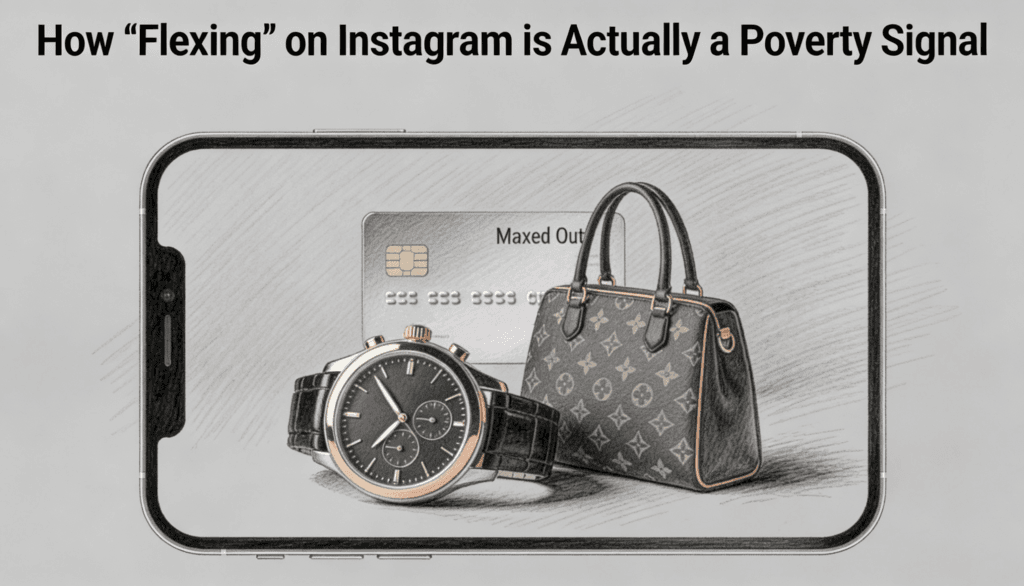
So when someone shows you their expensive purchases, they are showing you their anti-wealth strategy. They are showing you the receipts of their financial regression. The flex is a poverty signal because it documents, in real time, the choices that keep people poor.
A Short Story About Two Neighbors
A financial planner I once read about described two clients who lived on the same street. One drove a new Mercedes, wore tailored suits, and renovated his kitchen every few years. He made $300,000 a year and had a net worth of roughly $40,000. Most of his income went to maintaining appearances.
His neighbor drove a twelve year old Honda, wore unremarkable clothes, and had not updated his kitchen since the early 2000s. He made $180,000 a year and had a net worth of over $2 million. He had been quietly investing the difference between his income and his modest lifestyle for two decades.
If you put both of them on Instagram, the first man would look wealthy. The second man would look ordinary. But in any financial metric that actually matters, the second man could buy and sell the first man several times over.
This is not a rare example. Thomas Stanley documented this pattern extensively in his research on American millionaires. The typical millionaire in his studies drove a used car, lived in a middle class neighborhood, and had never spent more than a couple hundred dollars on a pair of shoes. They were invisible. And that invisibility was not a bug. It was the strategy.
Why the Brain Falls for the Trap
Understanding why people flex despite it being financially destructive requires a short detour into evolutionary psychology.
Humans evolved in small groups where status was survival. Higher status meant better access to resources, mates, and protection. Signaling status was not vanity. It was a life or death communication strategy. Your brain still carries this operating system. It still believes, at a deep level, that visible status signals translate to real survival advantages.
Social media hijacks this ancient circuitry with ruthless efficiency. Instagram is essentially a status arena compressed into a screen. Your brain cannot fully distinguish between the dopamine hit from genuine tribal recognition and the dopamine hit from strangers double tapping a photo of your new shoes. Both feel like status. Both feel like survival.
The problem is that the modern environment has completely inverted the relationship between visible status and actual security. In a prehistoric tribe, the person with the most visible resources probably did have the most resources. There was no credit card debt in the savannah. You could not lease a mammoth.
Today, visible consumption often correlates negatively with financial security. The more you display, the less you likely have. Your brain does not know this. Your brain is running software from 200,000 years ago on hardware that was never designed for a world where you can finance a lifestyle you cannot afford.
The Audience Problem
Here is another layer worth examining. Who is the audience for the flex?
When someone posts a photo of their luxury purchase, they are signaling to a specific audience. And that audience, overwhelmingly, consists of people who are impressed by luxury purchases. Wealthy people are generally not in that audience. A person with a $5 million portfolio does not look at someone’s new Gucci bag and feel impressed. They feel nothing, or possibly mild concern for the buyer’s financial priorities.
The people who are impressed by flexing are, almost by definition, people who do not have wealth. They are people for whom these objects still carry aspirational weight. The flex, therefore, is a performance staged by financially insecure people for an audience of financially insecure people. Everyone involved is performing and consuming a fantasy of wealth while the actual mechanics of wealth happen entirely offscreen.
This creates a bizarre feedback loop. The person who flexes gets validation from people who admire the flex. That validation reinforces the behavior. The audience, in turn, internalizes the idea that wealth looks like consumption. So they start consuming to signal wealth. And the cycle deepens.
It is a poverty engine disguised as aspiration.
The Influencer Economy Makes It Worse
There is an important caveat here. Some people who flex on Instagram are doing it as a business strategy. They are building a personal brand around the image of wealth, which they then monetize through courses, sponsorships, or affiliate links. In these cases, the flex is not consumption. It is marketing.
But even this caveat reveals something uncomfortable. What are they selling? Almost always, they are selling the dream of wealth to people who do not have it. The product is aspiration. The customer is someone who believes that buying a course or following a strategy will give them the life they see in the photos. The entire business model depends on a large audience of people who are financially insecure enough to buy the dream.
The influencer who flexes for profit is not signaling their own poverty. But they are building a business that profits from the financial insecurity of others. The flex is still a poverty signal. It has just been redirected from the broadcaster to the audience.
What Actual Financial Security Looks Like
If the flex is a poverty signal, what does wealth actually signal? The honest answer is: almost nothing visible.
Financial security tends to express itself as calm. It is the absence of anxiety about money. It is not thinking about the bill when you order dinner, not because the bill is small, but because your finances are structured in a way that makes the bill irrelevant.
Wealth shows up as optionality. The ability to say no to a job you do not like. The ability to take six months off without panic. The ability to absorb an unexpected expense without rearranging your life. None of these things photograph well. None of them generate engagement. But they are the actual experience of having money, as opposed to the performance of having it.
There is a concept in ecology called crypsis. It is when an organism benefits from being hard to detect. Some of the most successful predators in nature are the ones you do not see coming. Wealthy people often practice financial crypsis without even thinking about it. They are hard to detect because there is no advantage to being visible. The money does its work quietly. The portfolio compounds in silence. The financial security hums in the background like a machine nobody needs to admire.
Meanwhile, the peacock stands in the open, feathers spread wide, hoping that the display will compensate for what is missing underneath.
The Quiet Counter Revolution
Something interesting is starting to happen though. A growing segment of younger investors and financial thinkers have begun rejecting the flex entirely. The “stealth wealth” and “quiet luxury” trends are not just fashion movements. They are philosophical statements about the relationship between appearance and substance.
The idea is simple. If showing off is what financially insecure people do, then not showing off becomes its own signal. Understatement becomes a flex of its own, which is ironic but also structurally sound. When you do not need validation from strangers about your financial status, you have achieved something that no Rolex can provide.
This is not about being cheap or denying yourself pleasure. It is about understanding the difference between spending that serves your life and spending that serves your image. A vacation you genuinely enjoy is not a flex. A vacation you take primarily so you can post about it is.
The Bottom Line
The next time someone in your feed shows off their latest purchase, try seeing it through this lens. Do not see wealth. See cost. See the compound interest that will never accumulate. See the retirement that just got pushed back by a few months. See the financial anxiety that needed soothing with a visible acquisition.
The flex is a confession dressed as a boast. It tells you everything about the person’s relationship with money, just not what they think it tells you.
Real wealth is boring. Real wealth is invisible. Real wealth does not need you to know about it.
And the most expensive thing about a Lamborghini in an Instagram photo is not the car itself. It is the future that was traded away so someone could stand next to it for thirty seconds and pretend.