Table of Contents
There is a country in the heart of Europe that builds some of the finest cars on the planet, engineers machines that other nations can only admire, and runs an economy so productive it essentially bankrolls half a continent. And yet, when it comes to investing in stocks, this same country behaves like a nervous cat near a bathtub.
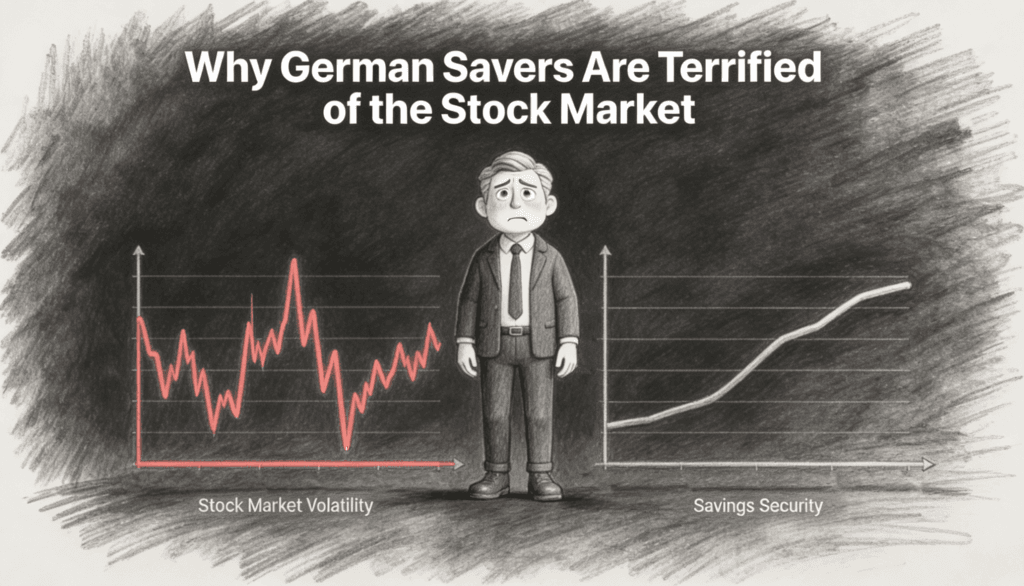
Germany is on the lower end of stock market participation in the developed world. Fewer than one in five Germans own equities in any form. Compare that to the United States, where roughly 55 percent of households hold stocks. The gap is not small. It is enormous. And it is not explained by poverty, ignorance, or lack of access. Germans are wealthy, educated, and surrounded by financial infrastructure. They simply choose not to participate.
The question worth asking is not what Germans are doing wrong. It is what shaped a national psychology so deeply that an entire population looks at one of the greatest wealth building tools in modern history and says no thank you.
The Ghost That Never Left
To understand German saving behavior, you have to start with destruction. Not metaphorical destruction. Actual, physical, monetary destruction.
In 1923, Weimar Germany experienced hyperinflation so extreme that prices doubled every few days. People carried wheelbarrows of cash to buy bread. Life savings evaporated not over years, but over breakfast. Then, barely two decades later, the currency collapsed again after World War II. The Reichsmark became worthless. Germans who had saved diligently, who had done everything right by the standards of their time, were wiped out. Twice.
This does not just leave a mark on the people who lived through it. It leaves a mark on their children and grandchildren. Behavioral economists call this intergenerational trauma transmission, but you do not need a fancy term to understand it. When your grandmother tells you she once watched her family lose everything they had saved, you listen. And what you internalize is not a lesson about inflation hedging or asset allocation. What you internalize is a deep, visceral suspicion that the system can and will betray you.
Stocks, in this framework, are not an investment. They are a gamble. And gambling is what people do before they lose everything.
The Sparbuch Religion
If you want to know what Germans trust instead, look at the Sparbuch. This is a savings passbook, essentially a bank deposit account with a guaranteed but tiny interest rate. For decades, it was the default savings vehicle for German households. Parents opened Sparbuch accounts for their children the way American parents might open a college fund.
The appeal was never the return. The appeal was the certainty. You put money in, and it stays there. It does not fluctuate. It does not crash. It does not depend on what some CEO in Frankfurt or New York decides to do on a Tuesday afternoon. The Sparbuch promised something that stocks never could: absolute predictability.
Now here is the painful irony. For years, the interest rate on these accounts has been lower than the rate of inflation. Germans have been paying their banks to slowly destroy their purchasing power, and they have done so willingly, because the alternative felt worse. They chose a guaranteed small loss over an uncertain potential gain. From a purely rational standpoint, this is difficult to defend. From an emotional standpoint, it makes perfect sense.
This is not stupidity. This is a culture that has been burned so badly by financial chaos that it developed an almost religious devotion to the appearance of safety, even when that safety is an illusion.
The Language Itself Tells You Something
German has a word that does not translate neatly into English: Schuld. It means both debt and guilt simultaneously. This is not a coincidence. In the German moral framework, owing money is not just a financial state. It is a moral failing. Debt carries shame in a way that it simply does not in American culture, where leveraging yourself to the hilt is practically a sport.
This linguistic overlap reveals something profound about how Germans relate to money. Saving is virtuous. Spending beyond your means is sinful. And speculation, which is how many Germans view stock investing, is reckless in a way that borders on immoral. You are not just risking your money. You are risking your character.
Compare this to the American relationship with risk. In the United States, the stock market is woven into the national mythology. It is where ordinary people build wealth. It is democratic. It is aspirational. The person who puts their savings into an index fund is considered prudent. The person who keeps it all in a savings account is considered timid, maybe even foolish.
Same behavior, two completely different moral judgments. What one culture calls wisdom, the other calls cowardice. And vice versa.
The Dot Com Scar
Germany did have a brief love affair with stocks. It happened in the late 1990s, when Deutsche Telekom went public and the government actively encouraged ordinary citizens to buy shares. They called them Volksaktien, the people’s shares. Millions of Germans, many of them first time investors, piled in.
And then the dot com bubble burst.
Deutsche Telekom shares lost roughly 90 percent of their value from peak to trough. People who had trusted the government’s encouragement, who had broken with generations of saving tradition to try something new, were devastated. The experience confirmed every suspicion their grandparents had ever whispered. The market is a trap. It takes from people like us.
An entire generation of potential investors was lost in a single crash. Not because the crash was uniquely German, it was global, but because it landed on a population that was already predisposed to distrust. The scar tissue from the 1920s and 1940s was still there. The dot com collapse just ripped it open again.
This is something that rational finance theory struggles with. Markets recover. Historically, they always have. But people are not spreadsheets. They do not experience a 90 percent loss and then calmly wait fifteen years for the recovery. They experience it as a confirmation of their deepest fears, and they never come back.
What Behavioral Science Actually Explains
Loss aversion, the finding that people feel losses roughly twice as intensely as equivalent gains, is usually discussed as a universal human trait. And it is. But cultures amplify or dampen it.
American culture dampens loss aversion through narrative. The story of the self made investor, the comeback kid, the market timer who bought the dip, these stories frame losses as temporary setbacks on the way to triumph. The cultural script says keep going.
German culture amplifies loss aversion through narrative too, just in the opposite direction. The stories passed down are not about comebacks. They are about collapses. The cautionary tale is not the person who sold too early. It is the person who invested at all.
This is where it gets interesting from a psychological standpoint. Germans are not irrational. They are operating with a different information set, one weighted heavily toward catastrophic outcomes that actually happened in living memory. Their risk model is not wrong. It is just calibrated to a different history.
Think of it like this. If you grew up near an ocean that had never produced a tsunami, you would probably build your house close to the water. Beautiful view. Great property value. If you grew up near an ocean that had produced two devastating tsunamis in the past century, you would build further back. Both decisions are rational. They are just informed by different experiences.
The Rent Paradox
Here is something that surprises most outsiders. Germany has one of the lowest homeownership rates in Europe. More than half of Germans rent their homes. In a culture obsessed with security and stability, this seems contradictory. Why would a nation so devoted to safety choose not to own its shelter?
The answer reveals another layer of the German approach to money. Germany has strong tenant protections and a large, well regulated rental market. Renting in Germany is not the precarious, temporary arrangement it is in many other countries. It is stable, affordable, and carries no social stigma. A German can rent the same apartment for thirty years and feel perfectly secure.
This connects back to the stock market aversion in an unexpected way. Germans do not equate ownership with security the way Americans do. They equate predictability with security. A regulated rental contract with fixed terms is predictable. A house with a mortgage exposes you to interest rate changes, maintenance costs, and market fluctuations. A stock portfolio is even worse on the predictability scale.
The German saver is not hoarding cash out of ignorance. They are optimizing for a specific variable that other cultures rank lower: the absence of surprise.
What Everyone Else Can Learn
The German case is not just a curiosity for cultural anthropologists. It holds a mirror up to every investor, everywhere.
If you are American and you pour money into stocks without a second thought, it is worth asking how much of that confidence is rational analysis and how much is cultural programming. You are not braver than a German saver. You are differently conditioned. Your culture taught you that markets go up over time and that participation is the smart default. That happens to have been true for the past century of American markets. It is not a law of physics.
And if you are German and you keep your savings in a zero interest account because the market feels like a casino, it is worth asking whether you are making a decision or inheriting one. The fears that shaped your parents’ and grandparents’ choices were legitimate responses to real catastrophes. But the question is whether those catastrophes are the most useful lens for evaluating a globally diversified portfolio in the 21st century.
Every culture has financial blind spots created by its history. The Americans underestimate catastrophic risk because they have never experienced a true monetary collapse on their own soil. The Germans overestimate it because they have experienced two. Neither position is purely rational. Both are deeply human.
The best investors are probably the ones who can see their own cultural programming for what it is, inherited software running in the background, and update it with better data without deleting it entirely. Because the German instinct for caution is not useless. Plenty of American investors could use a little more of it. And the American comfort with risk is not reckless. It has built enormous wealth over generations.
The trick, as with most things, is knowing which voice in your head is wisdom and which one is just a ghost.